Nestled in the heart of Cambridge, Ill., the Henry County Courthouse stands as a symbol of civic heritage and architectural elegance. Its journey from humble beginnings to a Victorian masterpiece reflects the growth and resilience of the county itself.
Over the past several years, the courthouse has gone through yet another transformation. The finishing touches are expected to be completed this fall.
Construction began on the fourth courthouse in the county’s history in 1878 and was completed two years later at a cost of $77,000.
Designed by Thomas J. Tolan & Son, renowned Midwestern architects, it is known for its Empire style used in many of the stately courthouses Tolan designed.
Comprising 45,000 usable square feet, the original building features a mansard roof, similar to the one that covers the famous Louvre in Paris, with dormers and a cornice decorated with special indentations. There are four facades, each with three pavilions, and a large clock tower on the very top. Its red brick and decorative stone elements make it one of the most beautiful government buildings in the State.
Inside are marble floors, arched hallways and an original courtroom adorned with ceiling paintings depicting local skylines. Known as Courtroom 1, it is occupied by Judge Terry Patton.
Outside the building, more history greets employees and visitors. A 44-foot-tall granite shaft surmounted with a 5-foot figure of Lady Columbia, the earliest female personification of the United States, graces the northeast lawn. Erected in May of 1885, it was designed as a Civil War monument at the suggestion of Cambridge resident John Jennings, who served as a color sergeant in the War. It was placed where many young Cambridge men met to enroll in the 112th Regiment of the Union Army.
Included on the statue is the wording:
To all her soldiers and sailors,
who on land and sea,
periled their lives in defense of
liberty and law,
Henry County dedicates this monument
1861 – 1865
Over the years, various changes have been made to the historic structure. A legal records wing was added in 1940, followed by a modern expansion to the jail, court services, a judicial wing, and administrative offices in 1999. Funded primarily through court fees and fines, the expansion created a state-of-the-art facility that houses a huge part of the county’s services.
According to the County Administrator Erin Knackstedt, the current renovations began in 2018 with a capital development plan for the work to be done in three specific phases.
First on the list was to install programmable logistics that monitor jail activities to keep inmates, staff, and the public safe. Much-needed updates to plumbing were also completed. This is paired with upgraded WIFI, allowing remote testimony in the courtroom (essential during Covid) and the ability to run court training sessions remotely.
Secondly, the original Kewanee boiler was replaced, and the HVAC system was updated. The bell tower was restored with material to mirror the original copper. Asbestos was removed, and the stone around the roofing was restored.
“The clock in the bell tower was shut off for a year during the restoration,” said Knackstedt. “It’s a familiar landmark, and everyone is happy to have it working again.”
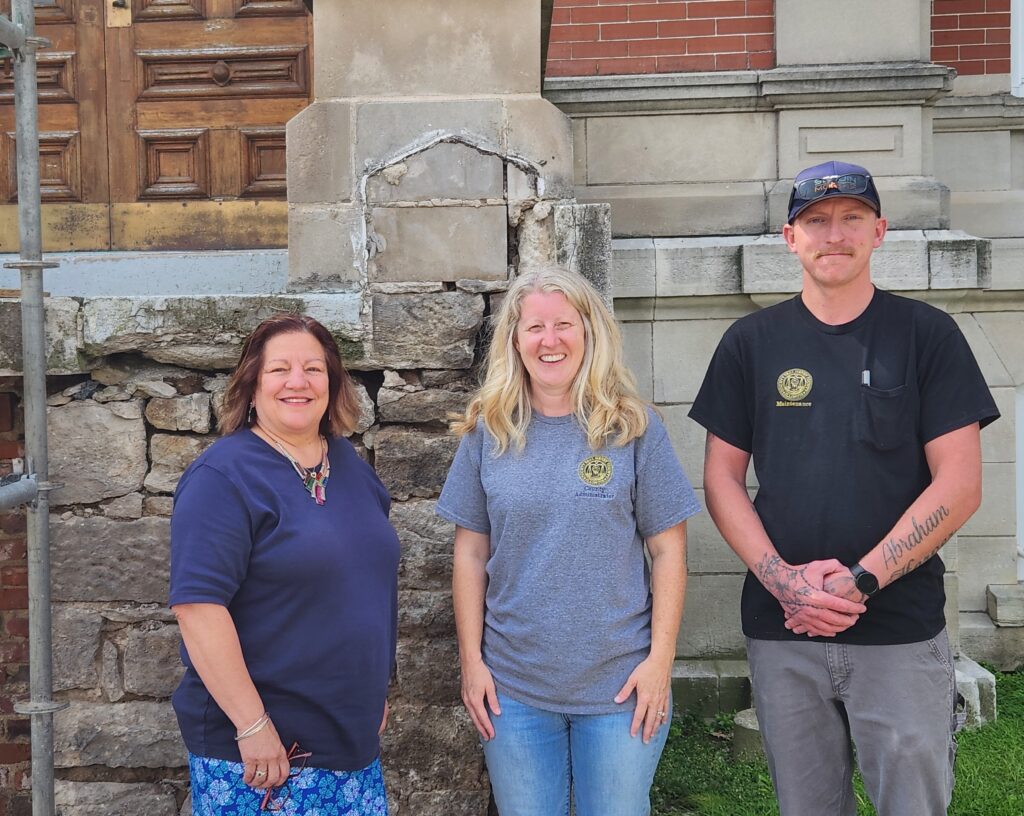
Knackstedt noted that replacing the flooring in the basement area and jail and installing new windows will help reduce the county’s energy costs. Safety concerns over the original stairways that lead into the former entrances have prompted their removal and replacement. The compromised foundation will also be replaced; drainage and waterproofing will be added. Decorative stonework is being repaired to its original condition.
“Renovating the exterior foundation, stairs and concrete is the third and final stage,” said Knackstedt. “We anticipate that these will be completed this fall.”
To cover the costs of the renovations, cooperative bidding, renegotiating contracts, diversifying revenue sources and thinning expense budgets have allowed the $15 million renovation to be done without raising the county line in the tax levy.
“We have been proactive rather than reactive with maintenance,” says Knackstedt. “We know what happened to the Rock Island courthouse, and we don’t ever want that to happen here.”
Knackstedt also recognizes the contributions of courthouse employees, who are cost-conscious and aware of their role in keeping budgets tight.
“Their work is important as the county is always faced with unfunded mandates which add to our costs,” she said. “But we are proud that we are one of the few counties in the State that is operating in the black.”
She also gives credit to the maintenance department staff who work hard to keep the large building in great shape. “They cover a lot of ground every day, and unlike most employees, are on call 24/7 if emergencies happen.”
The courthouse was added to the National Register of Historic Places on Aug. 20, 2004, cementing its status as a historic landmark.
Henry County board chair Kippy Breeden has followed the renovation from its launch.
“The Henry County Courthouse is more than a building,” she said, adding, “It reflects the spirit of a community that values history, justice and civic pride.”