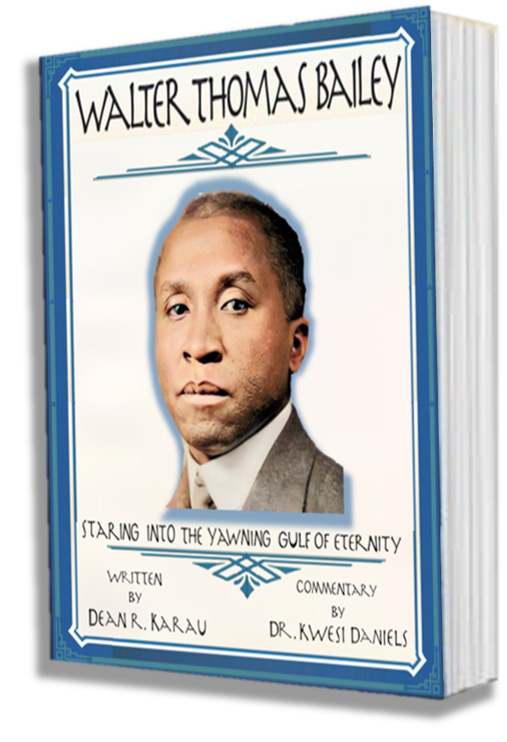
The Kewanee Voice’s Dean Karau has been earning plaudits for his ground-breaking work on Kewanee Black American architect Walter Thomas Bailey. Karau was motivated by the work on the Kewanee mural honoring Mr. Bailey, the research for which drew his attention and inspired him to find all he could about this Kewanee man.
Here are some of the comments on the book, Walter Thomas Bailey – Staring into the Yawning Gulf of Eternity.
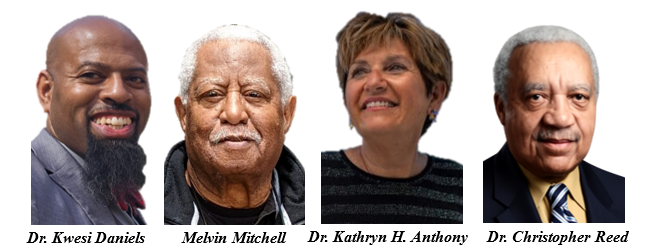
“I opened your book Friday evening and was simply unable to put it down until I finished it just now. Your long labor of love has resulted in a magnificent accomplishment. . . . The graphics and photography are astounding, and I am feeling intellectually uplifted by the wealth of history I just learned about.”
Melvin L. Mitchell, CEO of Bryant Mitchell, PLLC, Washington, D.C.; Fellow in American Institute of Architects; past president of D.C. Board of Architecture.
“I am thankful for the tremendous effort Dean devoted to writing this book, because it reveals that we all have a role to play in the realization of the American dream, not just for the benefit of one group but for the benefit of all Humanity.”
Dr. Kwesi Daniels, department head and associate professor, Robert R. Taylor School of Architecture and Construction Science, Tuskegee University.
“IT IS IMPRESSIVE AS TO ITS DEPTH! CONGRATULATIONS! It should be well received and the Black Chicago History Forum will spread the word as to its existence.”
Christopher Robert Reed, PhD; professor emeritus of History at Roosevelt University; author of six books on the early history of African Americans in Chicago.
Listen below to the comments of Kim Dulaney, V. P. of Education & Programs, DuSable Black History Museum & Education Center, Chicago, Ill., on Karau’s presentation at the DuSable’s Lunch & Learn.
Here, in its entirety, is a book review published in the Illinois State Historical Society’s March-April 2026 edition of its magazine, Illinois Heritage, written by Kathryn H. Anthony, Ph.D., Professor Emerita, ACSA Distinguished Professor, School of Architecture, University of Illinois at Urbana-Champaign. (The article is reformatted for the Kewanee Voice.)
“In 1904, well over a century ago, Walter Thomas Bailey (1881-1941) made history as the first Black architecture student to graduate with a bachelor’s degree from the University of Illinois at Urbana-Champaign, and in 1910 as the first to receive a master’s degree in architecture from the same school.
“Yet as one of only about ten Black students enrolled at Illinois, he was not permitted to live or eat on campus. On the other side of the country, Paul Revere Williams (1894-1980), a successful Black architect in Los Angeles who designed more than 3,000 buildings, was not permitted to eat by the pool or stay as a guest at the Beverly Hills Hotel, which he had redesigned. Williams designed scores of homes in neighborhoods with legal agreements that prevented Blacks from living there. Hattie McDaniel (1893 or 1895-1952), played Mammy in the block-buster 1939 film, “Gone with the Wind,” the first Black actor to receive an Academy Award. Yet she was not permitted to attend the world premiere, held at Atlanta’s Loews Grand Theater, a whites-only venue.
“In this respect, trailblazers Bailey, Williams, and McDaniel showed a remarkable ability to overcome adversity in the face of rampant racial discrimination that was all too common in their day.
“Not long after he graduated with his bachelor’s degree in 1905, Bailey became the first Black architect licensed in the state of Illinois.
“By the time he passed away at age 60, Bailey had become one of the most prolific architects of his era, having designed approximately 100 buildings throughout Chicago, Memphis, and the South.
“Yet until only recently his legacy largely remained in the shadows.
The creation of a new mural in 2018 celebrating Walter T. Bailey, located on the Side of the B & B Printing Company building in Kewanee, Illinois sparked the curiosity of author Dean Karau, who shares the same hometown. Karau, a retired Minneapolis attorney, took it upon himself to find out more.
“His search for information about Bailey revealed relatively little short of a 1998 article by Lee Bey in Chicago Sun-times, “Black Designer All But Forgotten,” a 2002 master’s thesis at the University of Illinois by Mikael David Kriz, ‘Walter T. Bailey and the African-American Patron,” and an all-too-brief Wikipedia entry. Karau then took on the role of detective, conducting meticulous historical research. Worth mentioning is that he did so over the course of a year or more without the aid of a research assistant, research grant, or an academic or commercial publisher. For Karau, his mission to shine a light on Bailey became a labor of love, culminating in his recent book Walter Thomas Bailey: Staring into the Yawning Gulf of Eternity. He also created some corresponding videos, including a fascinating 2025 lunch and learn presentation to the DuSable Black History Museum and Education Center (click here).
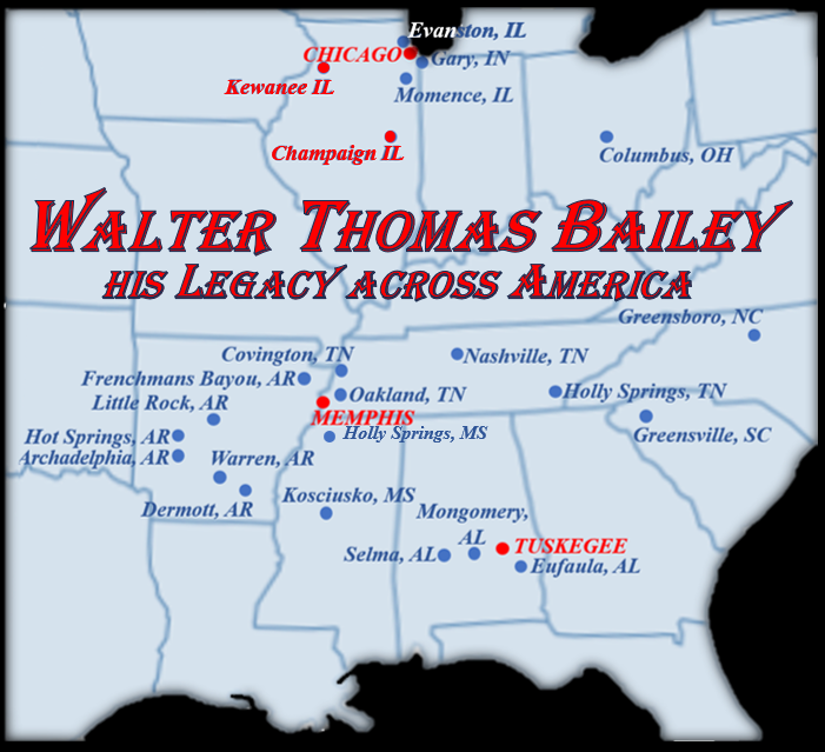
“Karau’s comprehensive, well-written text, along with hundreds of illustrations, detailed maps identifying precise locations of Bailey’s designs, a plethora of first-hand correspondence, historic announcements and press coverage of Bailey’s buildings, all make for a fascinating read. In addition, commentary by Kwesi Daniels, Ph.D., Department Head of Architecture at Tuskegee University, is interspersed throughout the book, lending yet another valuable perspective.
“Bailey’s personal and professional accomplishments are indeed remarkable, especially given the times in which he lived. Having lost his father at a young age and experiencing the devastating loss of many siblings who died before adolescence, could have turned anyone else to despair. But instead he persisted.
“He received a strong foundation at home through his mother and her family. His uncle, Lou Reynolds, became a professional baseball player with Black American teams in Chicago and instilled in Walter a love of sports. An exceptionally supportive environment in his hometown of Kewanee laid the groundwork for his future success.
“Bailey’s career, as Karau deftly demonstrates, is nothing short of meteoric. While serving as head of the department at Tuskegee Institute, his pioneering work with legendary Booker T. Washington contributed to the design of several buildings on campus and elsewhere. This set the stage for his future success designing scores of buildings across the South and the Midwest.
“Bailey lived and worked in Memphis for a decade, where he designed churches, school buildings, fraternal organization lodges, temples, sanitariums and bathhouses, as well as business and apartment buildings and individual residences. His buildings while based in Memphis were mainly in Tennessee, Arkansas, and Mississippi, but also in Illinois, Indiana and Ohio.
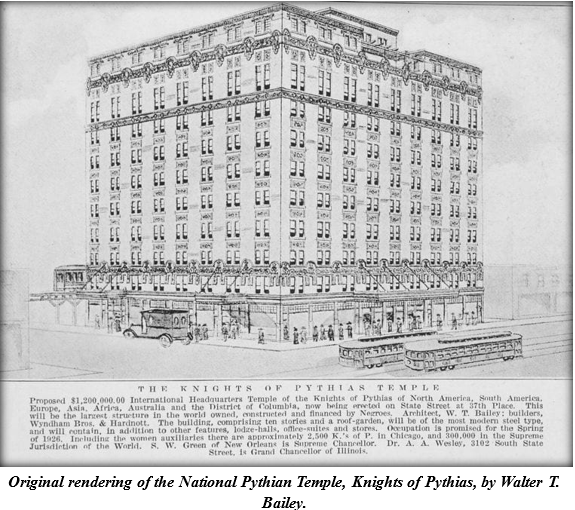
“Bailey moved to Chicago to design and build the Knights of Pythias National Temple, in the center of the Bronzeville neighborhood. At that time it was the largest building in the world designed, built and financed by Black entrepreneurs. It was known as “the skyscraper of Bronzeville,” and contained a 1500-seat theater, a seventh floor ballroom, a roof garden, stores and offices. The project was featured in Howard University’s Exhibition of the work of Negro Architects in 1931, in the school’s Gallery of Art in Washington, DC. This project led to scores of other commissions throughout the Chicago region.
“Notably, many public buildings that Bailey designed became the centerpiece of Black culture and community during the tumultuous Civil Rights era of the 1960’s. In 1961, the First Baptist Church in Montgomery, Alabama served as a refuge and fortress for the Freedom Riders, attacked by angry mobs as they integrated interstate travel on Greyhound buses.
“I was aware of Bailey’s ground-breaking role as our first Black architecture graduate from the University of Illinois at Urbana-Champaign, where, decades later, I served on the faculty for 40 years. My familiarity with his work included a visit to the First Church of Deliverance on a National Organization of Minority Architects’ conference tour in Chicago, serving as an invited symposium participant at Tuskegee University, and co-authoring a book chapter on the history of African American architecture alumni at the University of Illinois. I developed a new seminar on gender and race in contemporary architecture which I taught for over three decades. Yet it was only after reading Dean Karau’s Walter Thomas Bailey: Staring into the Yawning Gulf of Eternity, that I realized my prior knowledge was just the tip of the iceberg.
“Karau’s masterful book chronicles Bailey’s lifelong career in a way that no other publication has accomplished to date. It reflects an incredible amount of work to illuminate and document the entirety of Bailey’s work over his lifetime, thus preserving his legacy for future generations.”
The book is available at the Kewanee Public Library and on Amazon.com.
You can learn more about Walter T. Bailey by clicking here.