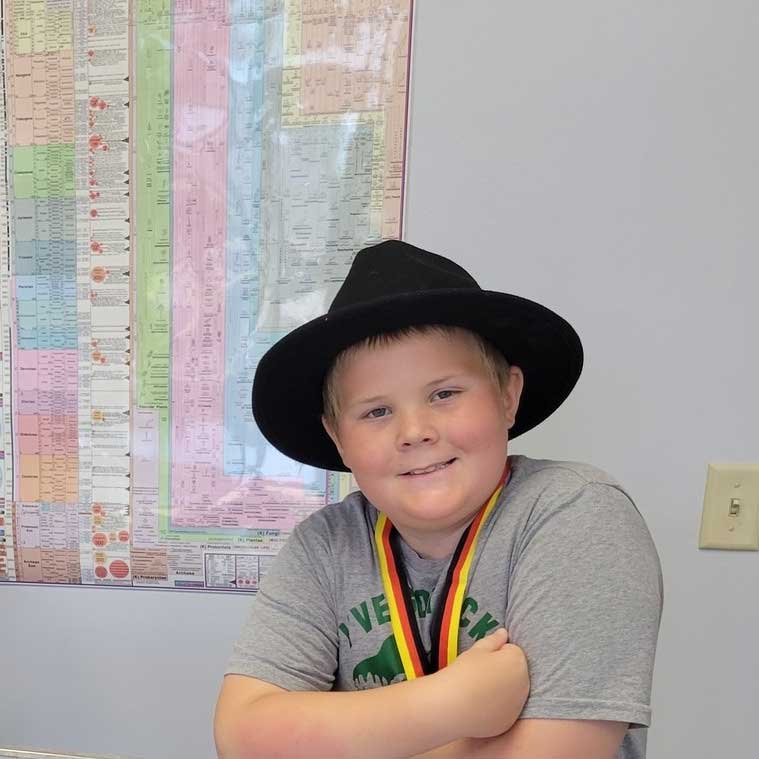
Young anthropologist, Anderson Taylor, has been collecting fossils, bones and archaeological bits of history for several years. He’s searched for them in Ireland, Scotland and in the Western U.S. At just 11 years of age, he opened the Cambridge Natural History Museum and is a sought-after speaker for schools and community organizations.

Speaking confidently in his signature black hat, he has uncovered some interesting facts about those who unearthed ancient treasures. His programs are developed to share a glimpse of what the world was like in prehistoric times.
His recent program at the Cambridge Public Library entertained his audience with some surprising facts. “Famous Female Paleontologists” featured the contributions of three women, each of whom has provided much of what we know today about prehistoric creatures. The program featured colorful and informative slides to accompany his talk. He also had a large display of fossils for a hands-on experience.
His interest in the women who led the identification of fossils and helped create much of paleontology was twofold. First, their discoveries were some of the first ever found and often predated what males in the same field produced. Second, their work was barely, if ever, considered to be important, with male scientists taking credit for their work. Two of those women were Mary Anning and Mary Mantell. A third woman, Sue Hendrickson, fared much better, most likely because she was born over 200 years after the previous two.
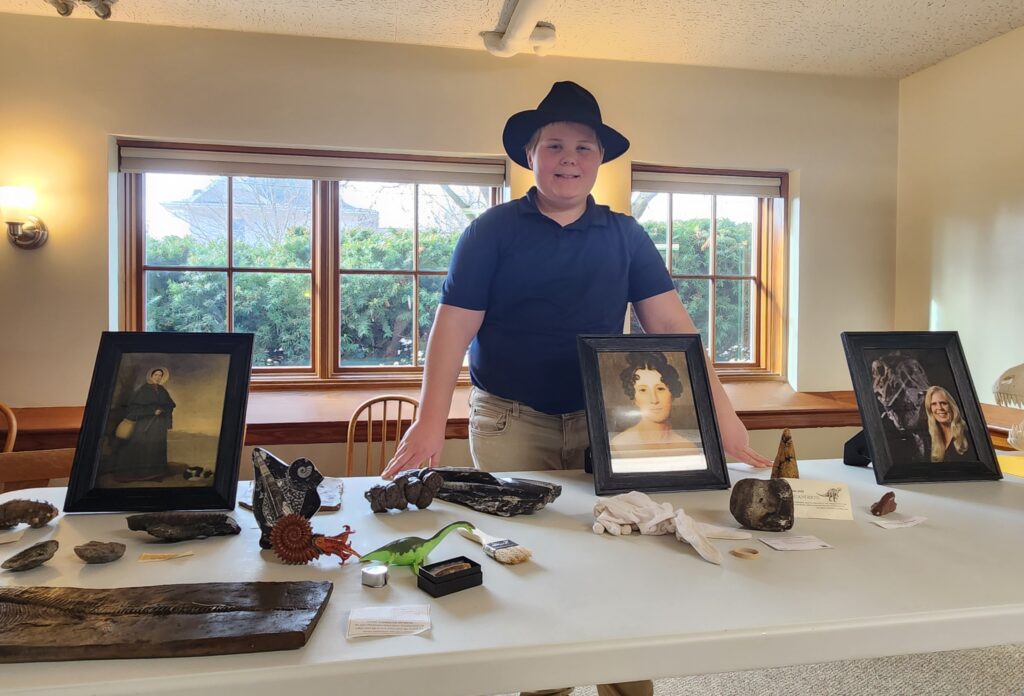
Mary Anning, born in England in 1799, is considered one of, if not the earliest, paleontologists. “Her most famous find, at age 12, was the skeleton of the ichthyosaur, a large, extinct marine reptile,” explained Taylor.
“It could grow to be one hundred feet long and is described as a ‘killer dolphin.’” He also told the group that Anning is credited with the discovery of the plesiosaurus, an aquatic animal that has been compared to the Loch Ness Monster. “She also found a squid like creature, called a belemnite, complete with its ink, which is believed to be 600 million years old.”
Gathering and selling fossils to tourists was a family affair for the Annings, and after the father’s untimely death, young Mary carried on the business. Soon, she added a storefront to her house named “Annings Fossil Depot,” which became well known for her variety of ancient artifacts.
As with all women scientists at the time, Taylor explained that females were not allowed to attend colleges as men were, or to join scientific organizations. Their works were almost exclusively attributed to men. Although she made significant finds, Anning’s contributions went unrecognized, and the only published article bearing her name was a rebuttal to an article written about one of her discoveries.
“She was, however, the inspiration for the song, ‘She sells seashells by the seashore,’ which has been recited for generations,” Taylor said with a smile.

Mary Ann Mantell, also born in England a few years before Anning, was another female scientist who added greatly to the study of fossils. Taylor told the audience that Mantell’s husband was a paleontologist who took credit for his wife’s discoveries.
“Mrs. Mantell was the one to find fossilized teeth of the Iguanodon (predecessor to the Iguana), and gave it to her husband, later creating sketches of the fossil for him as well.”
Her discovery of the Iguanodon caused excitement amongst paleontologists, all of them male. It was the second largest reptile fossil to be discovered, and the teeth of the Iguanodon suggested that the large reptile was an herbivore, surprising the scientific community, as many believed that all ancestors of reptiles were carnivores.
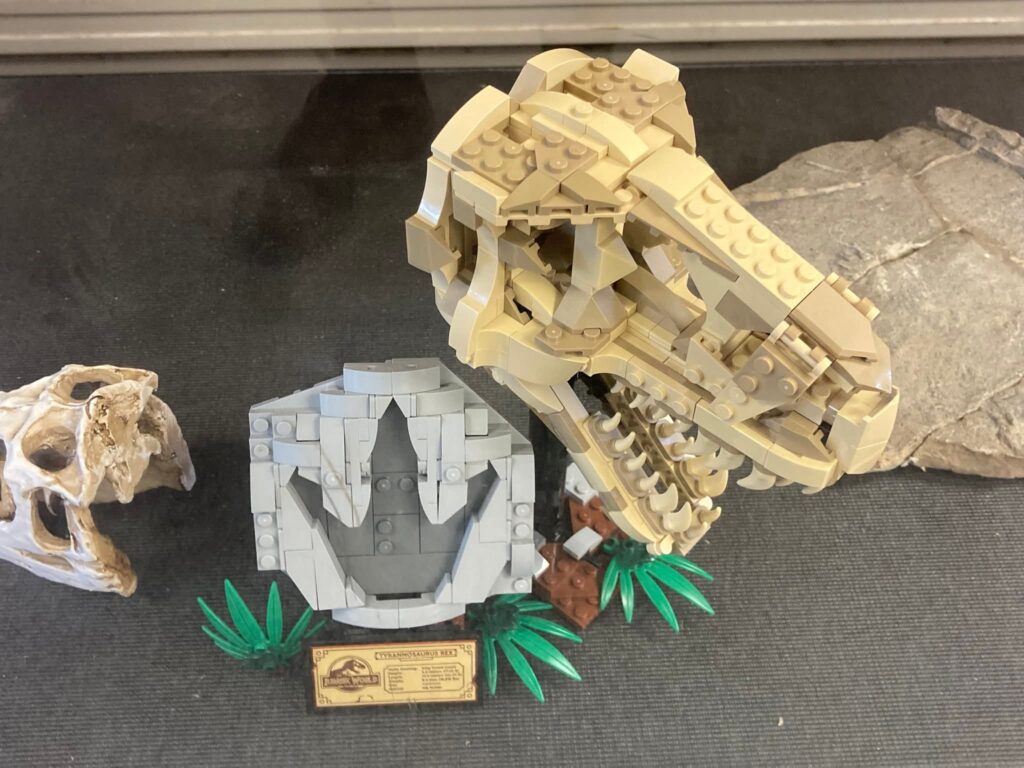
Taylor pointed out that early prehistoric creatures were meat eaters. “They tore the flesh and swallowed it whole.” He went on to explain that when the landscape changed to include plants and grasses, those without the ability to chew had no way to eat. “That led to their extinction,” he said. “Mantell’s early finds help to prove that.”
A modern-day discoverer, Sue Hendrickson, has been given credit for her work, unlike Anning and Mantell. Leaving school to scuba dive in Florida, she began exploring shipwrecks, which took her to the Dominican Republic, where she joined a group of archeologists, helping to excavate whales.
“There,” Taylor said, “she began to collect amber, becoming one of the largest producers of the stones for scientists.”
He went on to say that Hendrickson also discovered three perfectly preserved butterflies, determined to be 23 million years old.
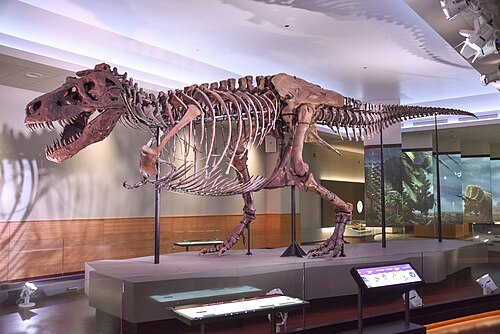
“This discovery,” explained Taylor, “makes up half of such butterfly finds to date.” He spoke about how she joined a group of paleontologists in the Black Hills of South Dakota, where she made her famous T-Rex discovery. Taylor told the audience that her work uncovered one of the largest, most extensive, and best-preserved Tyrannosaurus Rex fossils ever found.
“At over 90 percent recovered, it is one of the most significant finds by any paleontologist.” He told the audience that it permanently resides in Chicago’s Field Museum. “It was named ‘Sue’ after its discoverer and weighs approximately nine tons.”
When asked about the T-Rex’s habits, Taylor pointed out that it was considered the king of the tyrant lizards.
“It had excellent senses and could see and hear its prey easily,” he cautioned. “And if they couldn’t run more than 20 miles an hour, they were lunch.”
Taylor also told the audience that the T-Rex had a rib cage, featuring a small wishbone and feathers on its head. This finding helped confirm that birds evolved from dinosaurs.
Unlike her female predecessors, Hendrickson has been given much credit for her work and has written a best-selling autobiography. Hendrickson lives in Honduras and remains involved with various scientific societies.
Taylor’s research highlighted the wealth of knowledge provided by female paleontologists such as Anning, Mantell and Hendrickson.
Following his program, the audience toured his museum, where many of his fossils and other artifacts, such as the ichthyosaur, are on display. The museum is located on West Center Street in downtown Cambridge.
Taylor thanked the audience and the library for allowing him to share his program. His efforts are funded, in part, by an active microgrant from Illinois Humanities.
Information on the museum and Taylor’s programs can be found on its Facebook page or by calling 309-704-0110 or emailing cambridgenatural@gmail.com.