When The Kewanee Voice’s June 3 report on its community survey about the Galva carbon storage project came across my Facebook feed, it reassured me in a way I had not felt in a long time.
Of the 385 people who responded, the overwhelming majority oppose the Big River Resources and Lapis Carbon Solutions carbon storage project, and they rated the city’s communication a 1.59 out of 5. The paper noted it is not a scientific poll. Fair enough. But after nearly two years of feeling like the only family in this project’s path still willing to say so out loud, it told me the one thing I needed to hear: I am not alone, and my neighbors see what I have been seeing.
I have opposed this since the first time they brought me in to talk about this, in August 2024. I sat alone in that room, representing my family, across the table from the Big River CEO and the Lapis team. When they laid down a map with the well sited along Route 34, I told them what I still believe: it was too visible from a road that carries that much traffic, a drilling rig would sit there for a year, and the people of Galva would not stand for it. I pushed them to move it toward a site with fewer people living over the storage zone. By my own notes, they admitted they had not considered the public reaction or the optics as carefully as they should have. The survey is the community answering that conversation for me.
So let me add the perspective a survey cannot capture, and let me be clear about who I am, because it matters. I do not own this land. My family does. It is the farm my mother, Margaret Collister, was raised on, and that her father, Edward Collister, owned and farmed before her after he emigrated from the Isle of Man in 1907 and settled in Galva in the 1920s. My father holds the title now, as a remote landowner who lives out of the area, and I hold his financial power of attorney, so I am the one who has dealt with these companies on our family’s behalf.
I did not grow up here. I visited as a child, and about eight years ago I chose to move here and start farming the family-owned ground. My tie here is a choice, not an accident of birth, and it is why I have watched this so closely. When the companies came to sign us up, my father and I did not brush it off. We talked it through and had our own attorney out of Geneseo review the agreement. After all of that, none of us was comfortable signing, and we still are not.
I was not trying to block a fair deal. I was trying to get one. The compensation we were offered was limited and short-term, essentially a one-time payment in exchange for a permanent lease of the ground beneath our farms. I asked for terms that would actually keep value in this area: recurring annual payments to the landowners who would carry this forever, instead of a single payment that ends, and fair additional compensation for the carbon dioxide that would be trucked in from Big River’s plant in West Burlington, Iowa. That out-of-state CO2 was a significant expansion of what began as a Galva-only project, and it was never fully explained at the start. The point of every one of those requests was the same. If this is going to sit beneath our land for generations, the money should keep flowing, year after year, to the people and the community that bear it. The companies would not move. They preferred a one-time transaction.
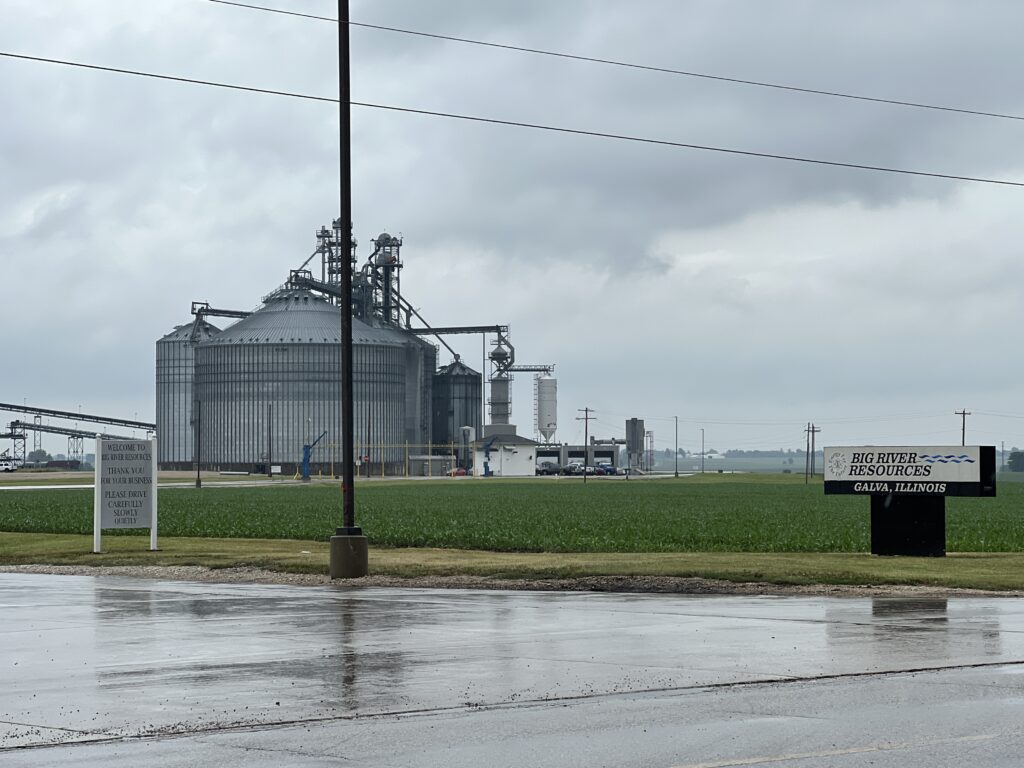
Follow the money, and follow the corporate structure, because together they tell the whole story. The Galva plant operates as its own company, Big River Resources Galva, LLC. It is a single-purpose subsidiary of Big River Resources, LLC, the holding company in West Burlington, Iowa. That is where the Galva plant’s earnings flow, and that is where the leadership, including the CEO, sits. Lapis Carbon Solutions, the company that would operate the storage well, is based in Dallas, Texas and is backed by out-of-state private equity. Layered on top of all of it is the federal 45Q tax credit, worth roughly 85 dollars for every metric ton of carbon dioxide stored. At more than 725,000 metric tons a year, that is on the order of $60 million annually, and it is not a paper write-off. A tax credit comes straight off what the companies owe the federal government, dollar for dollar, and under current law they can sell it for cash. And the credit is only half the draw.
By the companies’ own description, the purpose of storing the carbon is to lower the carbon intensity of Big River’s ethanol so it can be marketed as low-carbon fuel, where a lower carbon score commands a premium price. Both the subsidy and the premium are benefits the companies collect. A donated drone and a few small payments to the city do not change where any of it goes. It does not stay in Galva.
People will point to jobs. The Galva plant employed about 59 full-time people as of 2021, the most recent figure I have seen reported. Those are real jobs and they matter. But the construction and the well work that come with a project like this are different. Much of that is specialized drilling and construction crews, the kind that travel from job to job and, like the wind-turbine crews that pass through here, typically do not live in Illinois full time. They rotate in, stay a short while, rent a few rooms and eat a few meals, and then move on to the next site. That is transient traffic, not a strong, locally driven economy that lasts. And even the steady plant jobs, real as they are, do not add up to a reason to sign away what is underneath our land for the rest of our lives and our children’s lives.
Big River will tell you it is farmer-owned, and that is partly true. It grew out of a member cooperative, and its parent company is still held mostly by private member-investors, some of them area farmers. But that does not help the company the way it might seem. For one thing, you cannot actually see who profits. The only ownership stake that is publicly disclosed is REX American Resources, the Ohio public company, which reports in its filings with the SEC that it holds roughly 9.7%. The other 90% or so belongs to a private membership that is listed nowhere.
So, the people who stand to gain from the risk being placed on our land are, for the most part, people the public cannot even name. And for the host landowners, being member-owned changes nothing anyway. The people who share in the profit are the ones holding ownership units. The people who carry the risk are the families whose ground sits over the storage zone and the neighbors who would have to live through a leak. Those are not the same people.
And the way the project is structured leaves the risk parked here. The law does require the operator to carry insurance, set money aside for monitoring and cleanup, and answer for damage a leak causes. The question is whether that is enough. The set-aside is built to monitor the site and clean up a release, not to make a whole community whole, and a serious leak does not stop at cleanup. It can ruin land values, harm families, and injure people, at costs that run far past what is reserved. And the parties on the hook are limited liability companies. The Galva plant is one. The Lapis entity behind the project, despite the words “IL Development” in its name, is not an Illinois company at all. It is a Delaware LLC based in Dallas, Texas. These are the very structures designed to wall off everyone behind them, so a claim is only worth what is left inside them and their insurance, after the profits have moved up the chain and out of town. That is not an accident of paperwork. It is how these arrangements are built.
The risk that stays is the physical kind: groundwater, soil, drainage tile and whether our emergency services could even respond to a carbon dioxide release. All of it lands on the people who live here, and on the generations after us. The executives in West Burlington and Dallas will not be here in 50 years. We will. Our children will.
Lapis brought the oil and gas industry’s playbook to our door, right down to assigning a landman to me after their first push to get us to sign did not work. What I asked for was simple. Put your answers in writing. I had real questions, about damage to our tile drainage from their survey work, about contract terms that changed without notice, about who was actually going to buy this fuel. The answers came back verbal, or not at all. They preferred face-to-face meetings and “trust us” assurances to anything documented and legally binding. When a company will not put its own promises in writing, that tells you exactly what those promises are worth.
That is also why I tried to get landowners to negotiate as one group rather than one family at a time. Under the Illinois SAFE CCS Act, these companies need the rights to at least 75% of the surface area over the storage zone before they can ask the state to force the remaining owners in, and before the state may issue that order, the law requires a public hearing. Organized refusal was the one thing that could have held our leverage and forced this project into the open. But every presentation they gave was one-on-one, at the Big River plant. They never once brought the affected landowners together in the same room, and when I pressed for a group meeting, I was told it would be too hard to coordinate. The effect, whatever the intent, was that no one could compare the terms they had been offered or bargain as a group, which is the only place our leverage ever was. Being newer to the area myself, I leaned on longtime neighbors who knew everyone. It was not enough. One by one, the people I spoke with either signed or told me they already had. I ended up standing nearly alone.
Step back and ask what this project actually is. A factory might bring three or four hundred jobs to a town. A distribution center, a couple hundred. A meat or food processing plant, several hundred more. Projects like that come with real, lasting payrolls, the kind that fill the school, the diner, and the hardware store for a generation. This is none of those. It is a low-headcount injection site, run by a handful of people once it is built, whose whole purpose is to pump compressed, liquefied carbon dioxide deep underground and trust that it stays where it is supposed to.
We do not have to guess how that goes. In our own state, at ADM’s project in Decatur, the nation’s first and only operating site of its kind, the EPA found in 2024 that injected carbon dioxide and fluid had migrated about 500 feet above where ADM was permitted to inject, into a zone it was never allowed to reach, and cited the company for violating the Safe Drinking Water Act and its own permit. ADM paused injection for roughly a year before resuming. If the most established operator in the country cannot keep the carbon where it belongs, we are being asked to take an awful lot on faith.
The companies get to hope it works, from Dallas and West Burlington. We are the ones who would have to live with it, here.
This is the oldest story there is, and in my opinion, it is industrial exploitation of rural America, pure and simple. Outside companies extract the value, leave the risk behind, and count on small communities to be too polite or too tired to push back.
My family will not be one of those who looks back and wishes we had said something. So, I am saying it now.
Dennis Collister Busch
On behalf of Dennis E. Busch, landowner, under financial power of attorney
La Fayette, Ill.
Editor’s note: The views and opinions expressed in this guest column are those of the author and do not necessarily reflect the official policy or position of The Kewanee Voice, its staff, or its affiliates. Guest columns are published to encourage public discussion and represent the perspectives of individual contributors.