“Luke Short, whose stories of hard‐riding, hell‐for-leather Western heroes sold millions of paperback novels over a 30‐year period, died today . . . He was 67 years old.” So reported The New York Times in its obituary for Kewanee-born Frederick Dilley Glidden at his death in 1975.

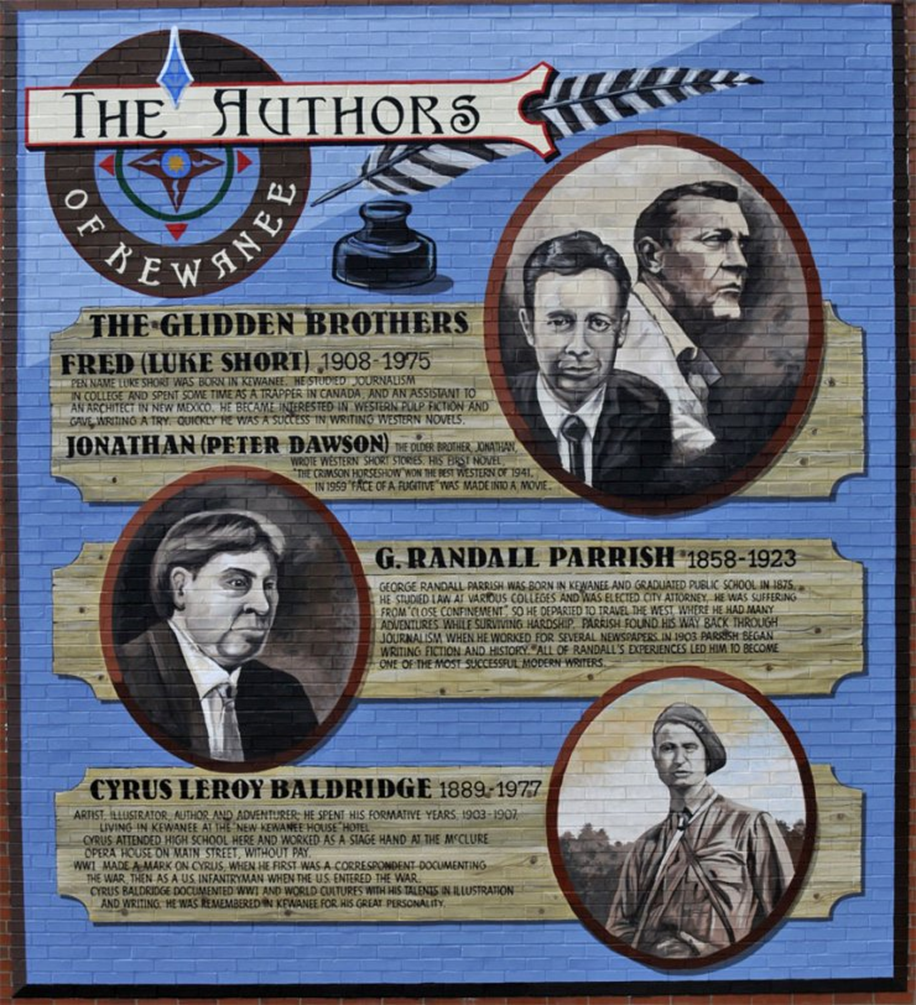
A good reason for Fred Glidden, aka Luke Short, to be on the authors’ mural on the north side of the Kewanee Public Library.
Fred Glidden was born in Kewanee in 1908 to Wallace Dilley and Fannie Hurff Glidden. Wallace worked for the Kewanee Boiler Company, eventually becoming an assistant treasurer and director. Fannie taught school and, after Wallace died in the 1920s, moved to Galesburg where she taught at Knox College and served for a time as the first women’s dean.

Fred was popular and successful at Kewanee High School, graduating in 1926. (His brother, Jonathan, graduated the year before.) Fred played football, basketball and ran track, and was captain of the 1926 football team. He was class president in 1923 and 1925. He was a member of the student federation, the Kewanite staff, the booster club and the Hi-Y, serving as president of the latter in 1926.
Fred then attended the University of Illinois at Champaign-Urbana for two and a half years. He transferred to the University of Missouri at Columbia to study journalism. In 1929, he and his brother traveled to Hawaii, and then Fred graduated in 1930.
Fred landed a job at the Illinois State Register in Springfield, but with the depression in full swing, the job didn’t last long. He headed to Iowa and worked briefly at newspapers in Des Moines, Cedar Rapids and Sioux City. He then worked a short stint at the Minneapolis Star.
After that, Fred made his way to New York, where, he wrote, “lived in a flea-bitten walk-up apartment with four other fellows as broke as I was.” Without work and at the suggestion of one of his roommates, they pooled their remaining money together and headed to northern Alberta in Canada, above the Yellow Knife River. They bought some traps and moved into an abandoned cabin miles from any traces of civilization. His mother, now dean at Knox College, said that Fred’s writing during this period was some of his best as the isolation allowed him to focus.
But the Canadian climate affected Fred’s health, so after two years, and on the advice of Kewanee friends, he moved to New Mexico. He worked for a while as an archeology assistant and then at other western-type jobs as he continued to write. In 1934, he married Coloradan Florence Elder, they lived in Santa Fe and over the next few years had three children.
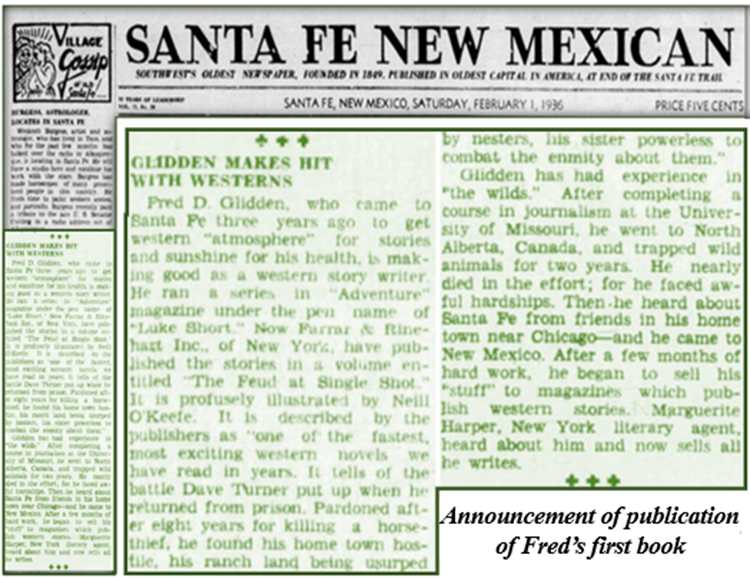
Fred began submitting Western stories to the “pulps” (low-grade magazines of fiction) while living in Santa Fe. He met Marguerite E. Harper, who became his literary agent until she died in the 1960s. Harper was a significant influence on his writing career, and she suggested the pen name “Luke Short.” It’s unknown whether this was a reference to the real-life gambler-gunfighter Luke Short.

In 1935, a collection of Fred’s short stories was turned into his first book, “The Feud at Single Shot”. After that, Fred’s work began to sell well, first in the pulps and then in the “slicks” (glossy magazines, such as The Saturday Evening Post). By the end of the 1930s he had turned out fourteen novels and numerous short stories. By 1940, Fred was earning more than $5,000 per year as a writer, at time when the median income for a male was $965.
His brother, Jonathan soon joined him in New Mexico and, not long after, started writing as well under the pen name “Peter Dawson.”
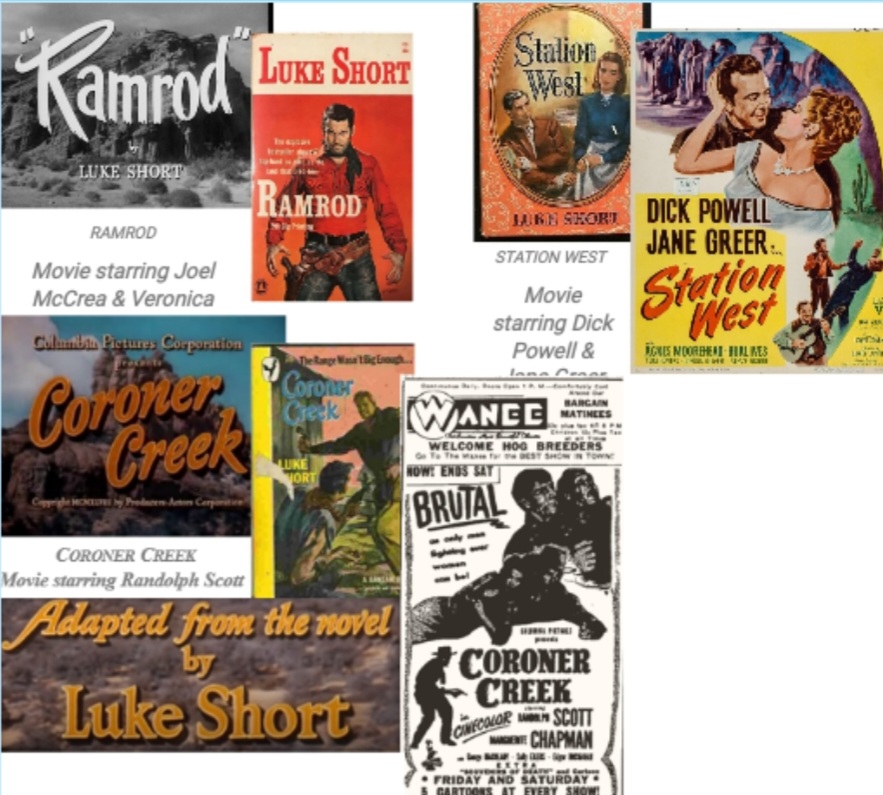
The 1940s were perhaps the pinnacle decade of Fred’s career. He signed contracts with paperback publishers, generating a lifetime total of over 26 million copies in sales. A number of his books were made into Western movies, starting with his 1943 novel “Ramrod,” which in 1947 became a United Artists film starring Joel McCrea and Veronica Lake. In 1948 alone, four Luke Short novels appeared as movies. Overall, at least 10 of his books were turned into movies and others were included as episodes in at least one television series.
Fred’s poor eyesight kept him out of the service in World War II, but he served for one year with the Office of Strategic Services in Washington, D.C.
After WWII, Fred was sought by paperback publishers and he experienced his peak Hollywood years. In 1947, he moved to Aspen, Colorado.
In the 1950s, the production of Fred’s Western novels fell off as he tried other genres, but not successfully. He also had to deal with literacy piracy and plagiarism. A variety of business deals and artistic ventures in stage and TV were not particularly successful, and a thorium mining company he founded failed.

His son, James, died accidentally in the early 1960s, and Fred eventually returned to the steady production of Western novels while spending summers in Aspen and winters in Arizona. He was a founding member of the Western Writers of America, and in 1969, he received the Levi Stauss Western Writers of America award.
In the 1970s, Fred produced six more Western novels, despite increasing trouble with his eyes which forced him to dictate much of his work. In 1974, he won the Western Heritage Wrangler award.
Fred was active in community affairs in Aspen. He was on the local hospital board, was a member of the city council, a member of the county zoning and planning commission, and at one time was the mayor of Aspen.
He also encouraged other writers, as he did his brother. He told Brian Garfield, who would go on to be a bestselling writer himself, to “[t]ake out all the Western trappings. Your story should depend on characters and behavior. If it still works after you get rid of the clichés, it’s a story.” He told Garfield that a western isn’t only horsemanship and gunplay. Fred once explained his formula for success: “First I write myself onto a corner. Then I write myself out.”
Kewanee-born Frederick Dilly Glidden died in 1975 from throat cancer. His ashes are buried in Aspen.
In 2013, a Walldogs’ mural was dedicated to honor four famous Kewanee authors, Fred Glidden, Jonathan Glidden, G. Randall Parrish, and Cyrus Leroy Baldridge. Fred was a well-respected writer of stories of our West, and deserves all honors bestowed on him.