***This column is the second of a two-part series written by Tim Pletkovich on Serbs in Kewanee and their history in the community.
When Croatia seceded from Yugoslavia in 1941 to form a fascist government modeled after Mousolini’s Italy and Hitler’s Germany, it set out to cleanse its borders of all Serbs. Myriad concentration camps emerged throughout the country, and with them came the extermination of more than 250,000 minority Serb inhabitants. Among those who perished was former Kewaneean, Jovo Kosutic.
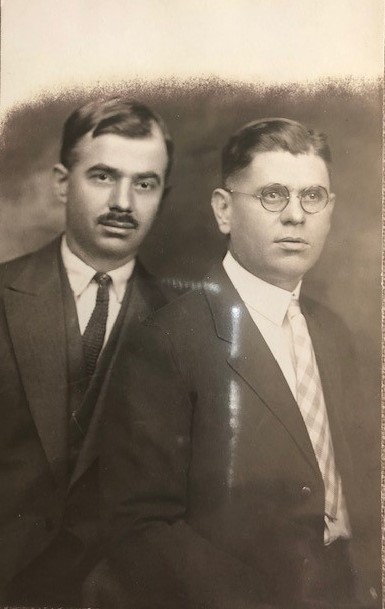
Shortly before the Great Depression, Jovo came to Kewanee from the northern Banija village of Slovinci, Croatia, to live with his cousin, Stoja “Stella” (Kosutic) Pletkovich, her husband, Stojan “Steve” Pletkovich, and their eight children. The home also included room for six Serbian borders. During his years as a Kewanee resident, Jovo worked at the Pletkovich’s confectionery store before eventually returning to his native country.
At the time that Croatia declared its independence from Yugoslavia on the tenth of April in 1941, Jovo was living with his family in Vojnic Kolodvor near the capital city of Zagreb. On that day, his oldest son, eighteen-year-old Branko, passed away.
“Branko’s death and the creation of a totalitarian state in Croatia were signs of terrible things to come,” recalled Nikola Kosutic, a second cousin of Jovo’s during a 1995 interview from his home in the same village of Slovinci.
Prior to the formation of Croatia’s fascist polity, Jovo and his brother, Coja, had acquired sizable land holdings and a tavern/inn near Vojnic Kolodvor. Their land included a forest and railroad, both of which the Croatian government coveted. At some point, the government purchased most of their property and exploited the forested area for its rich deposits of iron ore.
Then, immediately after the Fascists came to power, Jovo and Coja were arrested on their remaining property at their home and taken to the concentration camp at Koprivica, known as Danica. They were never heard from again. Their remaining land was seized by the Ustasa (the Croatian Fascist soldiers) and their home was ransacked and burned to the ground.
In May 1941, a massacre of Serbs took place at Petrova Gora in the forest of Biljeg, not far from Vojnic Kolodvor. Jovo’s wife, Andja, and their children were able to escape the slaughter, but Coja’s wife, Marica, was among those found among the carnage.
Another of Stella (Kosutic} Pletkovich’s cousins who was apprehended during the Holocaust was a nephew, also by the name of Jovo Kosutic.
After going to high school in Sisak, Croatia, young Jovo secured employment at the train station in Zagreb. While working there, he lived at the home of a railroad official in nearby Trnje and became engaged to one of his daughters.
Soon after the Fascists came to power, a friend of Jovo’s and fellow railroad employee, warned him that, as Serbs, they were both in danger if they continued to work there. Jovo, however, dismissed the warning since he had no political affiliation and was not in disfavor with anyone. Only two months, though, after the government takeover, he disappeared from work one day and was lost forever. As for Jovo’s friend who had warned him to leave, he fled Zagreb and went into hiding with his Croatian wife’s family to avoid any further detection.
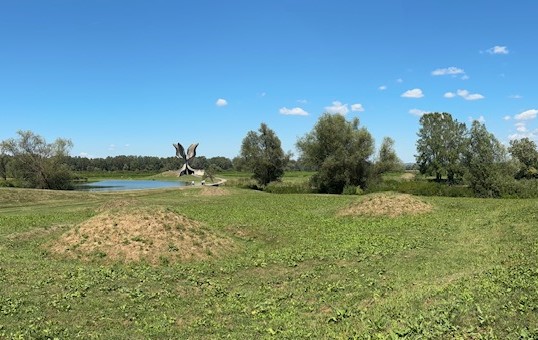
One of the most notorious death camps in all of Europe was built at Jasenovac, Croatia, along the Una River across from Bosnia. Jasenovac is referred to by historians as the “Auschwitz of the Balkans.”
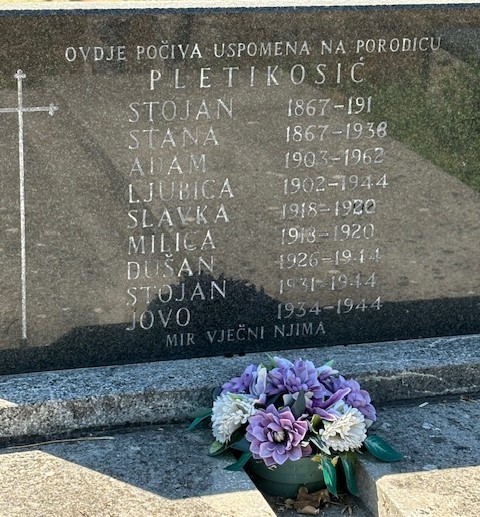
Located in the northern Banija region, the vast majority of current-day Kewaneeans with Serbian ancestry, had numerous family members who were confined there and murdered within its constructs. It was there that Dujo Pletikosic lost three of his uncles, his paternal grandfather, and countless other relatives. My own paternal grandmother, Stella Pletkovich, lost five Kosutic cousins at this apocalyptic site, which many Nazi soldiers professed to have been even more horrific than their own extermination camps in Germany and Poland.
At Jasenovac, young children were forced by the Ustasa guards, who had charge of these camps, to play musical chairs before their ruthless and amoral captors. One need not imagine the ultimate fates of the losing participants as they were eliminated from competition one by one.
Other victims at Jasenovac were simply bludgeoned to death with sledgehammers, axes, and other contrivances. Some were repeatedly pummeled with large rocks and pieces of wood while others were stabbed to death with knives. There were no gas chambers- only rifles and crude instruments were used to annihilate the helpless men, women, and children, who were deemed unfit to exist in the Croatian’s newly created totalitarian world.
Kewanee native and Serbian descendant Denise Loomis has counted more than 500 people with her Popovic grandfather’s surname who perished there. “The numbers are simply devastating,” she recently lamented.
The luckiest victims were those who died before entering the barbarous torture camps that sprouted throughout the Croatian countryside. A large number of the persecuted Serbs from the Banija Triangle region who were initially ordered to board the death trains at Staza, never arrived in Jasenovac via the stifling cattle cars. Instead, they were sprayed to death with machine gun fire before ever boarding the trains.
Such was the destiny of my father’s first cousin, 6-year-old Maca Kosutic, who perished one day with countless others, whose corpses were then hurled unceremoniously into an open pit. Little Maca was spared the horror of playing musical chairs at Jasenovac. For her and the others who perished at Staza, their endings came expediently and were devoid of the sadistic and insidious torment that befell the persecuted at Jasenovac under their evil oppressors.
In addition to the Serbs, other victimized peoples who expired in these heinous camps included Croatian dissidents, Jews, Bosnian Muslims, and Roma, or Gypsies. But the Croats’ long-standing, salient nemeses were the Serbs. Both sides had been at each other’s throats for centuries and had repeatedly committed blood-thirsty atrocities against their enemies that are well documented. It is no wonder that, during World War II, with most Serbs fighting with the Allied forces, and with most Croats fighting with the Axis powers, the degree of such devastation that occurred was both inevitable and cataclysmic.
I have often wondered if any other former Kewanee residents, in addition to Jovo Kosutic, may have perished in Croatia during the Second World War. Considering the number of Serbs who once lived here, it would seem more than likely.
In retrospect, as we contemplate our own mortality, let us be forever grateful that our forebears chose to come to Kewanee, that strange and foreign land, and to cultivate American ideals that superseded the ethnic contentions that existed in another corner of the globe.
About the author: Tim Pletkovich is a former resident of Kewanee. After graduating from Eastern Illinois University in 1982, Tim became a scout for the Chicago Cubs. At twenty-one, he was the youngest scout on the payroll of a major league team. After three years with the Cubs, Tim took a job covering the Boston Red Sox for WATD Radio in Plymouth, Massachusetts. He conducted pre- and postgame interviews for Red Sox home games and served as an in-studio analyst for the station’s weekly Sunday night sports talk show. Tim also spent twenty-five years as a secondary school teacher with positions in Queens, New York, and Peoria, Illinois. He taught U.S. history and English. Tim has authored two books: Civil War Fathers: Sons of the Civil War in World War II and Nuns, Nazis, and Notre Dame: Stories of the Great Depression, World War II, and the Fighting Irish. In 2017, he received the Ella A. Dickey Literary Award at the Missouri Cherry Blossom Festival for Civil War Fathers. Past recipients of the Dickey Award have included former First Lady Laura Bush, former United States Senator and Democratic Party presidential nominee, the late George McGovern, and former Texas First Lady, the late Nellie Connally. Tim is currently working on a book composed of narratives of grandchildren and great-grandchildren of American. presidents. He is a member of the Ponosno Pero Association of Central Croatia, a benevolent organization that helps indigent Serbian families in the northern Banija region of that country. He enjoys traveling to the Balkans.