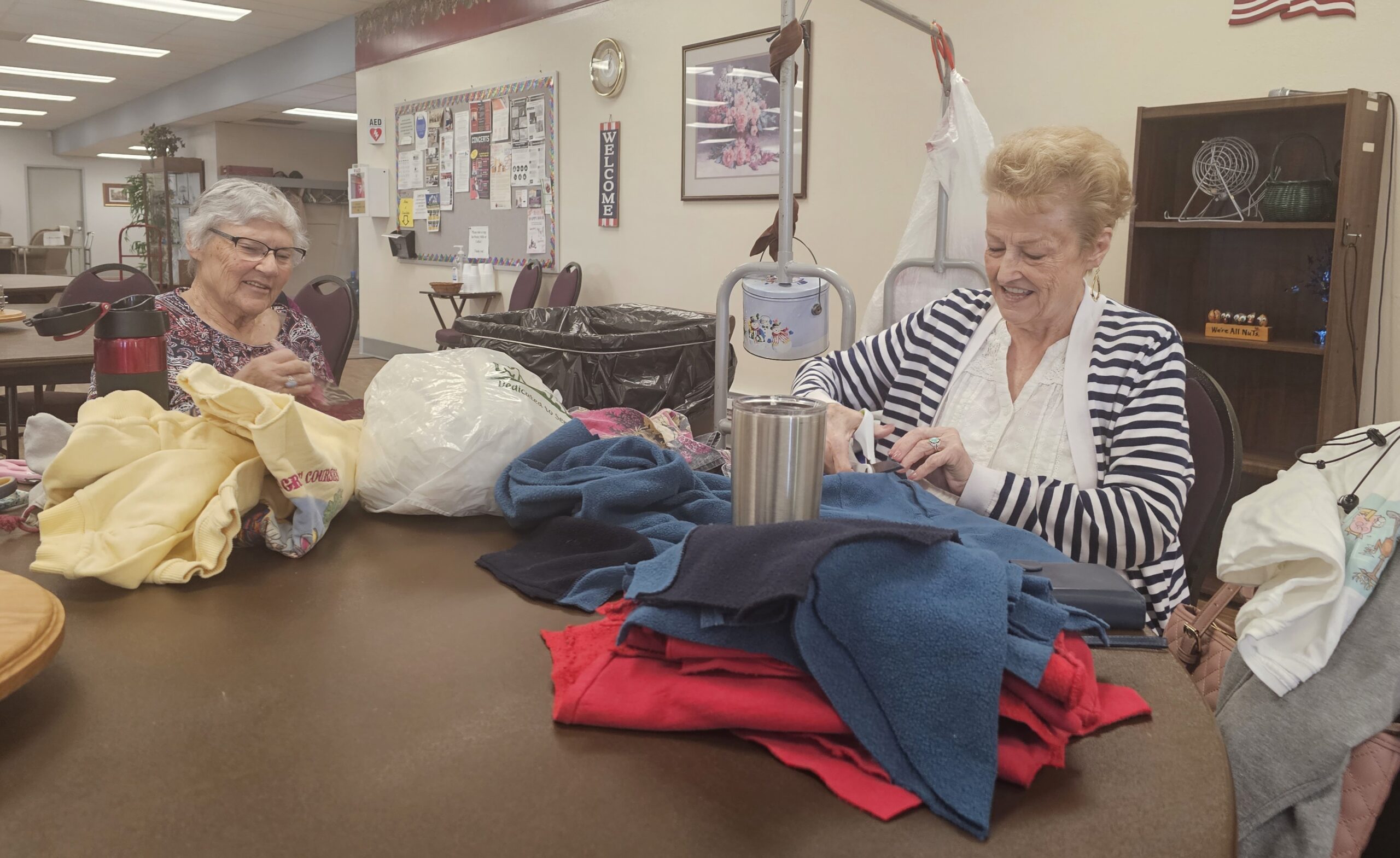
Doris Boehle, left, and Linda Beert volunteer their time every Thursday to cut up old clothing for the Henry County Senior Citizens. [Photo by Susan DeVilder]
For all but about eight years, I have called Kewanee my home and I like to think I know what is going on in my town, but on Thursday, I was reminded that a lot happens behind the scenes of which I am completely unaware.
The sight of Doris Boehle and Linda Beert cutting old clothes into squares at a table at the Senior Citizens Center really brought that fact home for me.
As many of you may know, The Kewanee Voice was given an office space at the center and while strolling through the dining area, I happened upon the two ladies and being curious, I inquired about what they were up to. They were more than happy to fill me in.
For at least nine years, the two women have been volunteering for the Henry County Senior Citizens. For several hours every Thursday, they take old, worn-out, donated clothing and cut them into rags- grease rags to be more precise.
The rags are then put into bags and weighed, before being sold by the pound to a local roofing contractor in town. The funds raised from the sale of rags goes to the HCSC.
“It gives them a second use,” said Beert, who prefers cutting up softer cloth. Blue jean materials are the worst and hard to cut, she said, and silk garments aren’t good at absorbing grease.
The best fabrics for rags are definitely towels and sheets because the fabric absorbs liquids, the two women agreed, but any kind of natural fiber fabric, such as cotton, is better than the more delicate or synthetic fabrics.
The rags are disposable, used once by the roofers, before being thrown out, but the recycled textiles means another chance for the old, worn out, out-of-style, often stained or torn clothing to be useful before they fill up the landfill. And fill up the landfill, they most certainly do.
A study done by Boston University found that every year in the United States, Americans throw out about 34 billion pounds of used textiles. That’s billion with a b.
I did just that several weeks ago before I learned about the operation going on behind the scenes at the senior center. I ruthlessly went through my closet, tossing out clothes that had seen better days to make some room for new clothes I probably don’t need. I always feel guilty when I throw clothes, even old clothes, into the trash. Turns out I didn’t need to.
I wish I had known about the rag project then because my “covid uniform,” or what I called a particular comfortable but shabby outfit that while sheltering at home, I would pull out and wear as soon as it was washed, could have had a third use as absorbent grease rags.
I am probably not alone in my previous lack of awareness about the rag operation, so I don’t feel too bad. The donation supply for the rag project is spotty, Beert said. Some weeks are better than others, and the women can usually produce around twenty pounds of rags in one session if the supplies are good. A few Thursdays ago, Beert was able to cut up that amount all by herself.
People are more than welcome to drop off their old clothes that aren’t fit for resale at the senior center and Beert and Boehle, along with Beth Dolieslager, who was absent that particular day, will dutifully and faithfully cut them into squares for grease rags. Just do them a favor, go easy on the blue jeans.
“They are hard on our arthritic hands,” said Beert.