(I’ve struggled for years, without success, to find the origin of the name of Windmont Park. Then, earlier this month, I was listening to a podcast of Dave Clarke’s interview with Larry Lock on Dave’s radio show, KEWANEE BACK WHEN. They remarked that I had yet to discover where “Windmont” came from. The gauntlet was thrown down, and I went back to my research. And, here’s what I found.)
William Henry Lyman was born in a small village, White River Junction, in Windsor County, Vermont, in 1852, to George and Minerva Briggs Lyman. His ancestors arrived from England in 1831, settling in Boston but then helping to found Hartford, Connecticut, in 1636. His paternal grandfather was a prominent shipping merchant, while his father was a merchant and a member of the Vermont legislature.
William was educated in local schools and then went to boarding school with private tutors. But when he was 17 years old, he decided to join his brother, Elias, in Kewanee.
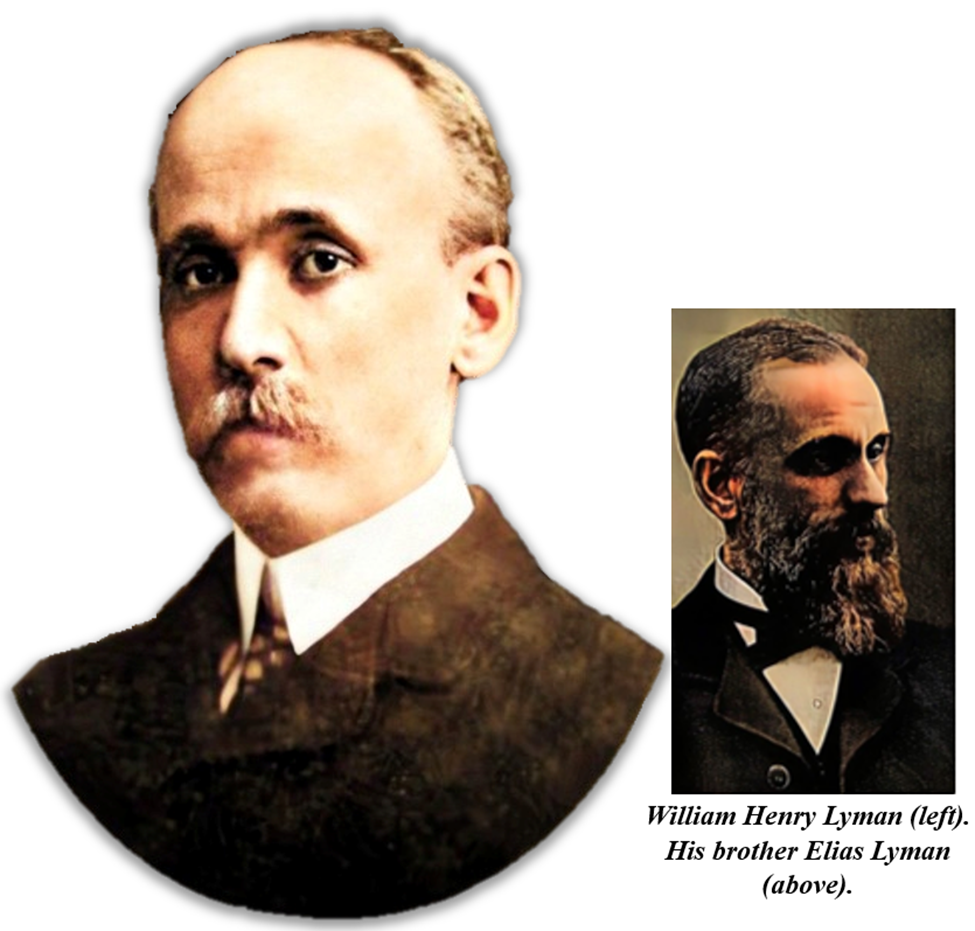
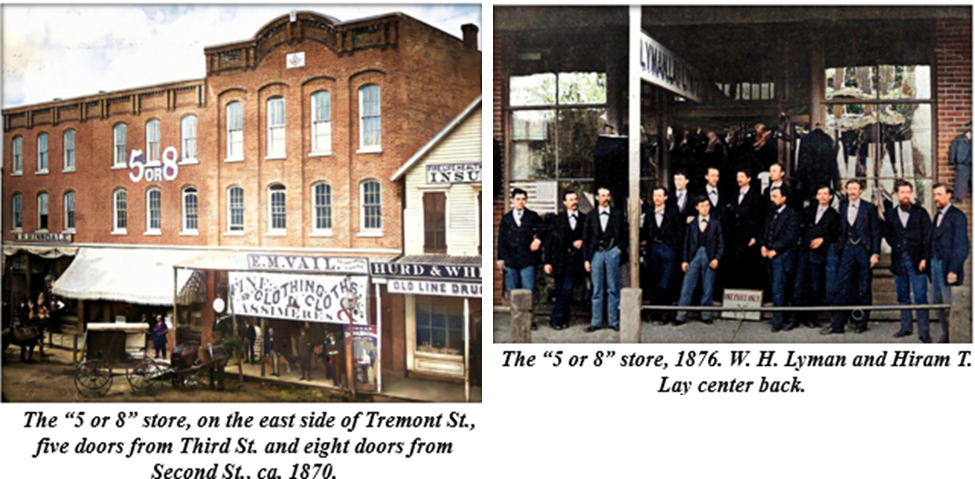
In 1862, Elias Lyman and his wife, Adelaide Trask, arrived in Kewanee from their home in Vermont. Lyman had worked in his father’s mercantile business, learning the trade there. He was hired on at the Pioneer Store, Kewanee’s first store. After a few business ups and downs, Elias eventually established the “5 or 8” store (five doors from one end of the block and eight doors from the other end, on the east side of Tremont between Second and Third streets). He subsequently took on Hiram T. Lay as a partner.
In the late 1860s, William was employed at the store. In 1874, he became a partner in the firm, which changed its name to Lyman, Lay & Lyman. In 1883, Elias retired and the firm became Lay & Lyman.
In 1886, they constructed a new 5 or 8 building, a block further south but still on the east side of Tremont St. It was described by some as the largest and finest department store in Illinois outside of Chicago. (The term “department store” was then a comparatively new one.) At the time, however, it was considered by many as entirely too large and a dangerous venture. But the critics were proven wrong. And, in 1903 it was enlarged and then in 1908 an annex was opened on Second St.
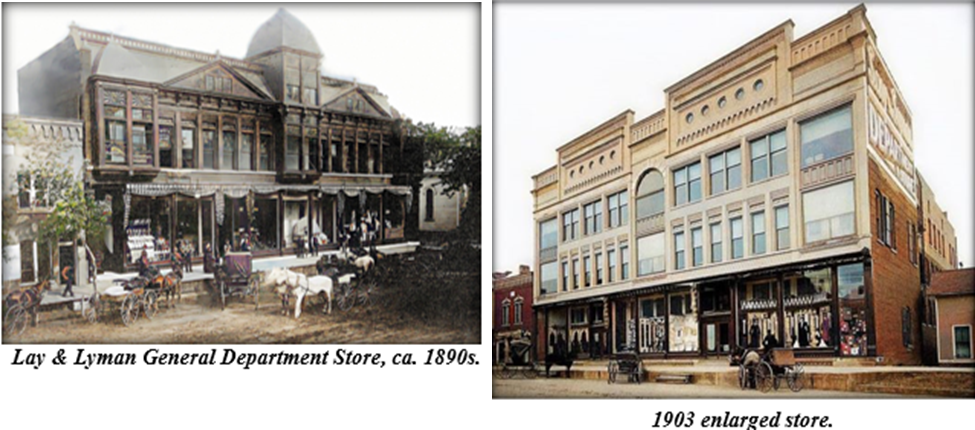
In January 1905, Lay retired, his interest in the store assumed by his two sons, Frank M. and Henry H. Lay, and the firm name then became the Lyman-Lay Co.
In 1919, Frank and Henry Lay sold their interest in the store to the other stockholders. The firm name changed once again, to W. H. Lyman & Co.
Ownership changed hands one more time, in 1924, when William retired and a St. Louis group purchased the main store (but not the annex), renaming it Kewanee Dry Goods.
But William Henry Lyman was not content to simply operate a department store.
Perhaps Lyman’s greatest business achievement was the organization and development of Boss Manufacturing Company.
H. H. Perkins had been producing corn husking pins, commonly known as “boss” pins. Lyman, H. T. Lay, Henry Terry and C. C. Wilson incorporated the H. H. Perkins Manufacturing Co. to exploit Perkins’ patents. The company grew, and soon started manufacturing windmills, a new shoveling board and a corn planter.
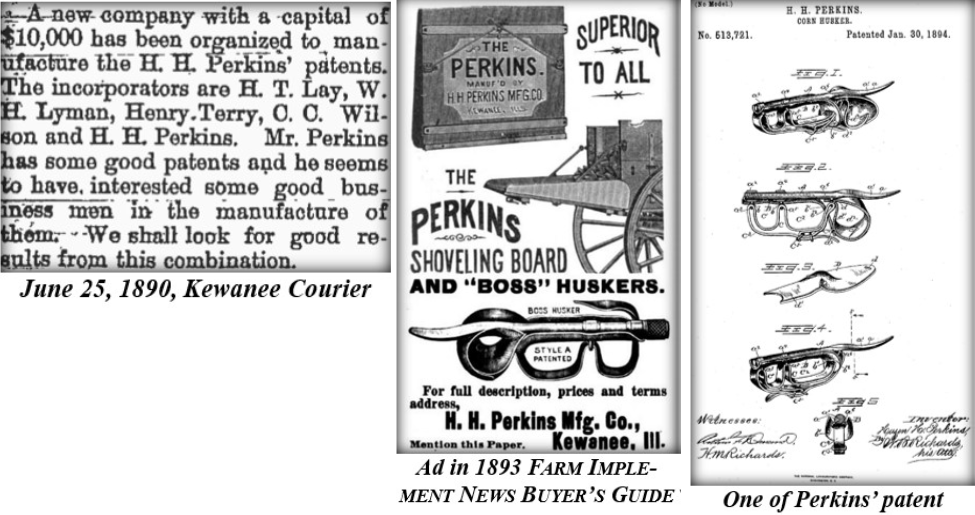
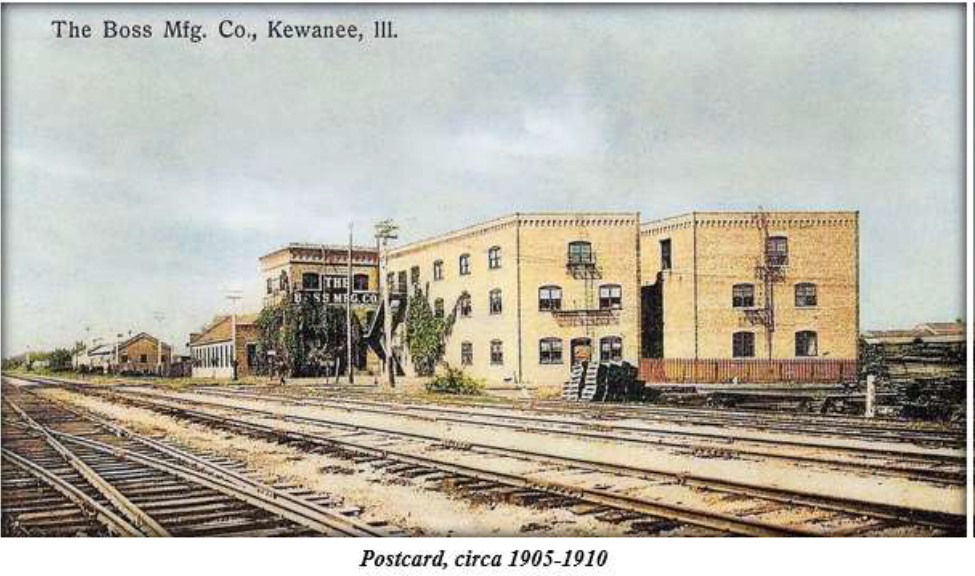
In 1893, a more highly-capitalized company, the Boss Manufacturing Co., was incorporated. That same year, it began manufacturing shirts, overalls, coats, and pants, its first foray into a sewing operation. The company also began construction of a new plant outside of the city limits, just north of the Chicago, Burlington, & Quincy tracks and to the west of the train depot.
About this time, Lyman noticed that farmers’ wives were buying cotton flannel at the Lay & Lyman department store in order to make mittens to protect their husbands’ hands. Boss decided that, with the sewing equipment it already had, it could profitably make mittens for sale to farmers. Boss first made mittens, and then a five-fingered product, which became the work glove. The mittens business took off, to the point that the clothing operation was discontinued and its equipment was devoted fulltime to making the popular mittens.
In 1902, it introduced jersey gloves, followed by a leather-faced palm glove. As the nation grew, Boss developed gloves for various industries – brick and stone masons, painters, steel workers, railway workers among them – as well as for home uses such as gardening. As it expanded its lines, Boss needed to expand production. In addition to adding to its Kewanee plant, in 1901 the company opened its first branch plant in Galesburg. It also started buying out smaller companies around the country to produce gloves.
Lyman was president, general manager and guiding genius of Boss from its inception until 1924 when he disposed of his business interests in Kewanee.
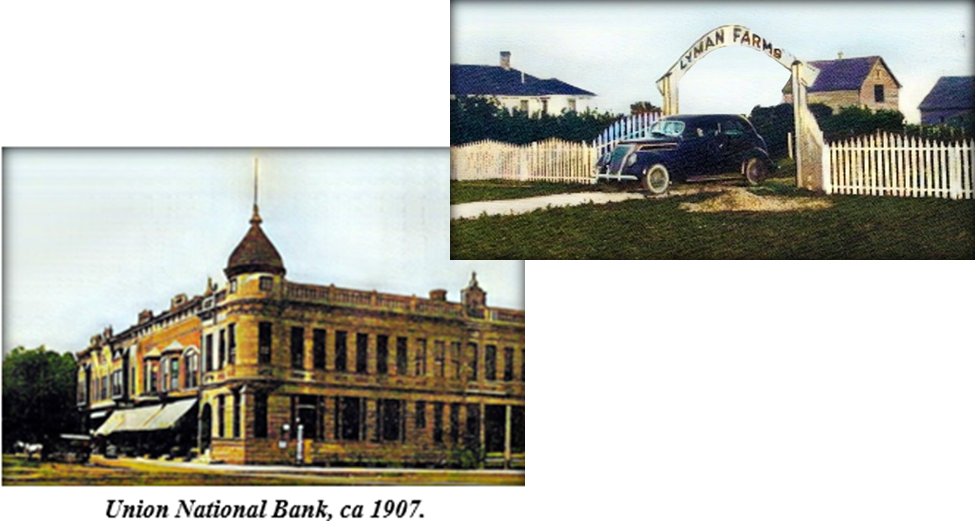
Lyman also was one of the founders in 1880 of the Union National Bank of Kewanee and was vice president and a director of that institution and its successor, the Union State Savings Bank & Trust Co., until 1924.
In addition, Lyman purchased tracts of farmland near Kewanee, which were later plotted into attractive residential and business additions to the city. In 1911 he acquired and began the development of 12,000 acres of prairie land in the province of Manitoba, Canada. This tract was divided into a group of grain ranches, known as the Lyman farms.
A leader in civic affairs in Kewanee, Lyman was involved with the public library, the Kewanee public hospital, the Y.M.C.A. and other public institutions. He served as a trustee and president of the village for two terms, and was active in the local, state and national chambers of commerce. He also served on the Nicaragua Canal Commission. During the first world war, Lyman attended various conferences in Washington relating to industry and the war.
Lyman was a member of Kewanee’s First Congregational Church. He was married in Kewanee in 1877 to Elizabeth Stevens, and they had one son, William Henry Lyman.
Oh, yes, most important to our story, W. H. Lyman was also president of the Galesburg and Kewanee Electric Railway (G&K) from 1904 to 1922.
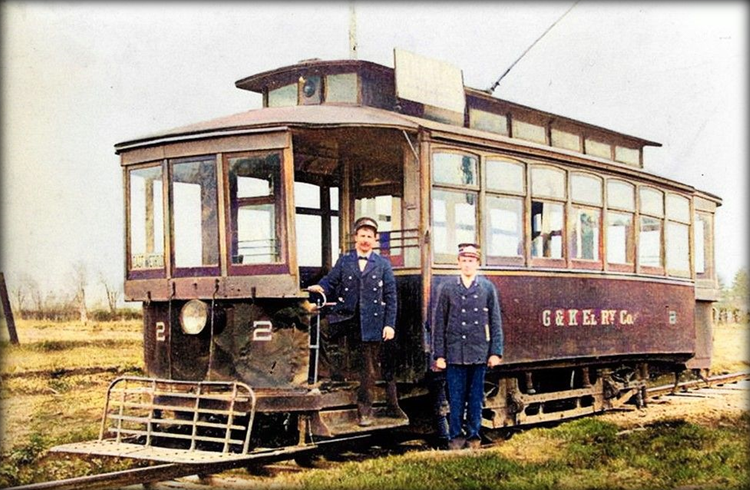
In late 1901, the Galesburg & Oneida Electric Railway Company was formed by Knox County businessmen. They planned an interurban line from Galesburg to the northeast, along the main line of the Chicago, Burlington & Quincy Railroad. They also contemplated extending the line to Galva. Kewanee railway supporters believed Kewanee should be included in the plans.
After G&O officials visited Kewanee in early 1902, the city council granted a franchise to the group for both a city line and an interurban line toward Galva. The executives then organized the G&K.
In early November, grading began in Kewanee with a goal to complete a line from the northeast part of Kewanee through downtown. On August 23, 1903, the maiden voyage of the first street car took place, from downtown to East Lake Park, renamed Terminal Park.
Before 1903 ended, W. H. Lyman was appointed to the G&K board of directors. Previously, Lyman had said “I certainly believe the streetcar system will be profitable in a very short time and would be willing to put some money into it, so strong is my belief.” And, he put his money where his mouth was, both financially and administratively, throughout the entire time the company was in local control. In 1904, Lyman was elected president of the company.
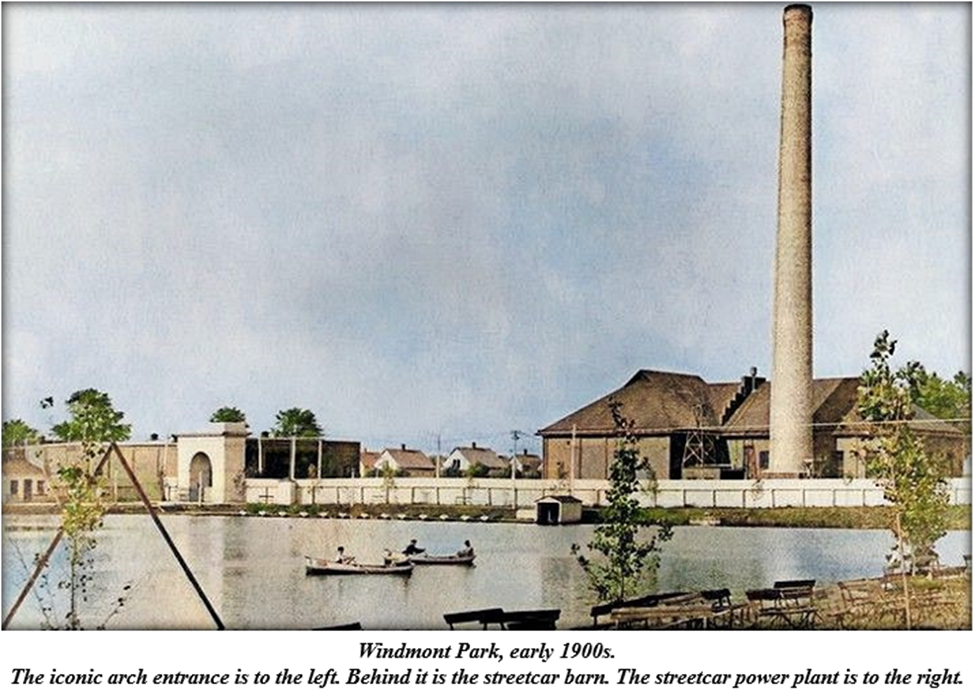
The interurban line was planned to enter Wethersfield from the west, between the new powerhouse and carbarn, and join the West McClure Street line for the trip into Kewanee. The grading for the interurban line had created a depression west of the new buildings. Since the company needed a water storage area near the powerhouse, it built a dam for what became a small lake, with a well to assure an abundant water supply.
The idea of a new park was born.
By the middle of January 1906, the company lighted the lake by the new powerhouse for ice skating. A heated shanty was constructed to help the skaters keep warm. Of course, most people who came to skate arrived on the streetcars.
By May, the company had purchased rowboats for the lake. Docks for loading the boats and a bandstand were next on the agenda.
By June, the pavilion at Terminal Park was being moved to the new park in Wethersfield, a fence was being built around the park, and entertainment offerings were scheduled to begin soon. In late July, the park’s iconic archway was completed. Soon the lagoon’s bridge was in place. The park became the most beautiful and most popular park in Kewanee and the surrounding area for a wide range of activities.
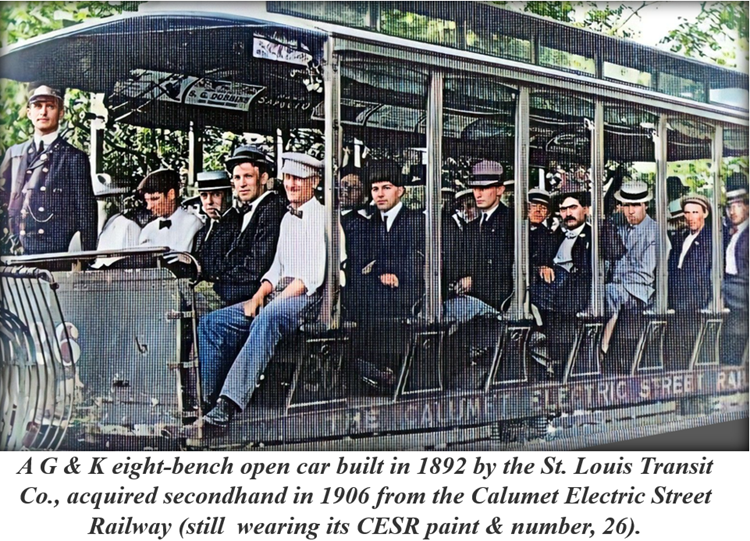
To handle the hoped-for crowds to the park, the G&K purchased three open trailer cars (no motors) from the Calumet, Illinois, Electric Railway to be pulled by powered cars.
In 1924, after he gave up all of his business interests in Kewanee, Lyman moved to California, where he organized and was president of the Lyman Corporation, a private organization, with his son as vice president.
William Henry Lyman died in Los Angeles in 1930, leaving behind a legacy of which he was proud.
Oh, so where did the name of Windmont Park originate?
It’s quite simple.
Lyman was very loyal to ancestors and where he came from. To honor the latter, he simply combined the first syllable of his home county with the last syllable of his home state:

(I relied heavily on Fred Rozum’s book, Streetcars in Kewanee and Galva, Illinois, for information on Kewanee streetcars. My source for the name “Windmont” is The National Cyclopædia of American Biography: being the history of the United States as illustrated in the lives of the founders, builders, and defenders of the republic, and of the men and women who are doing the work and moulding the thought of the present time / edited by distinguished biographers, selected from each state, revised and approved by the most eminent historians, scholars, and statesmen of the day, vol. 32, published by James T. White & Company, 1945.)
(I’ve also written more detailed chronicles on aspects of this story, all of which can be found on the Kewanee Historical Society’s website under the Dusty Roads® tab – click here.)