Lore has it raised in 1849-50 but records suggest it was 1850 or, more likely, 1851.
I’m writing a book on the history of the first five years of Kewanee’s existence, and I’m laboring hard to get the details right.
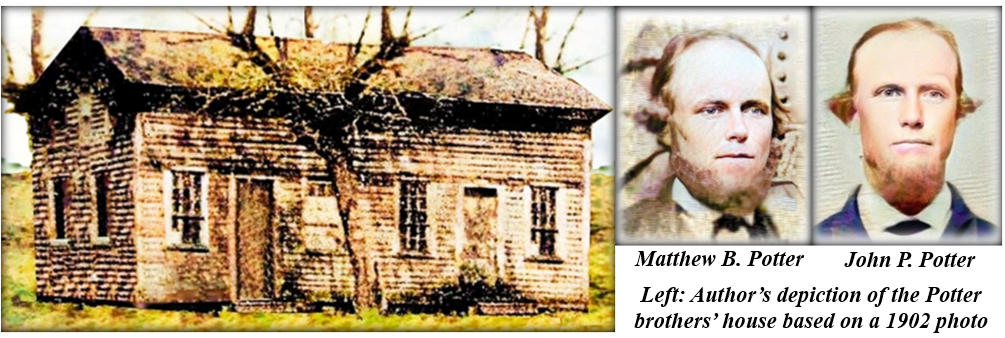
One of the critical dates in our hometown’s past is when the brothers Matthew B. and John P. Potter built their house on land which, in the spring of 1854, would become the village of Berrien, soon to be renamed Kewanee. The Potter brothers’ house is often described as the first house in the original village.
The Kewanee Chapter of the Daughters of the American Revolution pegs the date of the construction of the house as 1849-1850, and that has been widely used and generally accepted.
However, I’ve been using 1851 as the date. I think that’s probably correct, although it’s possible it could have been built in 1850. But I’m confident that it was not constructed in 1849. Here’s how I arrived at my conclusions.
I began my research by reaching out to the Kewanee DAR, and I had the pleasure of speaking with Betsy Tocha. But we were unable to pin down the date any closer or find the source of the date used by the DAR.
I then began combing through the Kewanee newspaper archives available online at the Kewanee Public Library’s website.
I believe that the DAR’s date is almost certainly based on a 1904 report written by Mrs. E. M. Vail, a then-active member of the DAR. She had read her report at a chapter meeting not long after the chapter obtained the Potter house in 1903, and it was published in the newspaper three decades later. (You can read that report as reprinted in the Star Courier newspaper archives by clicking here. Mrs. Vail also wrote similar reports and articles on Kewanee’s founding for later publications.)
But Mrs. Vail was born in Connecticut in 1848, and her family moved to Illinois only later. So, she was too young to have first-hand information about when the house was built. In her report, however, Mrs. Vail implied that she obtained some of her information from Ambrose Matthews (1831-1906), who she said was present when the Potter house was raised.
There is no reason to doubt Matthew’s presence at the time of construction. But we don’t know how many years passed before Matthews shared his recollections – including the date – with Mrs. Vail. The longer the time between the event and his sharing it with her, the more likely that the date may have been mis-remembered. In fact, it’s quite possible that the date was not shared until around the time the house became the property of the DAR in 1903, when the date was of greater importance and when Mrs. Vail was motivated to write her report. Thus, the time lapse could have been significant – 50 years – and, given his age in 1903 – 73-years-old – the possibility of mis-remembered dates grows larger.
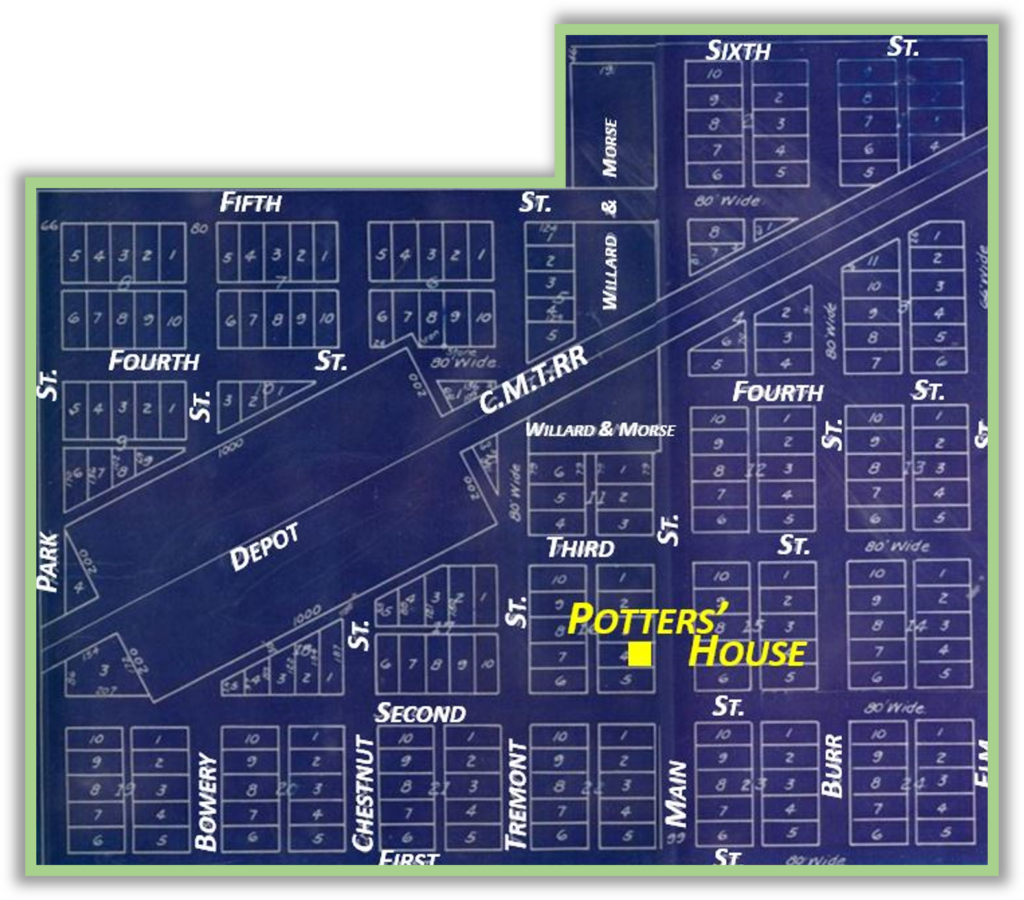
I next turned to Henry County land records for the Potters’ land, and they proved enlightening. With the help of Kewaneean Justin Raver, partner and CEO of the law firm Barash & Everett, LLC, here’s what I think I found. (Any errors in the analysis are mine.)
The land on which the Potter house was built – the northwest quarter of Section 33 in what became Kewanee Township – had reverted to the county for failure of the then-owner to pay the 1843 taxes on it. In 1844, Lloyd Morton of Adams County acquired the land by paying the back taxes and costs – about 4.00. Unfortunately, documentation of those transactions can’t be found, likely because Henry County and its recordation system was suffering growing pains. Morton, however, did apparently obtain a certificate of purchase.
Fast-forward to 1850, when new actions with respect to the land occurred.
On March 7, 1850, on the back of the certificate of purchase that he received in 1844, Morton assigned the certificate to Julius A. Pratt for the back taxes and costs. (Pratt later became one of the first Kewaneean to die in the Civil War.)
Then, on August 16, 1850, a tax deed was executed, reflecting the 1844 transactions and the March 1850 assignment. The tax deed was signed by Pratt and Henry County Sheriff Matthew B. Potter – yes, that Potter, who served as sheriff from 1848 to 1850.

Also on August 16, 1850, a sheriff’s deed was executed, again reflecting the 1844 transactions and the March 1850 assignment. The sheriff’s deed was signed by Pratt and Sheriff Potter.
Finally, on February 1, 1851, a quit claim deed was executed, transferring the land from Pratt to the Potter brothers for $200 ($1.25/acre). All three deeds were then filed at the Henry County Recorder’s Office in Cambridge on February 3, 1851.
What does this all mean?
First, I think it removes the possibility of the Potter house being constructed in 1849. History shows that the entire Potter family, arriving in Wethersfield in 1838, was well-respected as honorable folks. It’s hard to imagine that any of them would have squatted and built on land they didn’t own. That Matthew was serving as sheriff renders that possibility even more unlikely.
What about 1850 as the date we’re looking for? Clearly events were in motion with respect to the land by March. While the Potter brothers do not appear as buyers until a year later, it seems likely that Pratt was merely a straw man buyer. As sheriff, Matthew Potter may have been precluded from obtaining the land directly while sheriff, either by law or by a code of ethics. Specifically, the lack of proper Henry County records necessitating the tax and sheriff’s deeds and the need for the sheriff to be involved to clear clouds in the records may have lent itself to the machinations used. But after Matthew’s term ended, he and his brother would have been freed from legal or ethical constraints but, even then, paid what likely was the going cost of land rather than merely the back taxes.
But that still doesn’t necessarily get around the wisdom of the Potter brothers building on land they still didn’t own in 1850.
There is a wrinkle, though, which offers at least some support for 1850 as the build year. The 1850 census suggests that Matthew B. and John P. Potter and their families were living at least close to each other. The enumerator lists the brothers consecutively, albeit in different households. That does not preclude the families from living under one roof but in a duplex. But that also does not preclude them simply living next to each other.
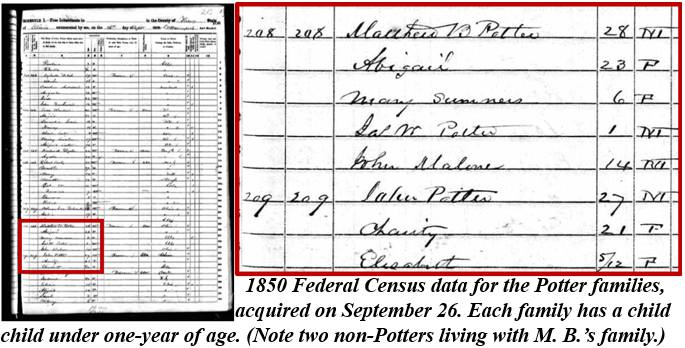
I can’t disregard the possibility that the Potters were living in their house as early as March 1850. But, again, given the possible legal and ethical considerations, I believe the brothers would have waited until Matthew ended his term before proceeding. In addition, it doesn’t make sense to me that the Potters would have started building a house on land owned by someone else, even if they trusted Pratt to follow through in selling them the land after Matthew’s term expired.
While it is by no means definitive, I continue to believe it is more likely than not that construction of the Potter brothers’ house did not begin until February 1851.