(Here is an excerpt from my book on Kewanee Black American architect Walter T. Bailey. I hope to be able to complete the book by fall. By the time of this story, Bailey had moved from Memphis to Chicago and had become a prominent member of Bronzeville’s Black community.)

The 1933-1934 Century of Progress Exposition was intended to look to the future from its site on Northerly Island, an artificial peninsula of land on Lake Michigan. It became a showcase for modern living, consumerism and entertainment, driven by the need to stimulate spending during the Great Depression. There were nearly two dozen corporate pavilions touting the latest devices and things for home and car.
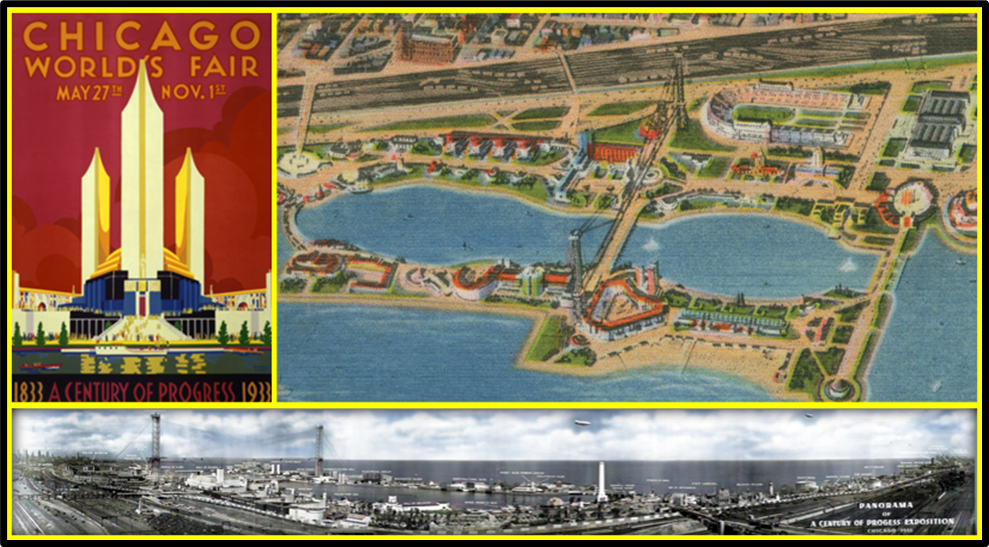
The fair planners embraced a vibrant modern aesthetic, later to become known as Art Deco and Art Moderne – clean lines, synthetic materials and bright splashes of color. A who’s who of designers constructed elements of the fair.
A progressive Black exhibit would have been a natural for the World’s Fair. After the Great Migration, nearly a million southern migrants had arrived in Chicago. With the fair to be held on Chicago’s south lakefront on the eastern edge of Bronzeville, a Black exhibit would bring attention to the Black Metropolis.
In 1930, singer Modupe Paris, a descendant of a French West African chief, engineer and architect Charles Sumner Duke, and Walter T. Bailey briefly joined forces to lobby for a Century of Progress pavilion designed to honor the advancement and achievement of the world’s Black people. (Duke later was a lead architect in the South Park Gardens / Ida. B. Wells housing project in which Bailey played a significant role.)


In a February 12, 1930, letter to the world’s fair planning committee, Bailey wrote “[b]ooths would show progress of all Africans and descendants . . . We are very anxious to teach the world some of the interesting history of the Black People long before the first boat of slaves ever landed in this country.” Bailey envisioned a 75,000 sq. ft. pavilion “designed in the Egyptian Style of Architecture.” He wanted a rectangular building with a central interior court with booths “showing the progress of all Africans and descendants.” Black achievement in fields such as education, science, and economics would be heralded. Bailey suggested putting the pavilion between Thirty-first and Thirty-fifth Streets along the lake. There, the pavilion would be a critical physical link to Bronzeville.
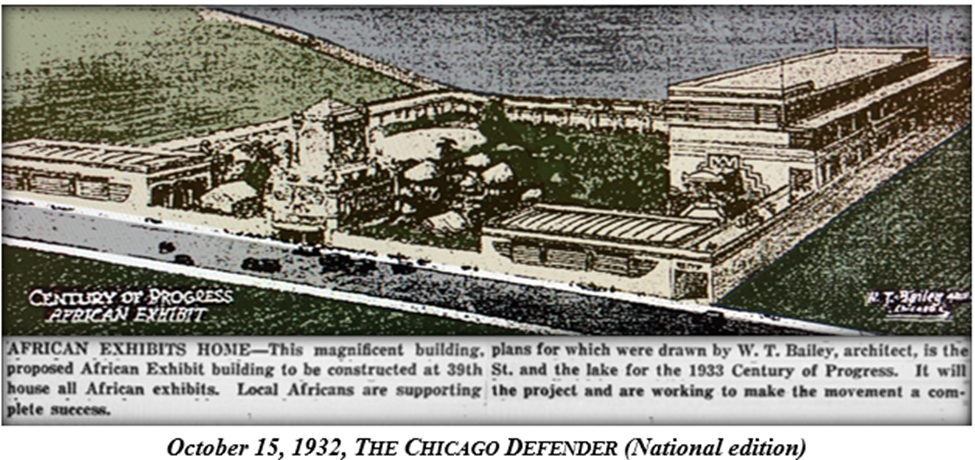
But the fair officials were not accommodating. In an internal memo to the fair’s Exhibits Department, a fair official wrote that the black pavilion “does not strike me as offering much of interest and it contains elements of considerable danger.” Bailey’s request was denied.
Fair organizers turned down at least six major proposals and counter proposals to create a black-themed exhibit at the Century of Progress. At first, they also denied a request for a replica of Jean Baptist Pointe DuSable’s log cabin. DuSable, a Black, French-speaking West Indian, is credited as Chicago’s first citizen, the discoverer and founder of “Eschicagou” at the mouth of the Chicago River when it was a wilderness.
But the “Pygmy Village” and other exhibits that featured exploitative and stereotypical depictions of black people largely overshadowed the later-built DuSable exhibit.

Bailey and Duke did share their expertise with Annie E. Oliver, whose efforts led to the building of the DuSable cabin. In addition, Bailey helped the cabin project in a May 13, 1933, letter to a top fair official, protesting that the cabin was not readily visible and in the line of the lake’s spray. As a result, the cabin was relocated closer to other fair buildings.
In 1933 while vacationing in Atlantic City at the Hotel Traymore, Bailey wrote back home to fair officials again. In an August 2, handwritten letter on hotel stationery, Bailey’s letter to the fair’s assistant director of operations, praised organizers for the exposition success. Bailey asked him to “send me some literature and colored prints” of the fair. The director complied and said “I appreciate more than I can tell you your interest in our fair.” But the time for the idea of an exhibit truly and honestly honoring the achievements of Blacks had long passed.
Modupe Paris did put together the African and American Negro Exhibition—a kind of black world’s fair—at the Bailey-designed Pythian Temple in 1933, just as the Century of Progress opened. The event celebrated an array of African art, design, and history while giving similar honor to African Americans. But the exhibition failed to introduce a worldwide audience to the achievements of Black people. Located in the heart of Bronzeville two miles west of the world’s fair, the exhibitor’s audience, unlike that of the Century of Progress, was largely local and Black, and it did not attract other attendees of the larger event.