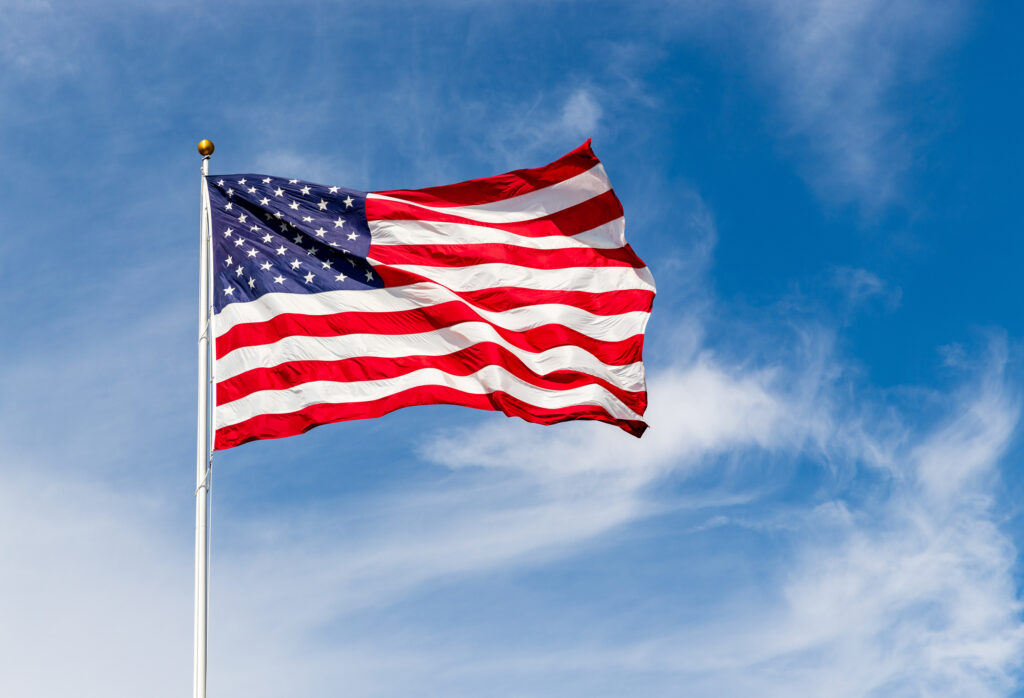
June 14 is Flag Day in the US. It is a special time to unfurl our nation’s banner and wave it proudly. We can credit several people for the stars and stripes, starting with the Father of Our Country, George Washington. When the Revolutionary War was being waged, each regiment fought under its own flag, creating a worry that the colonists appeared disorganized.
During the Second Continental Congress, a new flag, composed of 13 red and white stripes with a Union jack in the corner, was adopted as “the Continental Colors.” Soon after this, Washington was named the country’s leader and one of his first acts was to change the flag’s design. He felt a flag even remotely close to the Brit’s was not very unifying. And he didn’t want to give the George across the sea any ideas.


On June 14, 1777, a resolution was passed that created a banner with 13 alternating red and white stripes for the colonies with their union represented by 13 stars on a blue background. Fast forward 139 years later, President Wilson marked the anniversary of that decree by officially establishing June 14 as Flag Day.
Elizabeth Griscom Ross, better known as “Betsy” is credited with designing the new flag, but the historical data on her role is in question. While she may have been the one to arrange the 13 stars in a circle, it’s believed that Francis Hopkinson, a New Jersey delegate, was the one to whom the credit goes.
Most Americans are familiar with the “Star Spangled Banner” by Francis Scott Key penned as he witnessed the Battle of Fort McHenry during the War of 1812. While the lyrics give us a clear picture of the blazing bombshells, during which the flag swayed valiantly, we may not know that the words were set to the tune of a popular British drinking song, “To Anacreon in Heaven.”
The first formal observance of Flag Day was in 1885 at a grade school in Waubeka, Wisc., when teacher Bernard Cigrand engaged his students in a celebration. Cigrand carried his idea around the country, promoting patriotism and respect for the flag.
He later moved to Chicago to become a dentist, and editor-in-chief of the American Standard, a magazine promoting the work of the Ku Klux Klan. While he has been referred to as the “Father of Flag Day”, few agree he was the best role model for the title.
Others, such as Sarah Hinson, a Buffalo, NY. teacher began Flag Day exercises before the turn of the century by having students salute the flag and repeat the Pledge of Allegiance in the classroom. At about the same time, Elizabeth Gillespie, president of the Colonial Dames of Pennsylvania pushed to have the flag flown from all Philadelphia’s public buildings.
The Benevolent and Protective Order of the Elks requires its members to claim allegiance to the flag and many lodges observe the day with special celebrations. They were also one of the larger groups to press President Wilson to commemorate the day.
Wilson wasn’t the only president to embrace the significance of a Flag Day. In 1942, Franklin D. Roosevelt launched “United Flag Day” – sometimes called “United Nations Day” to show solidarity with the WWII Allies. For several years following FDR’s observance, New York City held a “New York at War” parade.
The week that includes Flag Day sees several observances across the US. Flying the flag from public buildings, parades, and flag-raising ceremonies are popular. Competition for which city has the longest-running history of parades puts Fairfield, Washington, Appleton, Wisconsin, and Quincy Massachusetts into the mix. Each one claims the title, with Troy, New York, boasting that it draws the largest crowd, with an average of 50,000 spectators.
Flag etiquette is necessary to give Old Glory the correct respect.
Flying a flag upside down is not always a sign of protest. It can also be an official distress signal. Draping a coffin with the American Flag is not reserved for military and government officials. Any burial can incorporate the flag.
Flag burning during the Vietnam War got protestors in trouble. Twenty years later, the Supreme Court took away the penalty for such an act, claiming it a First Amendment right. However, burning a damaged flag using the established protocol has always been acceptable.
Flags lowered from their poles must not touch the ground. Moreover, rugs and carpets featuring the Stars and Stripes are barred by the Flag Code. The Code also requires that when the flags of cities, states, or groups join the US Flag on a pole, they must never be larger than the US banner, and always appear underneath.
Adding a logo, drawing, or marking on the flag is prohibited – although some politicians have been known to sign flags for supporters, which is a Code violation. In addition, the Stars and Stripes should never be used as apparel, bedding, or drapery.
The United States Army shares its birthday with the flag, as it was established on the same day the Continental Congress adopted the new flag. Notable Americans who share a birthday with the flag are author Harriet Beecher Stowe, actors/singers Burl Ives, Gene Barry, and Dorothy McGuire, and photojournalist Margaret Bourke-White.
The US is not the only country to celebrate Flag Day. Mexico, Albania, Argentina, Australia, Columbia, Ecuador, India and Italy are the many other parts of the world that pay homage to their homeland’s flag.
This year, proudly fly your American Flag. George would approve. Our George, that is. Not the other one.