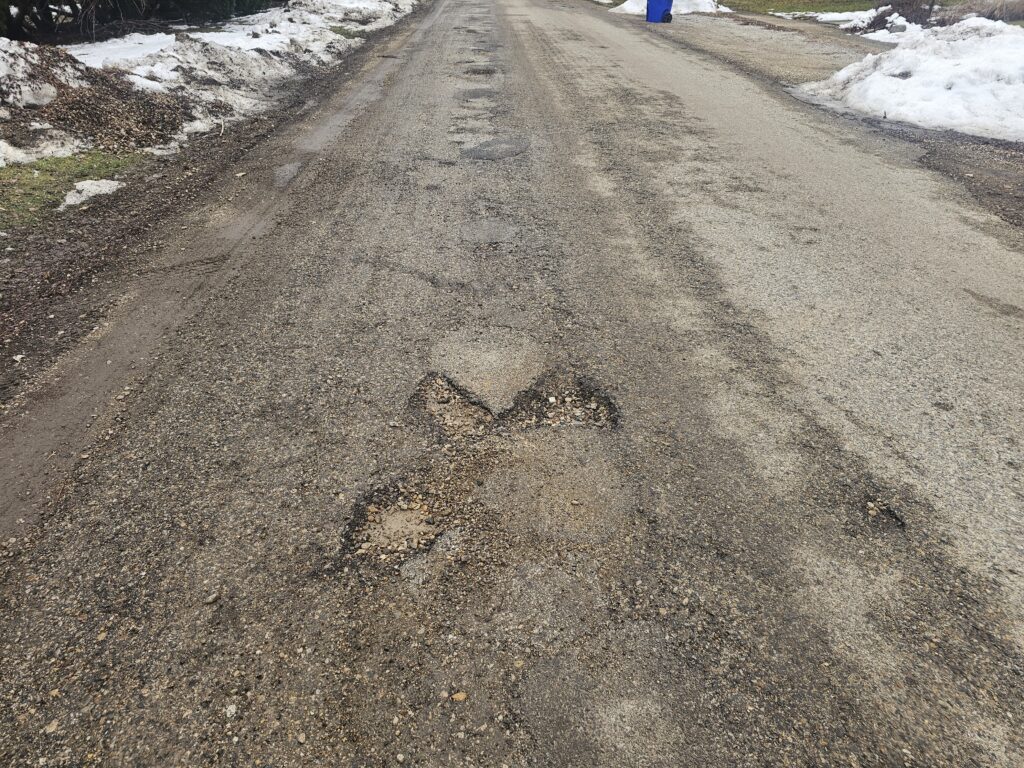
(This article is the last in a four-part series examining the state of the Kewanee streets; the scope of the problem; the cost of fixing them and the cost if we don’t. Mike Berry and Susan DeVilder contributed to this series.)
The road to convincing Kewanee taxpayers that a sales tax hike is the answer to the city’s street predicament could be bumpier than North Main Street. But a push by city officials to win over the hearts and minds of residents is in the works.
The Kewanee City Council passed an ordinance in December of 2023 that placed a question on the March 19 ballot asking voters to approve a half-cent sales tax increase to pay for future road and sidewalk repairs. Passing the ordinance was the easy part. The hard part will be convincing a majority of residents to head to the voting booth to vote yes. For that reason, city officials have included a public education campaign into their plan.
City Manager Gary Bradley said that residents can expect to start seeing informational posters and boards placed in spaces around town, such as the Kewanee Public Library. The hope is that people will learn more about what’s at stake when it comes to the future of Kewanee roads.
Public Works Director Kevin Newton is warning the community of the dire situation and said that waiting any longer to repair the streets will cost more money as construction material prices rise and the condition of city streets quickly deteriorate.
Kewanee Mayor Gary Moore said the purpose of the public education campaign will be to alleviate the fears and the falsehoods about the tax.
“That is important in today’s society where so much information, right or wrong, is available through social media,” said the mayor.
Moore said some of the information on social media about the tax is completely wrong or even in the best case scenario, only partially right.
“It is the goal of the city to give people information that is correct, thorough and transparent,” he said.
Moore said that the city council wants residents to fully understand what is meant by some of the ballot question language, such as sunset tax.
“Basically, a sunset tax will have a defining beginning and end. The idea is to estimate the length of tax period to coincide with the time needed to complete the project compared with time needed to raise enough money to cover the cost of the project,” he said.
But while the tax will expire in 10 years, the hope is for the community to see enough progress on road conditions that they will agree to renew the tax in the future, said City Manager Bradley.
Since passing the ordinance allowing the ballot question, Mayor Moore said he has been holding conversations with many residents and the response has been overwhelmingly positive.
“Some residents have expressed concerns that revenues generated from this tax would be used for other purposes, or the idea of it being a ‘sunset tax’ would be lost, and the tax would continue beyond the original purpose,” he said.
But Moore said that the purpose of sunsetting the tax was to “protect the interest of every resident of Kewanee,” and said the state will not continue to collect the tax after it expires. The annual audits, he said, ensures that the proceeds are used only for the intended purpose.
“Unfortunately many people have an inherent distrust of anything governmental,” Moore said. “I say it’s unfortunate because there have been so many instances where the government has deceived constituents. The ballot language for the proposed tax was intentionally restrictive.”
The goal of the tax increase, he said, is to provide the residents and businesses of Kewanee and all who visit the community with decent streets and sidewalks.
“Kewanee residents have made it abundantly clear they are not happy with the overall conditions of our streets,” said Moore.
The city does receive state funds from the Motor Fuel Tax, based on population and not on the amount of fuel purchased, nor the condition and miles of road. The mayor also stressed that Kewanee has never added additional tax to the gas prices paid at the pumps in Kewanee, and applies every cent of the MFT towards the road program.
“It has become abundantly clear, the MFT is not a sustainable solution to giving Kewanee residents the roads they deserve,” he said.
Moore cited the sagging infrastructure below the streets as part of the issue. Much of that infrastructure has been ignored for so long, that repairing a road over crumbling infrastructure makes little sense when newly surfaced streets will need to be torn up to fix a broken water pipe.
“Repairs need to be made from the bottom up,” he said.
The tax, Moore said, will give the city an opportunity to put a preventive maintenance program in place for streets, something he has been trying to implement for the past five years.
“In climates like we have in Illinois, we have moisture. Weather-related moistures seeps into cracks in our street,” he said.
That moisture then freezes, expanding the cracks and worsening them. A proper preventative maintenance program will help to keep moisture from entering the streets and creating the potholes in the first place.
Moore said because of the Illinois weather, the town will continue to have potholes, but the number and severity could be reduced with preventative maintenance.
“It is important that people understand, even with the successful passage of this proposed tax, there will still be a process. Not every street in the city limits will be fixed immediately. This process will take years to complete,” said the mayor.