“The only thing that you absolutely have to know, is the location of the library.” – Albert Einstein
(On March 14, 2025, the President Donald J. Trump signed an executive order which, in part read:
“(a) . . . the non-statutory components and functions of the following governmental entities shall be eliminated to the maximum extent consistent with applicable law, and such entities shall reduce the performance of their statutory functions and associated personnel to the minimum presence and function required by law:
. . .
“(iv) the Institute of Museum and Library Services;” . . . (Emphasis added.)
On March 31, the IMLS staff was placed on administrative leave via email. Here are excerpts:
“This is to inform you that you are being placed on administrative leave (i.e., non-duty paid status) starting today, Monday, March 31, 2025. . . . You may leave your laptop and work cellphones on your desk or in your office. . . . All email accounts will be disabled sometime today. . . .”)
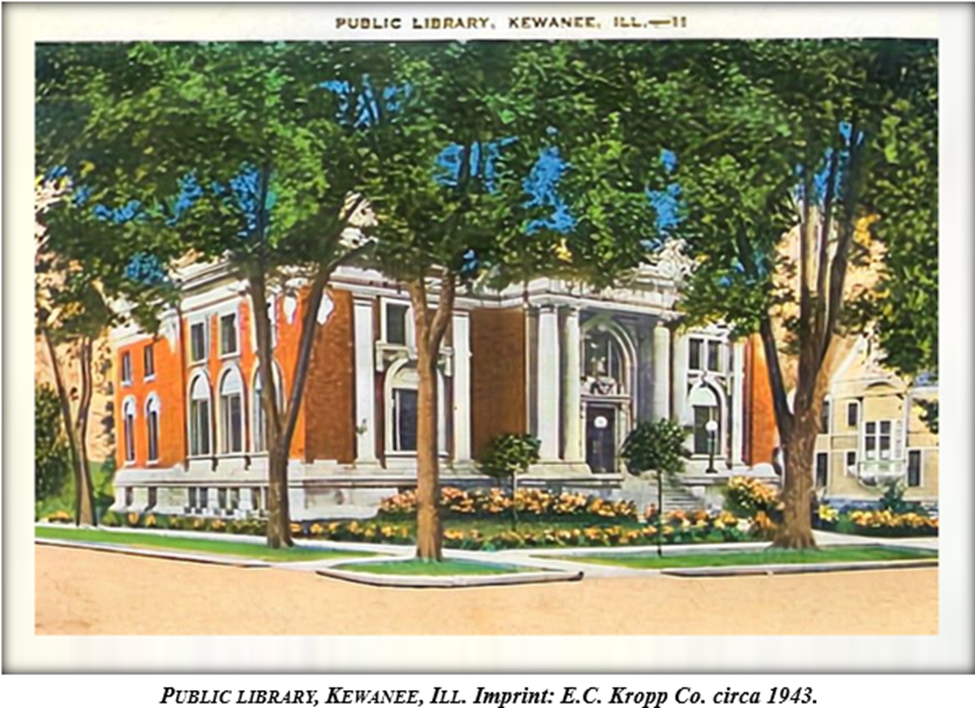
This year marks the 150th anniversary of the founding of the Kewanee Public Library. I’ve revised one of my previous stories of the library’s birth for the occasion.
One of the fondest recollections I have of elementary school is of the weekly trip to the library.
I remember the Kewanee Public Library as a majestic, warm, inviting place, filled with adventure and ideas, all at my fingertips. I sailed the seas with wayfarers, crossed treacherous mountain passes with pioneers, and heard Abe Lincoln speak to me.
I remember one of my teachers, Mrs. O’Neill, at Visitation, posting a sheet of paper on the wall at the back of the classroom on which we were to record the titles we read each month.
I remember checking out book after book after book. When the school year finished, I endlessly pestered my mom to let me go to the library on my own, maybe as much as I pestered her to let me go out to play baseball with my friends.
So how did the library come about? Larry Lock has written a brief history about it, which can be found at the Kewanee Historical Society, along with photos of the building. Sarah Sagmoen also has written a detailed history of the library, which can be found on the library’s website, also along with photos.
Here’s my quick summary of what I learned of the library’s history from those experts and other sources.
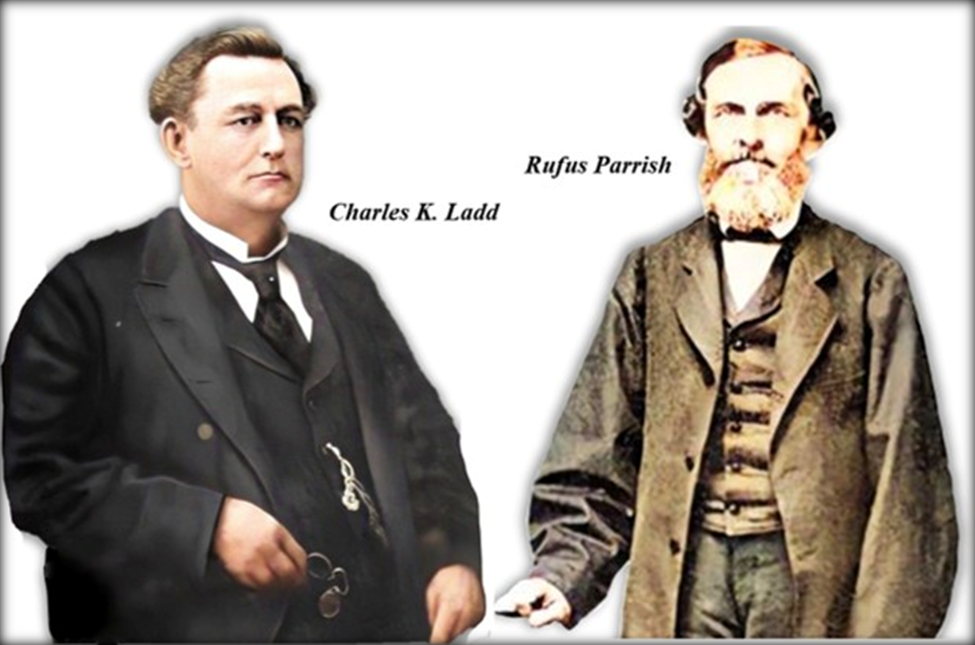
Bookstore owner Rufus Parker Parrish’s passion for books and learning made him a driving force behind the establishment of the library. Parrish was the library board’s only president from its inception until he died in 1903, elected year after year without opposition.
But well-known Kewanee attorney and prominent citizen Charles K. Ladd has been called by many the father of the Kewanee library. In Ladd’s May 28, 1908, obituary, the Kewanee Daily Star Courier said that “[t]he Kewanee public library movement . . . originated in the law office of Mr. Ladd. He had a store of books in one of his apartments and encouraged the idea of a public reading room. . . . To give the institution further material for growth he [later] contributed 500 volumes from his library and these are today on the shelves . . . .” Charles Ladd later made another gift of 1,500 volumes. His respect for the written word is reflected in the 4,800 volumes in his private law library at the time of his death.
Those who met in Mr. Ladd’s office discussed how to go about establishing a library. With the help of the state, they soon were able to move forward.
In 1874, two years after the state enacted a library law, Kewanee Township took advantage of the law to hold an election for a proposed one mill property tax for funding a library. Although it met with some opposition, it was carried by a majority of the voters.
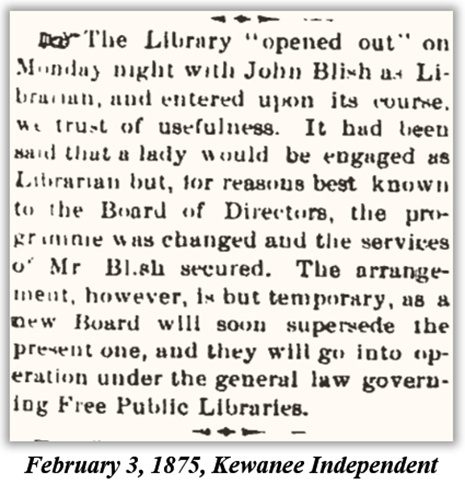
The next year, the Kewanee Library Association was formed, and on February 1, 1875, the library had its grand opening in the newly built town hall, aptly named “Library Hall.” The library, located in the northwest corner of the first floor of the building located at the northwest corner of Tremont and Third Streets, contained 262 books. The first librarian was John G. Blish, and the library was open to township residents during evenings and Sunday afternoons.
In 1875, the association was renamed the Kewanee Public Library.
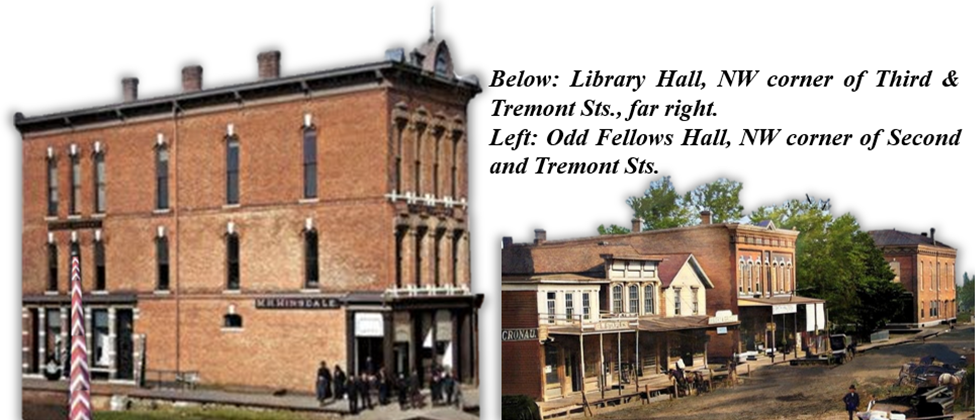
By 1880, the library outgrew its allotted space as city government grew, so the directors relocated it to the second floor of the Odd Fellows Building on the northwest corner of First and Tremont Streets.
At the same time, citizens approved another one mill tax levy to the maximum rate allowed so the library could maintain its building and grow its mission.

Once again strapped for space because of increasing patronage, an individual, Alexander McLean, wrote to Andrew Carnegie in 1901 to ask for a library grant. Carnegie agreed to contribute $20,000 for a library, but on two conditions: The township had to purchase a site, and it had to generate an income of at least $2,500 a year. The township failed to come up with the money needed, and Carnegie refused to double his gift.
In 1905, James K. Blish drafted, and the Illinois legislature passed, a bill that allowed libraries to borrow money to purchase sites for township libraries. As a result, the directors purchased a site on the corner of First and Tremont Streets.
The directors then began planning for the new library, but realized that, even with the Carnegie money now available again, they would fall short. Fortunately, Carnegie agreed to add another $5,000 to his grant, and the township voted to contribute an additional $15,000. With $55,000 in hand, the work could begin.
After a search, the directors hired well-known library architects Patton and Miller of Chicago to design the library. Nels Branquist was retained for the masonry work and Peter Swanson for the carpentry work.
Volunteers began reorganizing the books by the Dewey Decimal Classification and set up a card catalog for the first time. Community women raised money for new children’s books.
In January 1907, the building’s cornerstone was laid, and on April 21, 1908, the new library was dedicated. At the time of its opening, the library’s collection had grown from the original 262 books to over 9,000, with a capacity of up to 32,000.
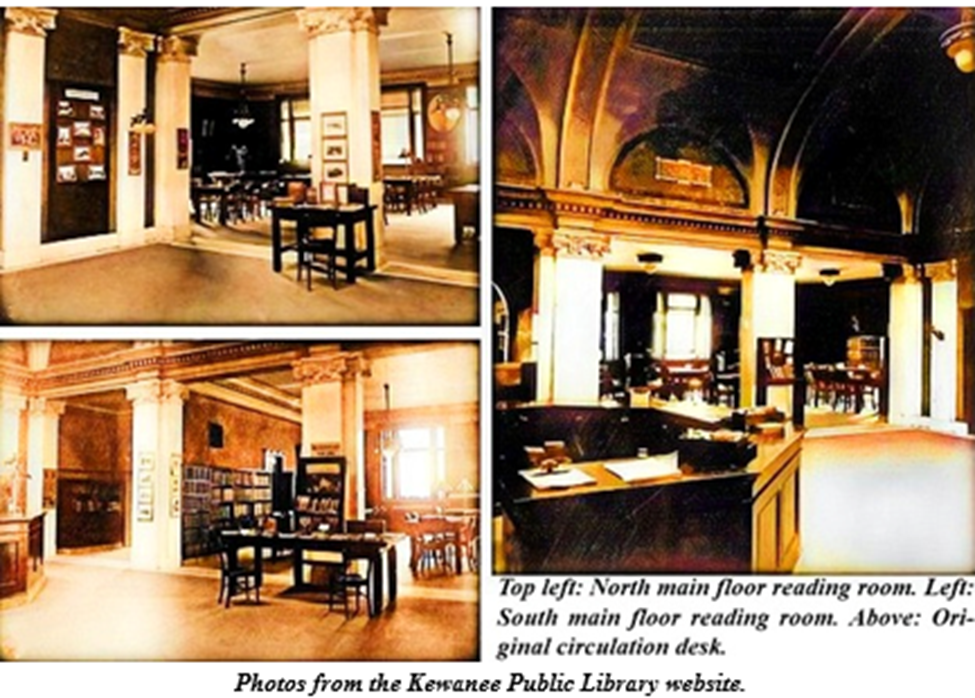
When I returned to Kewanee a few years ago for the first time in decades, the library was one of the first places I visited. It was like traveling back in time. All of my memories came flooding to the fore as I soaked in the special beauty of the space.
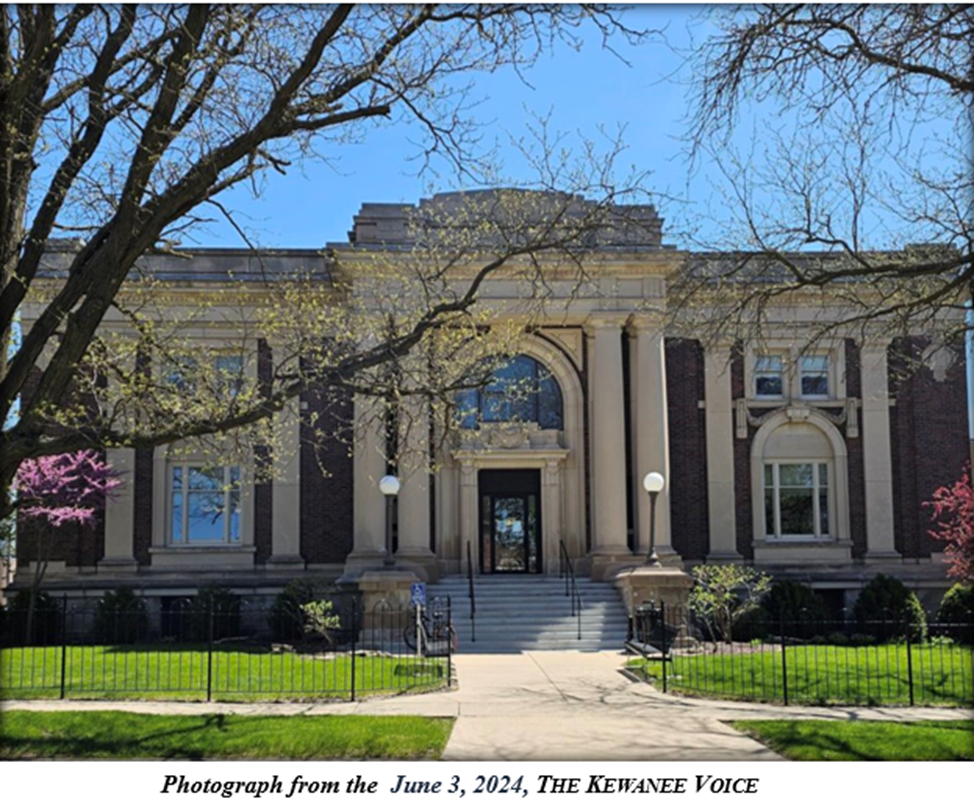
In the 2006 registration form for designation on the National Register of Historic Places, John E. Sayers wrote this elegant description of a beautiful space:
“[T]he building is an excellent example of the Classical Revival style building with both Classical Revival and Arts and Crafts represented on the interior. . . . [It’s] emphasis on symmetry, classical columns and pilasters, elaborate stone ornament and foundation, entablature with dentils, and frieze with metopes and triglyphs, are all characteristics of the style. On the interior, Classical Revival features include the moldings, dentils, and piers, while the Arts and Crafts influences are seen in the art glass window above the entry and the metal balusters on the staircase.”
A library is, first and foremost, an indispensable collection of the expressions of ideas of the human experience. But, in addition to bread, we also need roses, and a library can be a beautiful place to view the world. Thankfully, for a century and a half, Kewanee has had both the collection and the beauty.
Let’s hope that the Kewanee Public Library can withstand the onslaughts on the accumulation of knowledge.
A March 20, 2025, National Public Radio story reported that the Institute of Museum and Library Services is:
“an independent federal agency responsible for awarding grant funding to many museums and libraries across the country. . . .
“While libraries are mostly funded by city and county taxes, federal funding helps pay for things like workforce training, supports pilot programs, and bolsters basic library services such as computer and internet access in rural libraries (Emphasis added). The IMLS says it awarded $266 million in grants and research last year.
Jeff Jankowski, president of Hoopla Digital, which helps library users access eBooks, music, movies and audiobooks, sent NPR a statement that warns ‘without necessary funding, it’s likely that many libraries may be forced to scale back digital services, or in some cases, eliminate access entirely.’
“[T]he American Alliance of Museums, a group which advocates for museums, issued a statement saying: ‘There is no efficiency argument when IMLS represents just 0.0046% of the federal budget, while museums generate $50 billion in economic impact.’“