Soon after the founding of the Wethersfield Colony in 1837, the settlers built a small hewn-log meeting house on the northeast corner of Tenney and Church streets. In 1839, the Colony opened the first school.
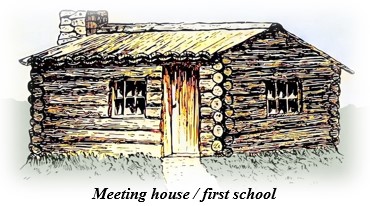
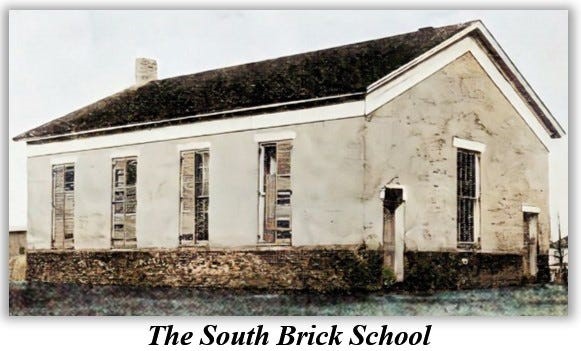
In 1850, after the Wethersfield Congregational Church built a new edifice, the school trustees moved the log school to the other side of Tenney Street and a block north on land acquired for a school campus. In 1856, the Wethersfield Baptist Church stopped construction of a building on the west side of Tenney Street between McClure and Church streets. The Wethersfield school trustees acquired the building for use as a school, later known as “the South Brick School.”
Soon after the founding of Berrien in 1854 (renamed Kewanee a year later), the new village turned its attention to schools. In 1855, Wethersfield and Kewanee pioneer Dwight Needham built a home on the west side of Tremont Street just south of its intersection with Second Street. With no schools in the fledgling village, Needham opened the doors of his new home for use as the first private school in Kewanee. Its first and only teacher was Miss Martha A. Hooker. But that was at best a very temporary solution.
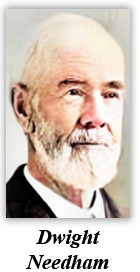
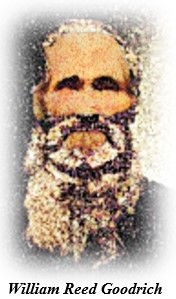
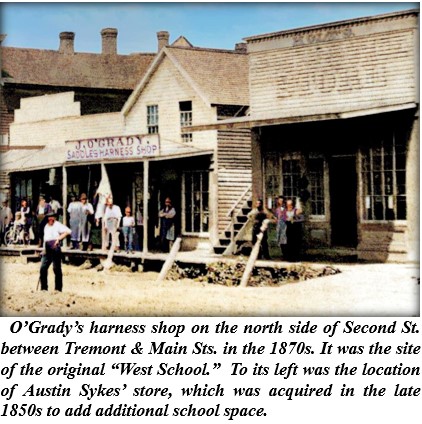
Therefore, in the same year, Nelson Lay, Henry G. Little, and Sullivan Howard hired William R. Goodrich to construct a small building on the north side of Second Street, midway between Main and Tremont streets, to house a school. Goodrich, the son of Rev. Joseph Goodrich, another Wethersfield pioneer, had been born in Hilo in the Sandwich Islands (today’s Hawaii) when his father served as the first Congregational missionary there. Goodrich built what soon became known as the “West School.” Hiram T. Lay, Nelson Lay’s then 14-year-old son and later owner of the largest mercantile store in Kewanee, recalls helping Goodrich nailing shingles on the roof of the building.
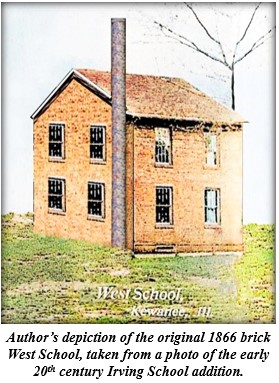
The new West School was still a private school, attended by children of the new Kewanee families of Howard, Little, Lay, Tenney, Needham, Goodrich, and Slocum, as well as others. Miss Hooker was hired to teach at this new private school, and she was later joined by Mrs. Eliza Ann Hawkes, who lived out by Mud Creek, north of town.
The schoolhouse was used for civic and other activities. For instance, when the Congregational Church congregation moved from Wethersfield to Kewanee in 1856, it held its Sunday school and Sabbath services in the West School before moving to the larger Cutter’s Hall on the northeast corner of Tremont and Third streets.
Another of the early Kewanee schools was first conducted in a small frame building put up by George A. Morse just north of the railroad tracks on the west side of Main Street. Morse had planned to live there, but changed his mind and donated it for education. School was held there for almost two years.
Austin Sykes had built a store just to the west of the West School. By 1858, Sykes rented it to the school trustees for additional class space for the school. The trustees also rented an upstairs room in Shriver’s Philadelphia Store, located on the east side of Main Street between Second and Third streets, for more class space.
Also in 1858, the trustees sold the old one-room school building on Elm Street and replaced with a new two-room school on the same site. (That old Morse building was moved again to the southwest corner of Tremont and Third streets where it served as the office of the newspaper, “The Henry County Dial.” It later was moved once more, to be used as a church and then as a dwelling.) Meanwhile, Kewanee and Wethersfield did not neglect education beyond the elementary level.
In January, 1856, citizens of Wethersfield and Kewanee formed an association to create a seminary for higher education which was unavailable from the existing schools. The association held a second meeting in February, and together they raised over $5,000. The association then appointed a committee to draft a constitution and by-laws, comprised of M. B. Potter, G. A. Morse, j. H. Howe, J. F. Willard, H. G. Little, and O. H. Loomis.
The association wanted to build its school near the line separating the school districts, which was a quarter of a mile north of the Wethersfield township line. James Elliott donated two and a half acres of land on the west side of what would become South Chestnut Street when it was extended from the original village.
In May, the association began construction of a two story, 40 ft. x 60 ft. building with a cupola housing a bell. They completed construction by the end of the year.
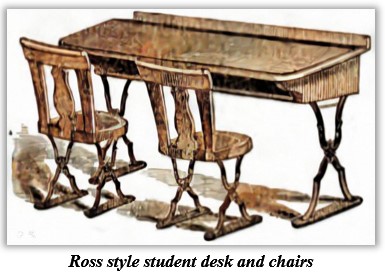
In early 1857, the association hosted an open house for the new school, and those attending expressed “the highest gratification” of the seminary. It was furnished with Ross school desks and was “fitted up in the best and most modern style.”
The school was officially called the Union Seminary, but eventually became known simply as the “Old Academy.” It began its first term in April 1857. Tuition ran $4.00 per quarter for common school studies and $5.00 per quarter for advanced branches and languages, with extra charges for music, drawing, and painting. The school promised the availability of nearby boarding.
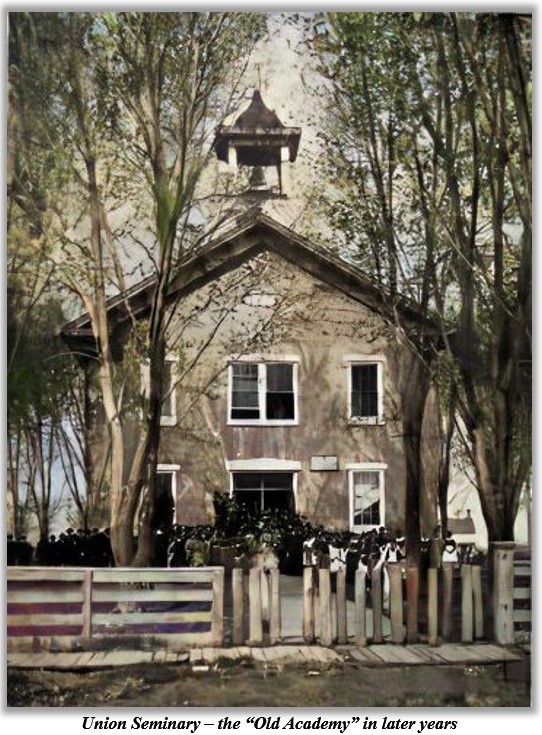
Only the second floor of the building was used for the school. The first floor was given over to use for lectures, lyceums, and a public hall. Newspaper publisher Horace Greeley, of “go West young man, go West” fame, spoke there, among others.
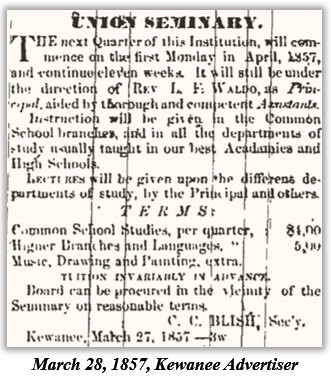
The first principal was Rev. Mr. Waldo, and he was assisted by Miss Atwood. The academic year was divided into three terms:
In the beginning, the school was quite a distance from where most Kewaneeans lived, that is, nearer to what is now downtown. The streets were in a constant muddy state in the winter months and there were no wooden sidewalks extending to it. So, a large wagon was pressed into service to transport most of the Kewanee students to and from the school.
But the private seminary was short-lived. In 1855, the Illinois legislature had mandated a free public school system. In early 1858, the seminary stockholders offered to give the Kewanee and Wethersfield school districts the building and the grounds for the purpose of a free union high school, provided the districts assumed the stockholders’ debt of between $2,000 and $2,500. Both districts voted to accept the proposition. Kewanee and Wethersfield, operating together, were in the business of providing a 40-week per year, free public high school education to the students in their districts. (Students outside of the districts still paid tuition.)
Unfortunately, discord developed between the two villages. In August 1870 at the Kewanee school district election, voters agreed to purchase Wethersfield’s interest in the high school. The sale included the building, the furnishings, and the quarter mile strip north of the Wethersfield Township line.) Kewanee’s growth continued, and its need for additional school space grew as well.
In 1862, because of the coal mines to the northwest of the city in what was then known as “Coal Valley” and the number of families living there, a one-room school was built on Cambridge Road. James A. Lyons built the schoolhouse for $430 on land purchased from Hosea G. Searle, a quarter acre off the northwest corner of the southwest quarter of Section 28. Known variously as Coal Valley, Coalville, Northwest, and Northville, with the latter becoming the most common name for the school, which operated for 20 years. (In the 1880s, while it was being moved to the East School “campus,” it burned down.)
In 1864, a duplicate of the Northville school was built in the northeast corner of Section 28 on what was known as North East Street Road, one mile north of the corner of Lake and East streets. It was built by H. Searle but at an increased cost of $735. The school became known as Northeast or Maunders School. (It was a rural district school until 1948, when it became a community unit district school.)
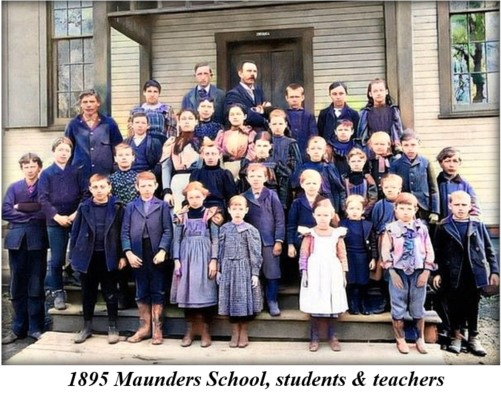
In 1865 the East School again had become wholly inadequate for the needs of that side of the village. In 1866, the school was enlarged to double its size. Over time, it became known as “Old Brown.” (In the late 1870s, two other small buildings were moved to the site, creating sort of an educational campus. A third building, the old Northville School, burned down during an attempted move to the campus.) At the same time and for similar reasons, the trustees decided to replace the old West School on Second Street with two new brick schools to the west and northwest of the expanding village.
One of the two nearly identical two-room brick schools was located on the south side of South St. (today’s Central Blvd.) between Grove and Cottage steets. It was variously known as West Brick, West Side, West, Grove, and finally, in 1899, Irving School.The second brick school was located at the northeast corner of Sixth Street and Cambridge Road, north of the railroad tracks. It was variously known as North Brick, North Side, Northwest, and, in 1899, Franklin School.
After the new West School was occupied, the W. R. Goodrich-built structure was acquired by James O’Grady for his wagon and harness shop business. Sykes’ former building was acquired by Elias Lyman and Hiram T. Lay, the owners of the “5 or 8 Store” on Tremont, for use as a grocery store. Shriver’s Philadelphia Store later moved to the corner of Tremont and Third streets. There were no more schools in what was the original village.