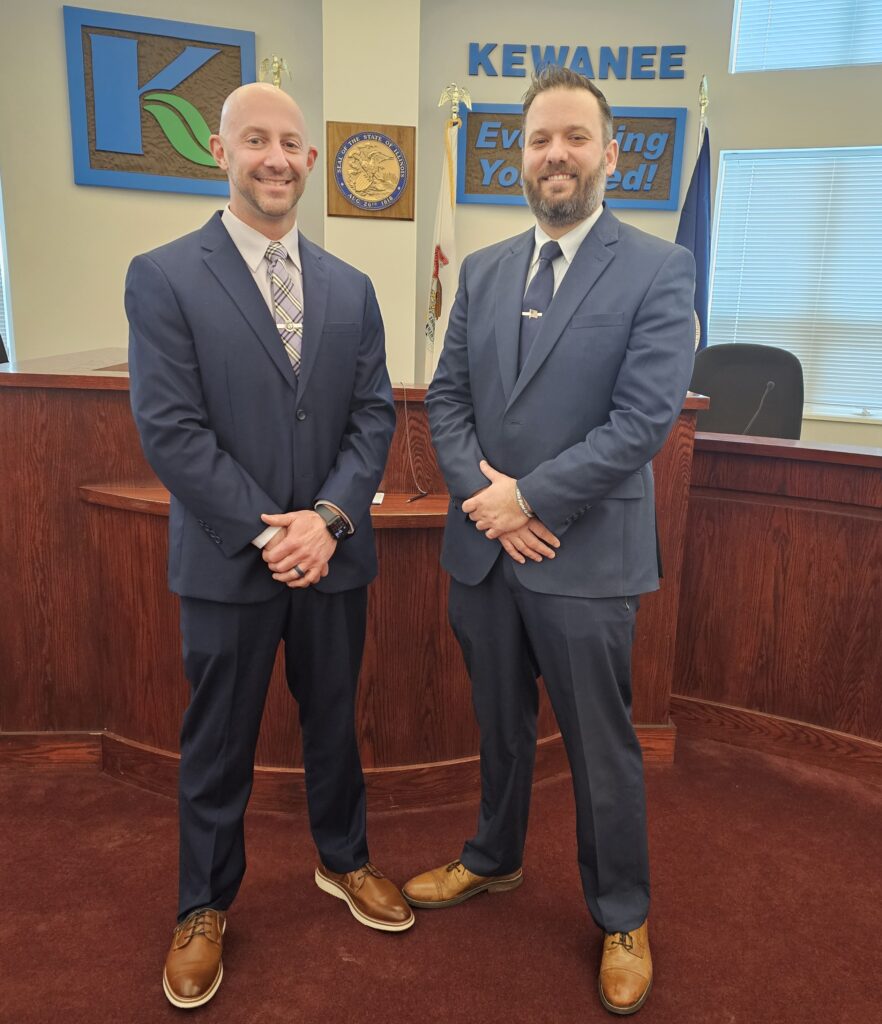
It was never supposed to happen so soon, but for Stephen Kijanowski and Michael Minx, their new roles within the Kewanee Police Department came years ahead of schedule. On Nov. 13, 2023, they were officially sworn in as Chief and Deputy Chief of the KPD.
Kijanowski was just settling into his role as Deputy Chief and Minx was enjoying his duties in investigation and advancing the department’s technology when former Chief Nicholas Welgat was diagnosed with lung cancer.
Welgat’s diagnosis came as a blow to his family foremost, but was felt deeply by the community and the officers within his department, who looked to Welgat to reshape the force and mold the next generation of local law enforcement.
With Welgat retiring as chief, that job now fell to Kijanowski. He and Minx were always the most likely choices to receive the passed torches, but they expected it to happen well down the road.
“For me, Nick had a plan,” said Kijanowski. “He came to me when I was a sergeant and wanted me to be his deputy chief. But I didn’t know if I wanted it. But I wanted to support him.”
When he took on the role of Deputy Chief, he took on Welgat’s goals of community policing, outreach and programs such as DAART and National Night Out.
Welgat’s and Kijanowski’s law enforcement roots are intertwined and reach far back. They both attended the police academy together and were hired by Kewanee in June of 2006. They both helped start the Street Crimes Unit, along with John Jagers, something Kijanowski still points to as his favorite accomplishment.
Kijanowski didn’t grow up in Kewanee, but in Elmwood and moved to Kewanee after being hired onto the force. He and his wife, Melissa, have three children. He was promoted to sergeant in 2014 and later hired as Welgat’s right hand man.
Minx joined the force just months after Kijanowski and Welgat. Born in San Diego, he moved to Northbrook, Illinois and graduated from Glenbrook North High School in 1998.
He went to Western Illinois University in Macomb, and tested with the Kewanee Police Department.
“Kewanee was the first to offer me a job,” he said.
He was hired on Jan. 29, 2007, and found he liked life in Kewanee.
“I really liked the community. Amanda, my wife, is from Kewanee,” Minx said. The couple have two children.
Minx started as a patrol officer and moved into investigation just five years later in 2012.
“I would say one of the biggest accomplishments was advancing technology in the Kewanee police department,” he said. “Technology that we’ve learned has helped us solve some big cases,” and they acknowledge the city council and the Henry County State’s Attorney for helping to purchase various investigative technologies.
Minx’s biggest and most impactful case involved technology and undercover work where he assisted Geneseo in catching a subject suspected of targeting 60 local kids. Minx said the case was impactful because it helped save countless more victims.
While they credit Welgat’s leadership for helping shape the kind of officers they are today, all three of them, Kijanowski, Welgat and Minx, grew into their roles as police officers early in their careers.
“Nick and I started together. Mike started six months later,” said Chief Kijanowski. “We had the same philosophies and moral background.”
As a young patrol officer, Kijanowski was an aggressive ticket writer and by parking a patrol car on West South Street, an officer could write a hundred tickets a day, he said. But one ticket in particular, changed him and he can still vividly recall the incident.
Kijanowski said he pulled over a female driver who was speeding on West South Street. Speeding there accidently was easy to do, he said, because the speed was reduced on that stretch to 30 mph and sometimes people forgot. He pulled over the driver and ticketed her and didn’t give it much thought.
But later, the woman came into the police department to pay her fine and her young son accompanied her. Kijanowski said he will never forget overhearing her tell her son that she couldn’t afford to buy him his shoes because she had to pay the ticket. He immediately regretted ticketing her and had to stop himself from paying the fine. It deeply affected him, he said.
“I questioned what we were doing,” he said. The incident stuck with him and still does to this day.
Minx’s lightbulb moment on community outreach and policing came early. He was a college student when he rolled into Monmouth and failed to slow down off the highway quickly enough. He was pulled over by an officer who refused to listen to his explanation.
“He wanted nothing to do with my explanation. It was black and white and he didn’t even want to listen,” Minx recalled.
When he went to Monmouth to pay the fine, the college student was a few dollars short and was forced to scrape up extra change from his car.
“It’s a balancing act between showing leeway and kindness and public safety and enforcement,” he said.
That philosophy of policing with compassion was cemented by Welgat and it’s still the culture carried on in the department by Kijanowski and Minx.
“It’s good to be aggressive but it’s important to have a heart for it,” Kijanowski said. “Have a little patience and remember, our goal is to serve citizens.”
Minx said oftentimes it’s unnecessary to write a ticket when a warning serves its purpose.
“Nick’s philosophy is you don’t have to give a ticket to correct behavior,” Minx said. Sometimes just explaining why the law is in place is enough, he said. If you don’t wear a seatbelt and have to swerve, the momentum of the car when it swerves can throw you off and make it difficult to control the vehicle. Often that explanation is all that drivers need to buckle up, he said.
“Have compassion for people and be mindful of the constitution. If a written warning can correct behavior, that’s the best route to go,” said Kijanowski.
Just months into their new positions both men say they struggle at the administrative part of the job. Kijanowski enjoyed being out in the community and now much of his time is spent doing paperwork.
“We have a team approach as administrators,” said Kijanowski.
Minx is still playing a dual role since the police department, with 28 staff members, is still a few officers short. Not only is he deputy chief but he is still an investigator for the department. Minx, along with Lt. Justin Reed, who also performs a dual role within the department, has taken on the duties of training coordinators.
“Sergeants too are stepping up to have a little more responsibilities as well.” the police chief said.
Kijanowski said the department is still focused on the plan put in place by Welgat.
“When I took the role as deputy chief, Nick had a plan to bolster community policing. The ideas that we have in place and the mindset will continue for the next several years. We don’t want to put too much on our plates. We’ll continue on with our key strategies,” said Kijanowski.
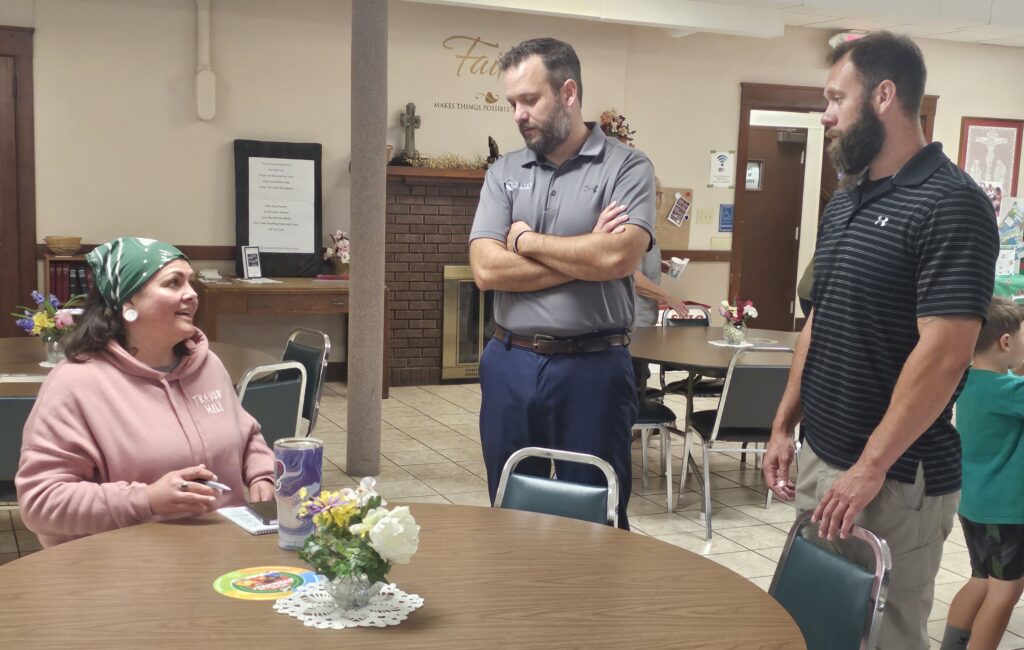
Those key strategies include community outreach programs like DAART, Lunch and Learn at the high schools, church and church group programs and outreach to community children, in events such as National Night Out and their annual participation in Kid’s Day during Kewanee Hog Days. They even purchased their own dunk tank for the event.
Major long term goals include waiting for a recruitment and retention grant, which they will use for specific targeting and technology for recruitment since they have found that career fairs aren’t as productive. Other projects down the road include an overhaul of the department’s body cameras, which have fallen behind on the technology side.
They would also like to recruit another officer for the Street Crime Unit, but it all comes down to dollars and sense, Kijanowski said.
Both men are settling into their new roles that are starting to become more defined, but the adjustment has required teamwork and learning as they go along.
“We care deeply about this department,” said Minx, “and we want to continue to see it grow and advance.”
For Kijanowski, it’s both a challenge and learning process on a path paved well by his former chief. “I want to carry on with the path, the idea of being a law enforcement agency that does what we have to do but continues to serve the community.”
The chief’s biggest fear, he readily admits, was stepping into big shoes left behind by Welgat and failing.
“But I have good people supporting me. It’s much easier to be a chief of a department that supports our vision and our mission,” he said.