The RMS CARPATHIA was a transatlantic passenger steamship launched in 1903. In 1912, she became famous for rescuing 705 survivors of the Titanic after it struck its infamous iceberg.
But most important to our story, the CARPATHIA later hosted Kewanee banker John Fischer, his wife, Etta, and their two sons, Emmons and Lyle, on what they called their “grande tour.” And it was on this tour that the fortunes of Fischer intertwined with those of Earl Derr Biggers, who later authored the Charlie Chan Mysteries.
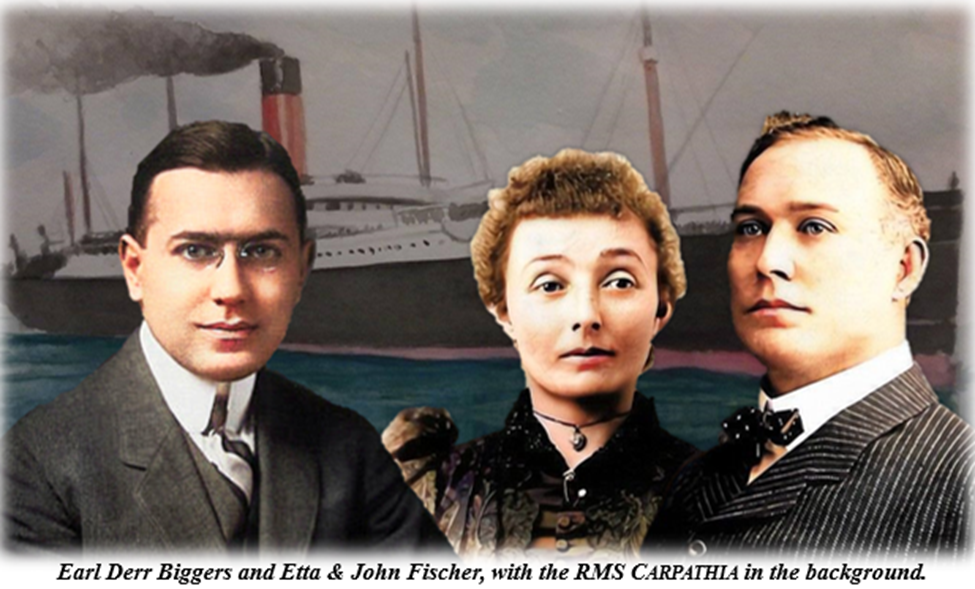
Biggers was born in 1884. He graduated from Harvard University in 1907 (where he was a member of The Harvard Lampoon) and then worked as a journalist for five years before successfully turning to writing fiction. Many of his plays and novels were later made into movies.
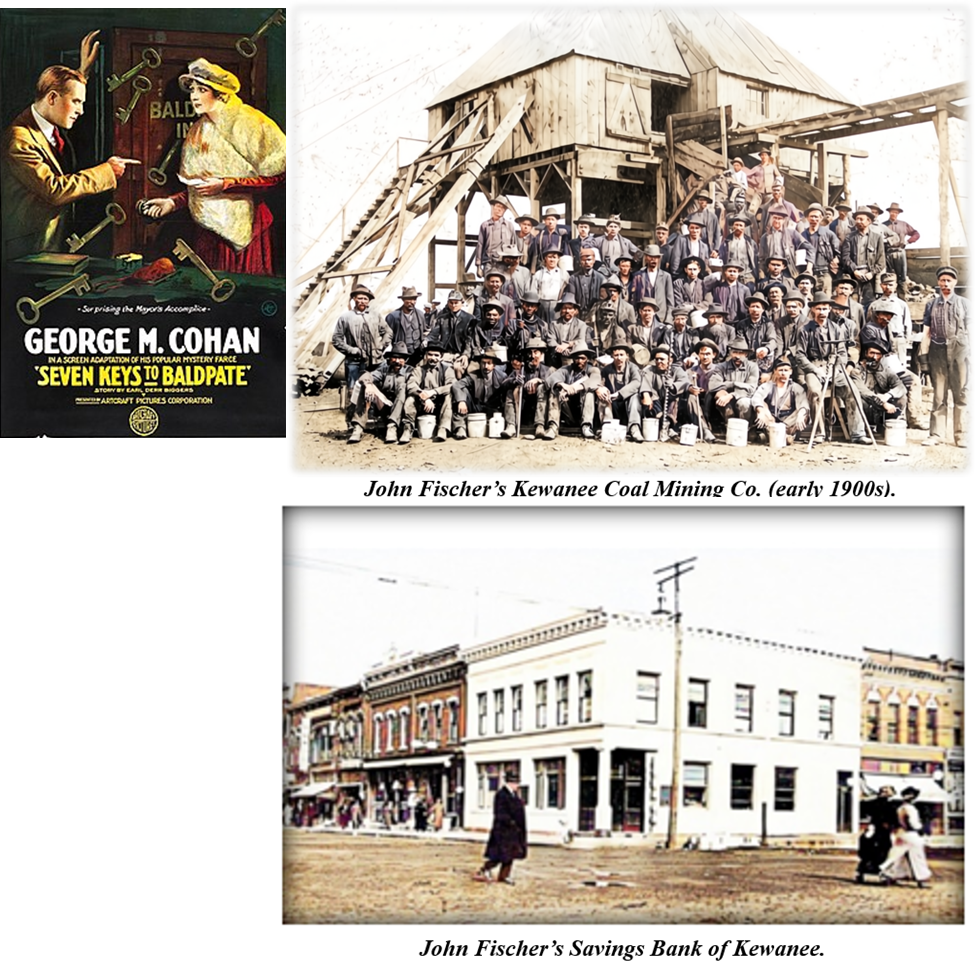
Biggers’ first novel, SEVEN KEYS TO BALDPATE, was published in 1913. That same year, American entertainer, playwright and producer George M. Cohan quickly adapted it for what became a hit Broadway play, and Cohan later starred in the 1917 film version.
By the time Biggers and his wife boarded the CARPATHIA in March 1914, he had become a well-known author.
John Fischer was born in 1858 in Prussia, and came with his parents, Peter Fischer and Margarethe Zang, to Kewanee in 1870. Two years after his arrival, Fischer began working in the coal mines with his father, followed by a two-year stint as a farm hand. He then entered the grocery business, starting as a delivery boy and eventually co-owning his own grocery store (with stretches in between working at Haxtun Steam Heating Co. and as a salesman).
In 1889, Fischer began in the real-estate loan business, and in 1890, purchased stock in the First National Bank, where he eventually became a director and vice-president. During this time, he also operated the Kewanee Coal and Mining Co. east of town on Kent Road. In 1902, Fischer organized and became president of the Savings Bank of Kewanee, known as the “White Bank,” on the northeast corner of Tremont and Second Streets.
Fischer married Etta Ruth Lyle in 1883, and the couple started their family the next year.
In 1914, the Fischers began their tour, sailing across the Atlantic Ocean to visit a variety of Mediterranean ports of call and other European sites.
The Fischers and the Biggers found themselves seated at the same dining table and the families soon became well-acquainted. Fischer and Biggers began a friendship on the voyage, talking often while onboard.
When they disembarked with fellow passengers for a stop at Gibraltar, Biggers saw Fischer look at his watch. But then, Fischer pulled out another watch and, much to Biggers’ amusement, announced that “the folks are just sitting down for supper in Kewanee.” Fischer had purchased a cheap second watch to track the local time while keeping his personal watch set on Kewanee time. Throughout the trip, Fischer would tell Biggers what was going on in Kewanee. It all stuck with Biggers.
Back on the CARPATHIA, Fischer told Biggers that a native Gibraltarian told him about how the harbor was mined, and all of the mines could be set off by a single flip of a switch. Biggers thought that would fit nicely into a play – but only if there was a war. Fischer opined that “there won’t be any war. People are too civilized for that nowadays.”
Fischer was wrong. World War I began later that summer.
The following year, Biggers produced his own smash hit for the New York theater, a war story called INSIDE THE LINES. One of the popular characters in the play was “Sherman of Kewanee.”
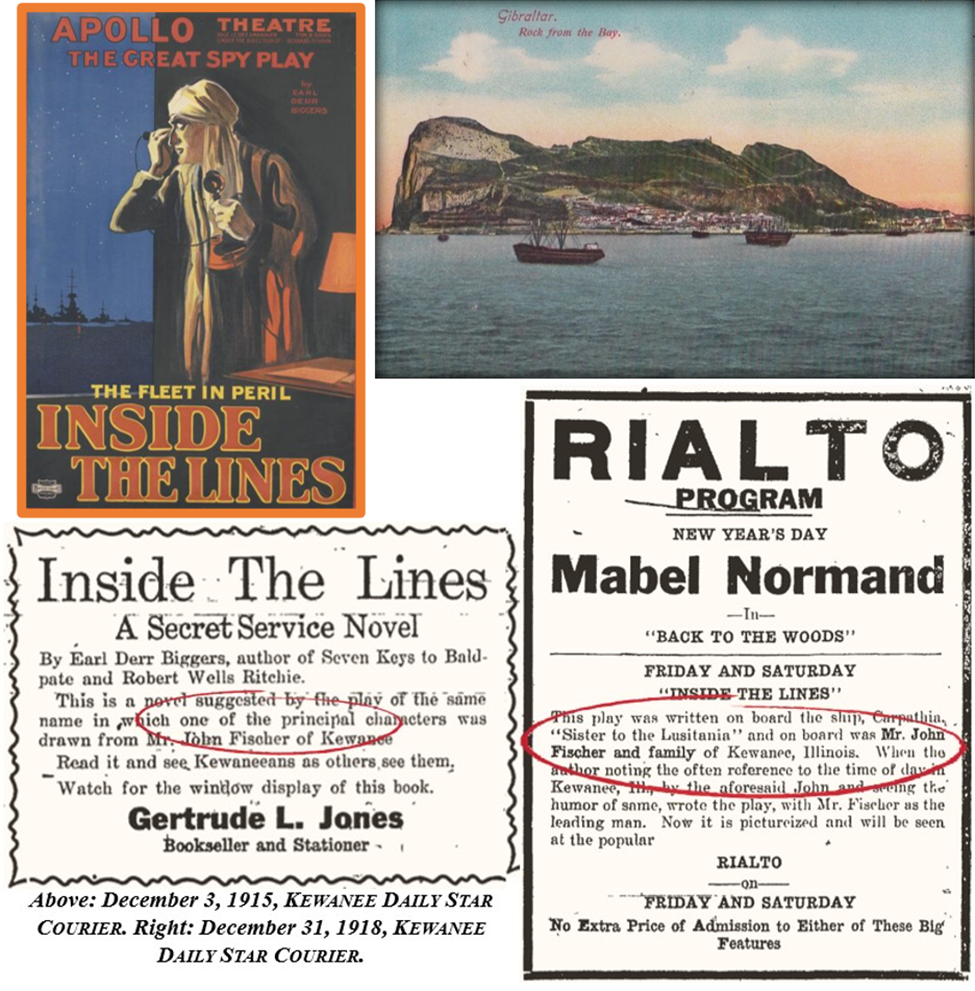
When Fischer learned that this popular dramatic character resembled him and his mannerisms, he wrote Biggers.
Biggers responded with his explanation. He wrote that, after the war started, he began working on the play.
“It was easy to get together a collection of soldiers and hotel keepers and spies for characters, but what I wanted most of all was a fine, lovable. patriotic American who would win the hearts of audiences from his first entrance. . . . It was then that I thought of you and Kewanee.
“The result was Sherman of Kewanee, who is by all odds the best-liked character in ‘Inside the Lines.’ Of course, he is not by any means an exact likeness of you – I would not be so impertinent as to put any man on the stage without his permission. But he got his home town from you, and his scheme of carrying two watches – and several other hints; above all, he got his fine loyalty to his home town and his own people from you, and I have seen these things bring tears into the eyes of people who had hardly finish laughing at him. I don’t think you or any other man from Kewanee will be ashamed of Old Sherman when you see him on the stage. I want to thank you for suggesting to me a character I am proud to have drawn. . . .”
And, in turn, Fischer was proud of his contribution to the story, and so was Kewanee.
While Biggers first novel made him famous around the country, in the early 1920s, Biggers created a new character and a series of books based on him, which made Biggers famous around the world.
While in Hawaii for his health, Biggers intended his fifth novel to track two San Francisco newspapermen on the islands, and a character called Charlie Chan would have a minor role meant to supply local color. Instead, after hearing of the legend of a Chinese- Hawaiian police detective, Chang Apana, Biggers made Chan into a Honolulu-based Chinese detective and the primary character in that and five subsequent novels. Those became known as the widely popular Charlie Chan Mysteries.
Chan, written as a physically unimposing, self-effacing family man, was perspicacious, patient, deeply courteous, observant and broad-minded. Biggers saw Chan as contrasting with the still-rampant racial prejudice against Asians – fear of the “Yellow Peril” persisting since the late nineteenth century. Biggers himself saw his writings as a literary countermeasure to the racial stereotyping of Chinese still prevalent at the time he was writing.
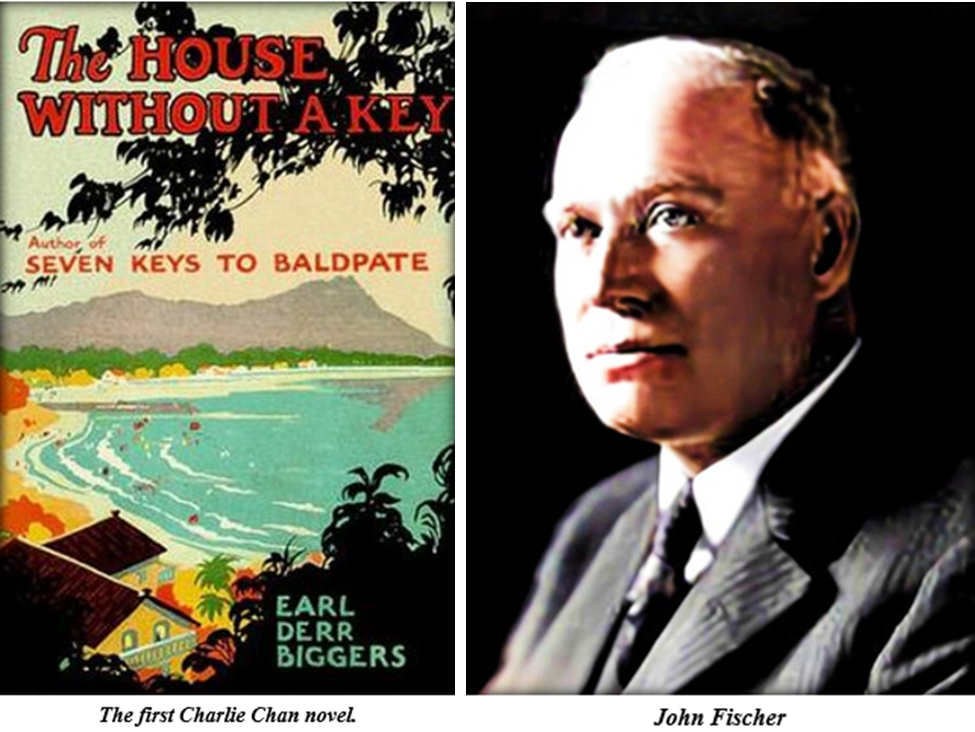
But in the 1960s, following the six books and almost fifty movies based on them, the character began drawing protests and condemnation from the Asian American community, becoming a kind of shorthand for the racist stereotyping of Asians in the popular American imaginary. Today, the tension continues as to the meaning of the Charlie Chan character.
But the character of “Sherman of Kewanee” is not an issue, nor is that of John Fischer, the man Biggers met on the CARPATHIA, a man of “fine loyalty to his hometown and his own people.”