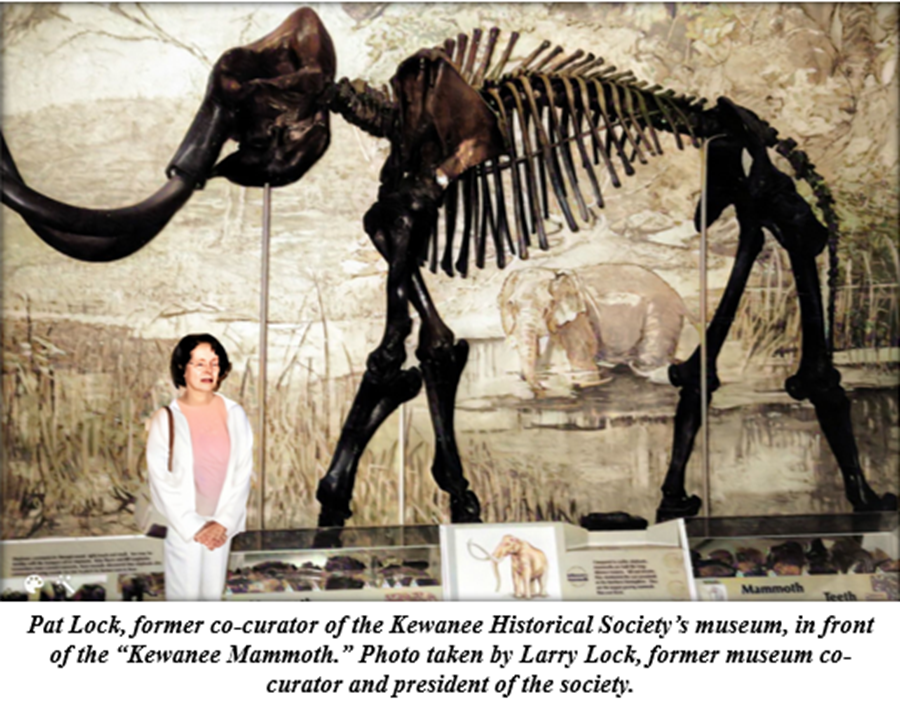
(I first published this story in 2019. Recently, I discovered more information and also received additional papers from the University of Nebraska State Museum at Morrill Hall. It warrants updating the story. You can also watch a video based on the story here.)
In 1933, barber Fred Kellar moved to Kewanee from Geneseo, and he worked at Barstow’s Barbershop. A year later, he opened a barbershop with Jack Hammer at 111 W. Third Street. In between, he became famous.
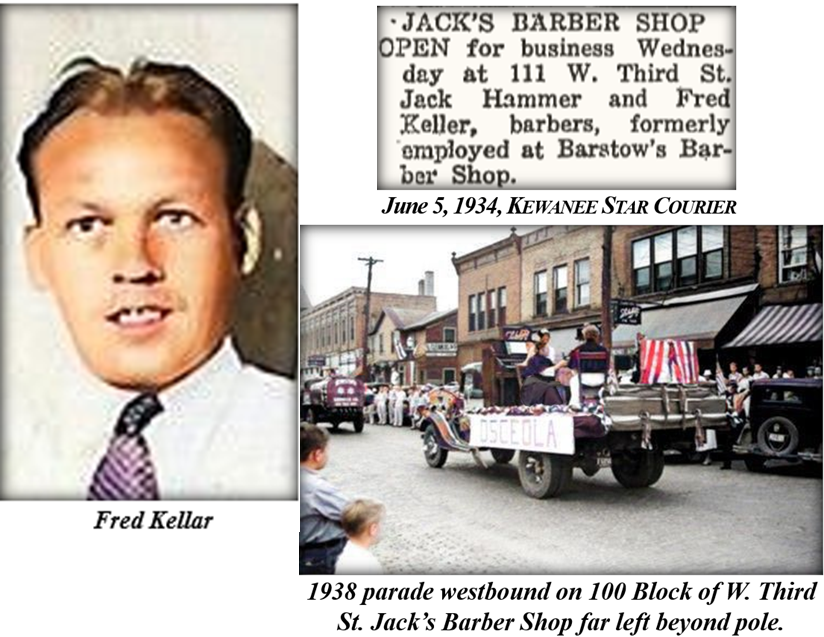
Kellar went a fishin’ on July 29, 1933, a sunny, warm Saturday morning which would reach the low 90s before clouds would move in that evening. He and his brother drove up Highway 78 to Annawan, and then took back roads to a secret spot in north Alba Township to drop their lines. Afterward, Kellar never said whether he had any luck catching fish.
But he did hook into a mammoth catch – literally!
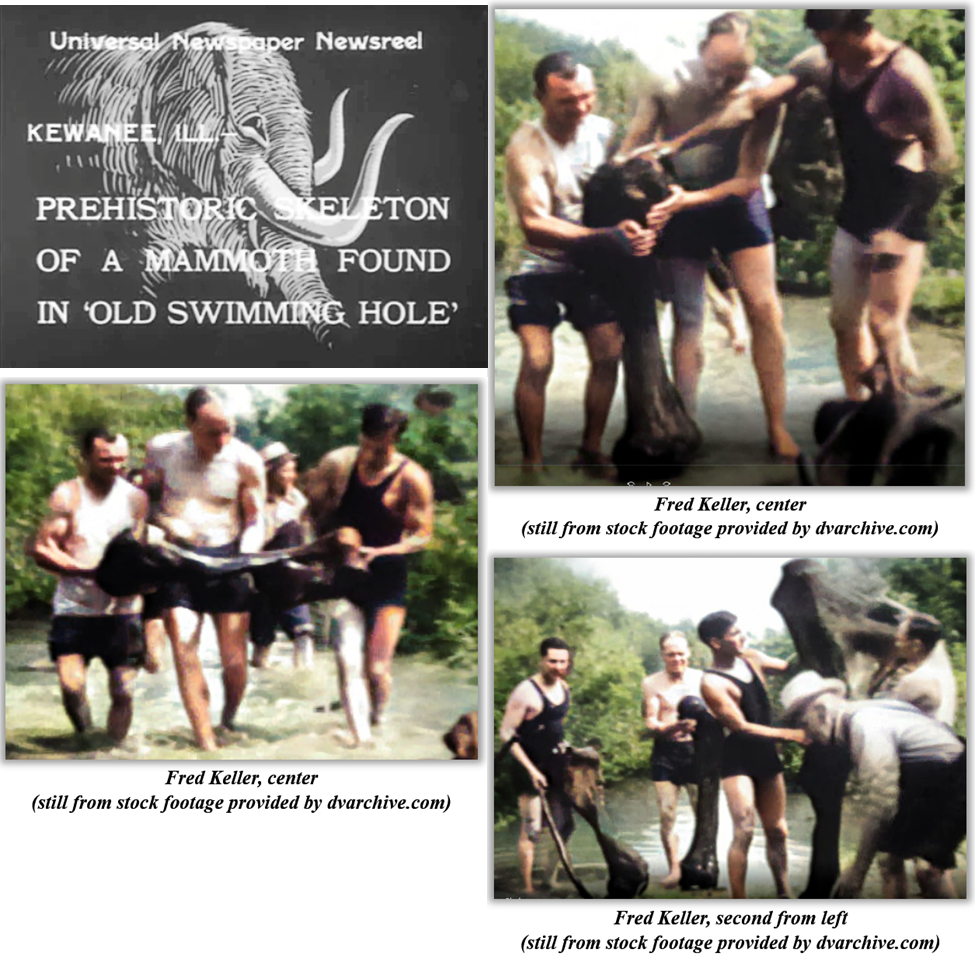
Kellar’s pole bent as he struggled to pull up something from the bottom of the water. When he got it to the surface, he initially thought he had hooked an odd-looking log. But he quickly saw it resembled a big – a very big – bone. Kellar stripped down to his shorts and repeatedly dove into the water and soon brought up all manner of bones.
Over the next weeks, Kellar and friends kept at work looking for and finding more bones at the fishin’ hole.
Kellar soon became a national celebrity. A Star Courier photograph was picked up by news services and appeared in papers from coast to coast. A film crew accompanied Kellar and his friends on another round of dives, and soon he was featured on Saturday afternoon news reels in theaters across the land.
The head of the Illinois historical museum, upon seeing the parts of the skeleton unearthed, unequivocally said that it was not a mastodon but “[t]hat is a mammoth and there’s no doubt about it.” The expert praised Kellar and his friends for “unusual care as laymen in the digging out of the bones and thus had a fine specimen of the mammoth which is rare for this section of Illinois . . . .” The expert said that the vertebrae of the neck, part of the ribs and the tusks were the main parts of the skeleton still missing. He opined that the mammoth stalked the area between 15,000 and 20,000 years ago and was between 60 and 70 years old when it died. The animal stood about 11 feet high to the shoulders.
By the next year, Kellar, aided by his father, brought to the surface about 85% of a whole mammoth, missing primarily the tusks, which would be the first parts of it to disintegrate. Based on the tusk sockets, if found, the tusks would be between 12 and 16 feet long.
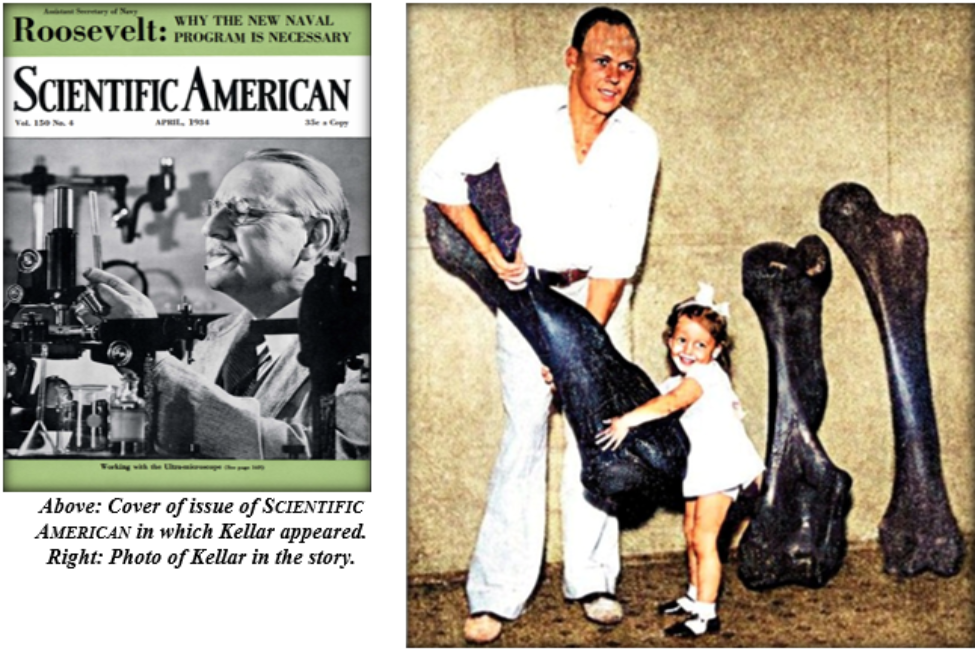
Kellar was featured in SCIENTIFIC AMERICAN magazine. At that time, Kellar planned to “build a house on his Buick [truck] and tour the country . . . .” But he was talked out of it when apprised of how others had attempted and failed in similar endeavors.
The Illinois historical museum had initially expressed interest in the skeleton. But soon, the University of Nebraska had stepped up to the plate. It appears that they believed they were overpaying but eventually agreed to give Kellar around $1,000. However, they found Kellar to be less than honest with them about aspects of their deal. The editor of the Kewanee Star Courier opined to them that Kellar had less than a stellar reputation about town.
Kellar had sketched out a map showing the approximate location of his find. But the reference points of the spot varied in name. It was described, variously, as at Cole Creek, then Spring Creek, and along the Green River, making it difficult to pinpoint precisely where Kellar found his bones.
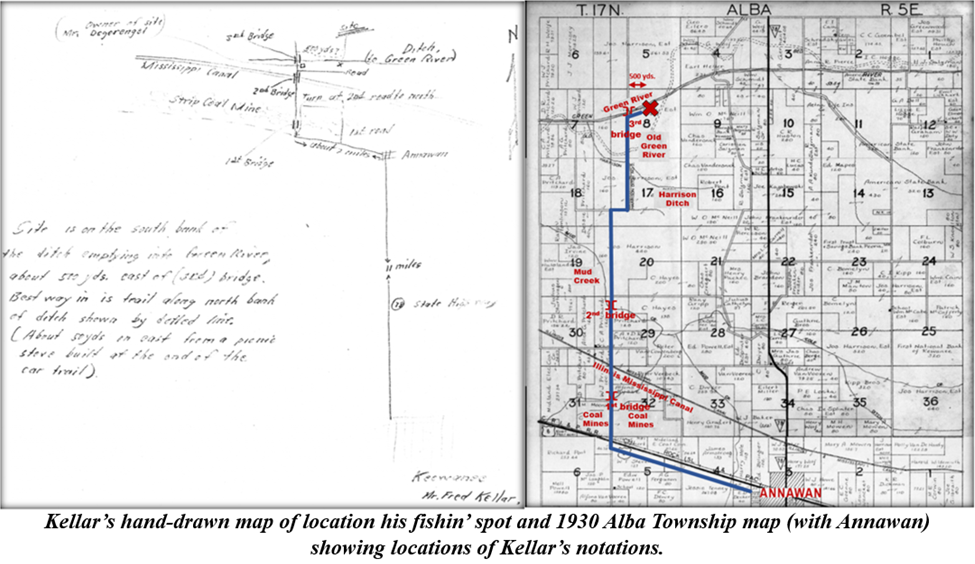
The university sent its chief preparator and a student to Henry County to attempt to find the remaining bones. The bones already found were in Nebraska but had not yet been assembled pending the results of the further search. They included the skull, jaw, huge limbs, and most of the vertebrae.
After painstaking searching and then the tedious process of assembly, the “Kewanee Mammoth” skeleton, formally a “Mammuthus Jeffersoni,” was put on display at The University of Nebraska State Museum in Morrill Hall.
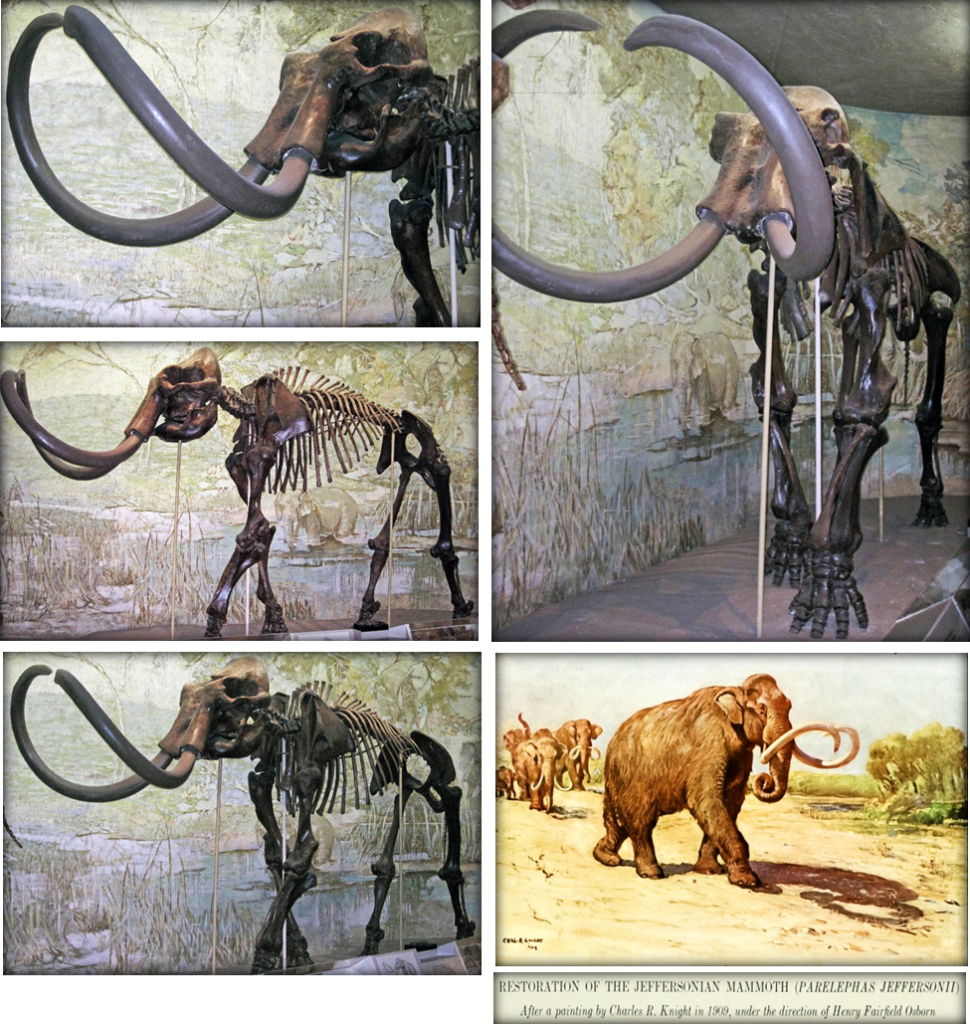
Fred Kellar’s find, however, was not the first prehistoric mammoth found in the area. In 1914, Roy Petitt found the bones of another mammoth near Messmore Hill, much closer to Kewanee. That find actually deserves the moniker “the Kewanee Mammoth.” But that’s a story for another day.
(Special thanks to Larry Lock and David Karau for helping me sort through some of the conflicting information. The Kewanee Historical Society has a file with copies of the 1930s correspondence and other information regarding the Kewanee Mammoth.)