They were both born in Kewanee a few years after its founding. They were the sons of well-known and highly respected, leading citizens of our hometown who lived on Chestnut Street, a then-toney street in the village. They also were classmates throughout school, and each of them was an honored speaker at their high school commencement exercises. One went to business college, then started in business and soon became an assistant cashier with a local bank, climbing the rungs of the ladder of success, while the other attended college and law school, and then began the practice of law out-of-state.
But the two men became felons and served time in Illinois prisons.
George Randall Parrish was the son of Kewanee pioneer Rufus P. Parrish. The elder Parrish helped found the first YMCA in the nation in Boston. He arrived in Kewanee in 1855 and soon became a leading citizen, a founder of St. John’s Episcopal Church and the Kewanee Public Library for which he served as president for 25 years. (See my story, RUFUS PARKER PARRISH – KEWANEE’S MAN OF BOOKS, on the Kewanee Historical Society’s website.)

G. R. Parrish’s national success as a writer of “dime novels” resulted in honors during his lifetime and after his death, and his writing reputation resulted in him being placed on a Walldog mural now on the side of the Kewanee Public Library.
But no one in Kewanee talked openly about his ignoble life of drunkenness, womanizing and felonious dishonesty during his life. As a result, no written record in Kewanee existed to inform those who came later about his sordid past. Recently, however, that disreputable side of his life has been exposed. (See my stories, KEWANEE’S G. RANDALL PARRISH: FROM CONVICT MINISTER TO FAMOUS AUTHOR, and A FAMOUS KEWANEE WRITER’S WESTERN ESCAPADES: BUT DID GEORGE RANDALL PARRISH CREATE THEM OUT OF WHOLE CLOTH?, both found in THE KEWANEE VOICE.) And, based on family accounts, Parrish’s character never changed – he continued his life with no moral compass, a disdain for honesty and womanizing until his death.
However, the mistakes of Junius Julius Pratt played out in public view in Kewanee and were fully reported, resulting in memorialization of his misdeed for future generations. Here’s his tale.
Norman H. Pratt came to Wethersfield from New York in the 1840s. He eventually became a commission salesman. When President Lincoln called for additional enlistments in mid-1862 during the Civil War, Pratt was one of many Wethersfield and Kewanee citizens to sign up, and he was elected as a lieutenant a company of Kewaneeans which eventually became part of the 124th Regiment of the Illinois Volunteer Infantry. After the Vicksburg siege in 1863, Pratt was promoted to captain.
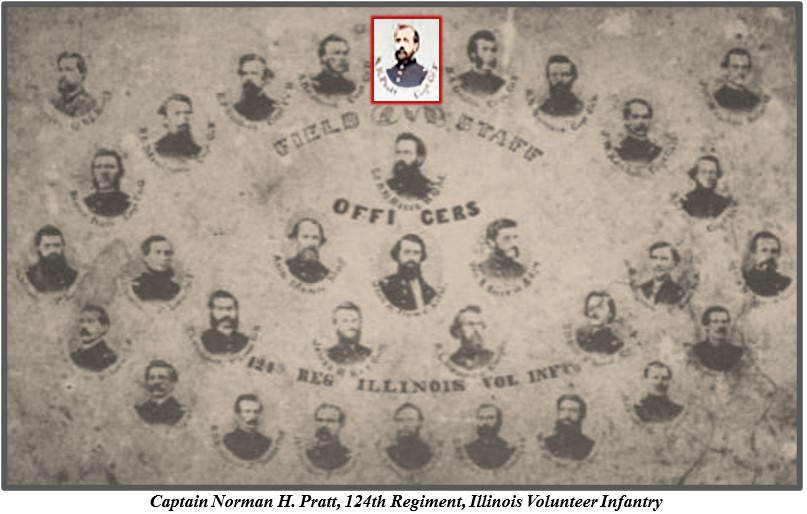
After the war, Pratt opened an insurance agency in Kewanee on the south side of Second Street midway between Tremont and Chestnut streets. In 1867, President Johnson appointed Pratt Kewanee’s postmaster, and he ran the Post Office from his Second Street business from 1867 until 1887 when his wife, Louise Anna Sloan, daughter of early Kewanee pioneer Seymour Sloan, died. Pratt moved back to New York, remarried, and eventually moved to the Chicago area, where he died in 1895. At his death, Kewanee’s newspaper, the Independent, wrote that “Capt. Pratt was a man of sterling qualities who always had the greatest respect of those who knew him.”
The Pratts had three children, one of whom was Junius Julius Pratt, born in 1858 in Kewanee. He was named after his mother’s brother, artist Junius R. Sloan, and his father’s brother, Julius A. Pratt, who later died in the Civil War.
Junius Pratt, known as “June,” lived with his siblings, parents, and Grandfather Sloan on the northwest corner of Chestnut and Prospect Street. (A house in which E. E. Baker later lived and then tore down for his LaVilla mansion.) June Pratt attended local schools with other Kewaneeans his age, including George R. Parrish, who lived just down the block from him. Both he and Parrish spoke at their 1875 commencement exercises for their high school graduation from Kewanee’s “Old Academy.”
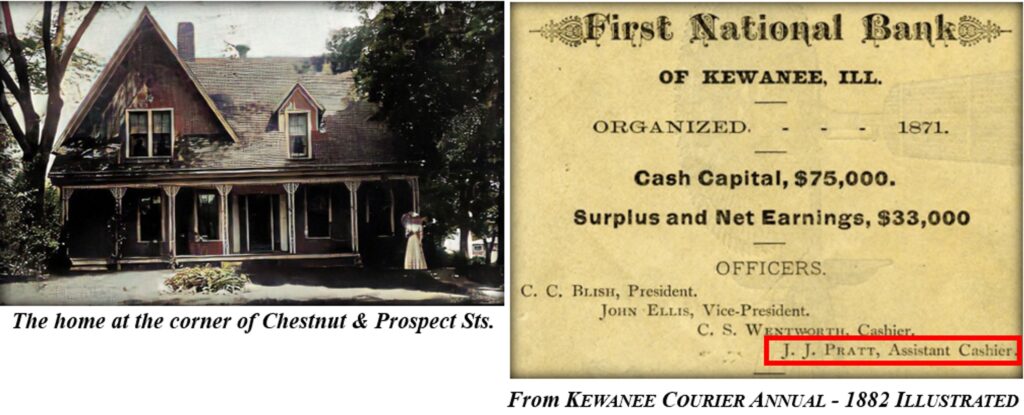
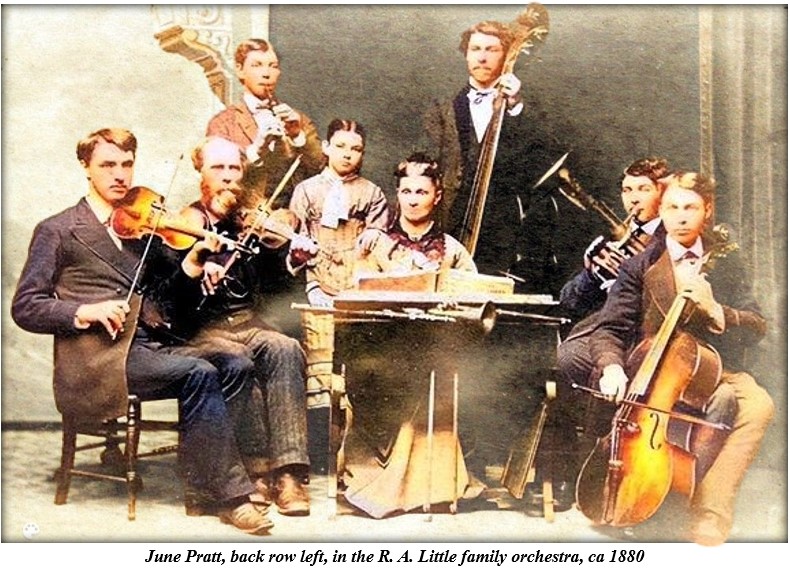
After graduation, June Pratt attended business college and then began working in his father’s business while also serving as assistant postmaster. By the early 1880s, however, young Pratt became the assistant cashier at the First National Bank, located in Library Hall on the corner of Tremont and Third streets. He had a good reputation, was civic-minded, and played in the R. A. Little family orchestra and taught Sunday school.
In 1882, G. R. Parrish had to flee Wichita, Kansas, when caught swindling people by borrowing money and not paying it back, followed by giving two mortgages on the same property. That kind of behavior continued over the next 17 years, culminating in a conviction for forgery and a sentence of not more than 14 years, of which he served two years in the Joliet correctional facility.
Meanwhile, 1882 was also an eventful year back home in Kewanee. The Kewanee Independent reported that on Monday, August 14, 1882, “[t]he whole town was electrified at about 7 o’clock P. M. . . . by the hurried news that the First National Bank had been robbed of a large sum of money, and that the robbers . . . had safely escaped with their plunder. . . . [S]oon collected an excited crowd about the bank building, who . . . rapidly armed for the pursuit of the thieves. The sight of Mr. June Pratt, assistant cashier, and Miss Charrie Palmer, lady clerk, both wounded and bleeding, from the rough treatment received at the hands of the villains, intensified the excitement, and the large crowds of citizens hastily gathered together what firearms could be found and started in hot, but unorganized pursuit.”
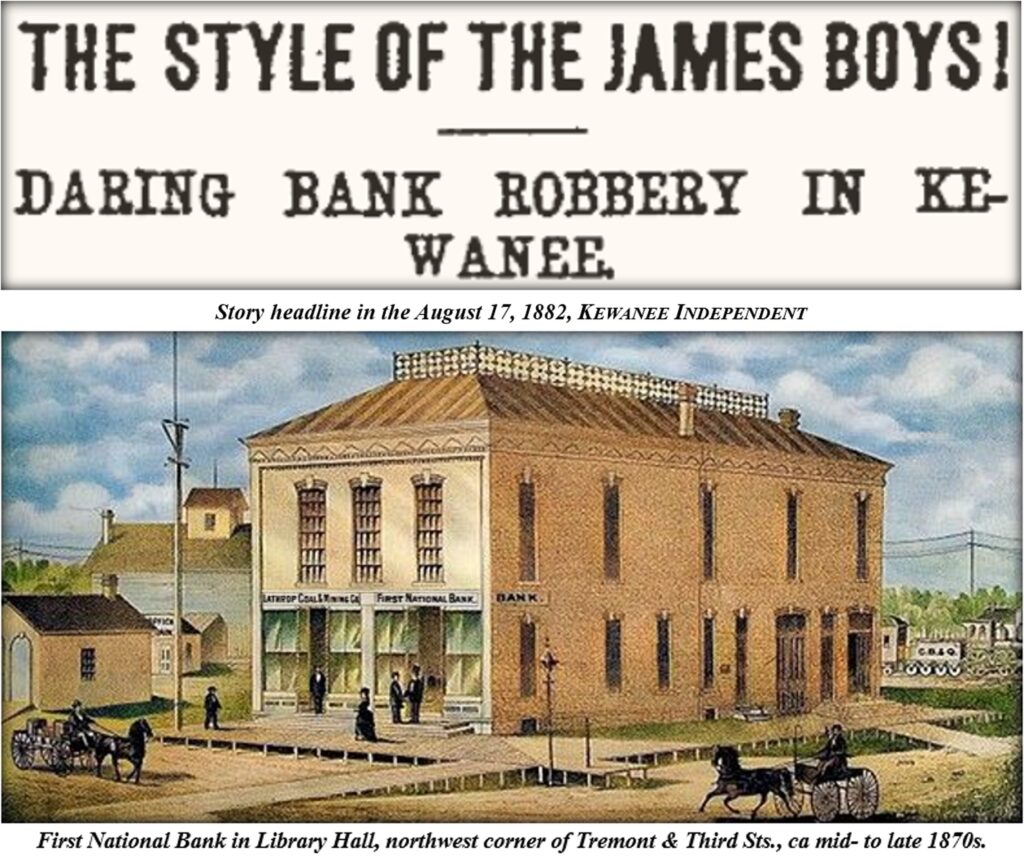
In the days that followed, updated newspaper reports added more details to the account.
On Monday afternoon, two men had entered the bank and asked if they could leave a satchel for safekeeping for a short time. The bank closed at 5 p.m., and about an hour later, while Pratt and Palmer were cashing up, the men knocked on the door and asked for the satchel. When Palmer opened the door, one of the men grabbed her by the neck and, when she tried to bite him, kicked her repeatedly. The other man rushed in and hit Pratt in the head with a revolver. The men entered the vault, stole about $20,000, including about $6,000 in gold, locked Pratt and Palmer in the vault, and left town. After an hour and in the pitch-black of the vault, Pratt was able to remove screws from the vault’s lock and give the alarm.
On Tuesday, business houses and shops were all closed and over three hundred men were in pursuit of the robbers, confident they would be caught. Then the Pinkerton Detective Agency took charge of the investigation. Within two weeks, arrests began being made, and the full story slowly came out.
In late August, the Pinkertons arrested Edward N. Welch in New York. Welch confessed, and named St. Louis dentist J. S. Scott, formerly of Kewanee, as the robbery’s planner, although he did not take part in the actual robbery. Besides dentistry, Scott had a reputation in Kewanee as a poker player.
Shockingly, Welch also alleged that June Pratt was an inside man in the robbery.
Days later, Pratt confessed and led the detectives to his parents’ home where they unearthed $6,000 in gold buried in the backyard, putting to an end to the protestations in the town that Pratt was innocent and had been treated unfairly by the Pinkertons.
Pratt had not been suspected at first by the Pinkertons. But after further questioning, his story didn’t ring true to them, including his injury. The Chicago Tribune reported that when Welch was captured, he said that as the two robbers were leaving the bank, Pratt demanded that they strike him so he could appear injured in light of the very real injuries to Palmer, but the blow was “but a love tap.”
The Tribune also reported that Pratt had become acquainted with Welch and Scott through playing poker, where he invariably lost. It alleged that Pratt previously had paid off earlier debts to them by forging two checks drawn on the bank. Later, however, the paper reported that Pratt was, or became, part of a team, giving signals to Welch and Scott in poker games with unsuspecting prey.
Near the beginning of October, the Pinkerton’s grabbed the fourth bank robber, Tot J. Dunkle, and returned him to Kewanee. With his arrest, all of the stolen money not spent was accounted for. Dunkle soon joined the other defendants in the Henry County jail in Cambridge.
At the trial at the end of October, esteemed Kewanee attorney Charles K. Ladd represented Pratt, giving an impassioned argument based on Pratt’s otherwise sterling reputation and behavior. After deliberation, however, the judge sentenced Pratt, Welch and Dunkle to six years in the penitentiary and Scott to four years.
Pratt was released early for good behavior and was back in Kewanee by 1887. He began taking photographs and soon opened a photography studio. In 1889, he married Grace Esther Loomis, daughter of businessman Orin H. Loomis.
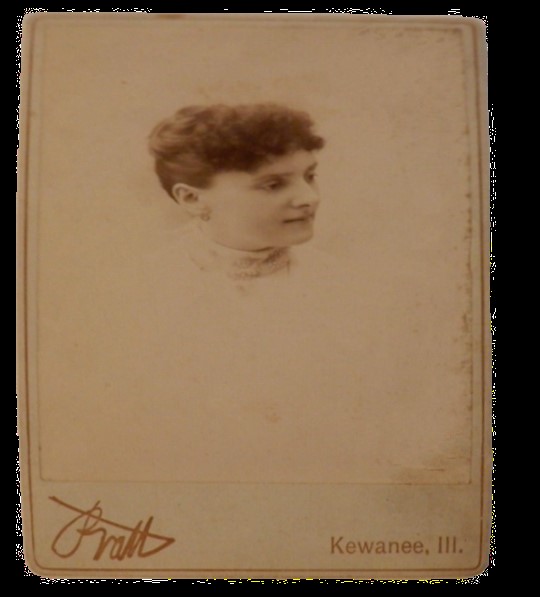
Of Pratt’s post-prison time in Kewanee, Henry County historian Henry L. Kiner wrote in his 1910 book, THE HISTORY OF HENRY COUNTY, ILLINOIS, VOL I, that Pratt “walked the streets with face fixed and set, looking neither to the right nor left. If a person saluted him, he returned the salute, but he never took the initiative. He seemed to have determined to live the past down.”
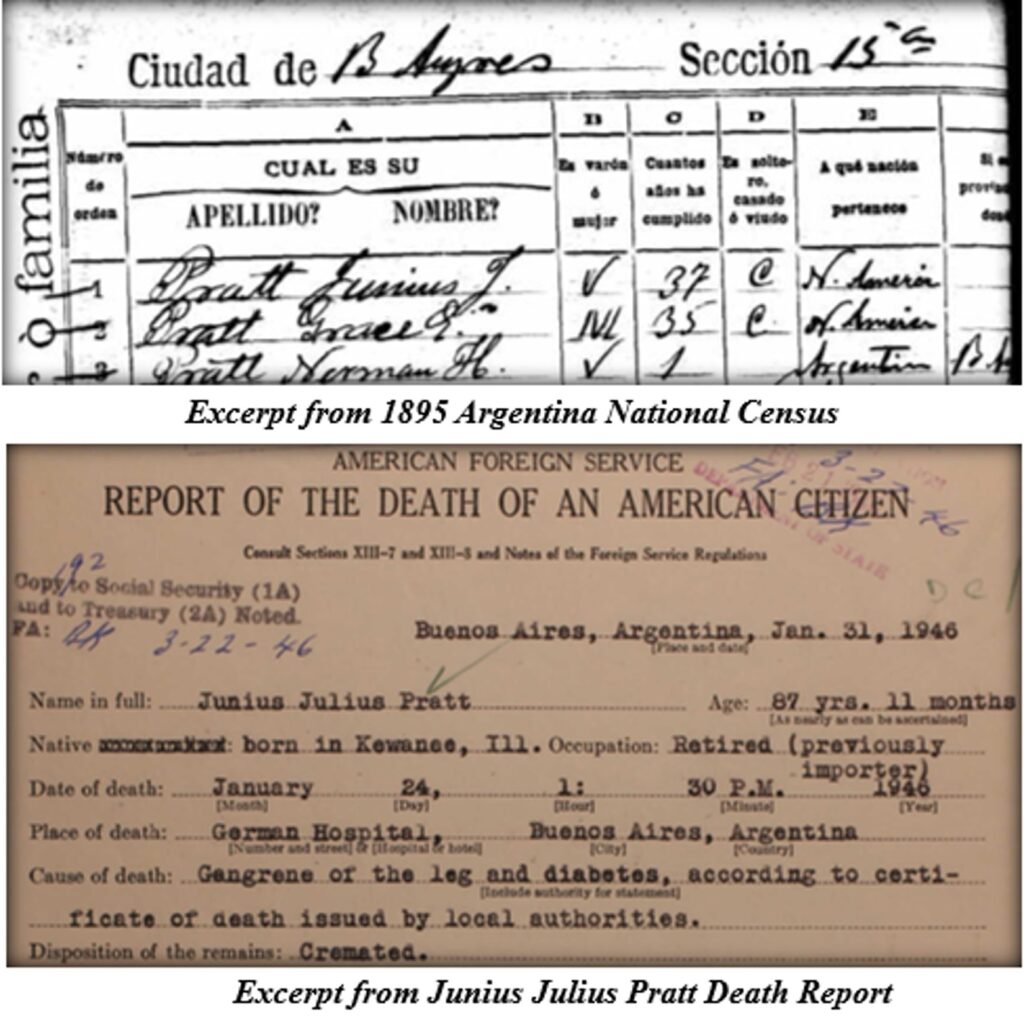
In 1890, Pratt emigrated to Buenos Aires, Argentina, where he established a photography business. His wife followed shortly, and they had a son named after Pratt’s father. J. J. Pratt later became an Argentinian importer. Junius Julius Pratt died in Argentina in 1946, survived by both his wife and son.
G. R. Parrish and J. J. Pratt were educated children of privilege, growing up in a rapidly-expanding city on the Illinois prairie. Each had the family support and the tools for success. Our hometown surely knew well the character of both men and knew well of their transgressions. Perhaps because one committed his sin in Kewanee while the other one’s were perpetrated elsewhere, only one had his transgressions memorialized.
Finishing his account of Pratt’s life, historian Kiner saw fit to cryptically compare him to Parrish: “A millionaire known to the writer started life with more missteps than Pratt made, came out of the penitentiary shriven and cleansed, and is today one of the men whom mothers point out to their offspring as a model and a pattern.” (Kiner, however, never wrote of Parrish’s wrongdoings in his account in the same history book.)
We can be charitable and suggest that Kiner’s opinion of Parrish, written in 1910, 13 years before Parrish’s death, was without the benefit of the knowledge of others who knew him well.
In a recorded interview of Dr. Judith Davidson. the great-granddaughter of George Randall Parrish, she told me that “my first thought was George Santos [the current New York Congressman accused of fabricating large parts of his life story]. [Parrish] is someone who is very much like George Santos. . . . We thought of him as a little unhinged, perhaps. Not able to really keep his feet in reality. . . .” Judy conveyed that Parrish had no acquaintance with the truth, even after prison, but finally found a profession – writing fiction – in which he could make a living while continuing to make-up things.
Judy also said that Parrish “didn’t have a very good kind of moral core.” In addition to Parrish’s time . . .. in prison, Judy gave an example of his lack of a moral compass.
Prior to his arrest, Parrish had had numerous affairs, and she said that he was “quite willing to make himself available to women wherever he was . . . .” She then told the story of when Parrish was on his deathbed. “He was trying to get [his son] to deliver a message to [another] woman that he was having an affair with.”
Judy closed by saying that “I was like, oh my god, someone wrote the other side of the story, yea!”
Based on what we know today, Parrish merely found a way to profit from his character without changing it, apparently keeping it hidden from even trained historians like Kiner. Meanwhile, Pratt continued to feel shame for his transgression and eventually left Kewanee and the country in order to come to peace with his out-of-character sin.
Can the character of a person be revealed by how they address their shame? G. R. Parrish seemed to have simply ignored his, while J. J. Pratt seemed to carry his with him, at least until he finally moved to faraway Argentina.
In retrospect and to paraphrase Kiner, perhaps today, mothers might point out to their offspring Pratt as a better model and a pattern than Parrish. Pratt, not Parrish, appears to be a man who owned up to his mistake and went about changing his life in regret for his misdeeds.
[I gave a talk at the Kewanee Public Library on August 11, 2023, on the hidden life of George Randall Parrish, and included audio-video excerpts from my interview with Judy Davidson. I will soon release a video of that talk so you can learn more about the other side of the life of G. R. Parrish and hear Judy in her own words speak of her great-grandfather.]