“CAMBRIDGE July 15 [1930] – Mike Dragolovich, whose place was raided last week in Kewanee by Sheriff Nash and deputies pleaded guilty to violating the liquor laws and was fined $200 and costs by Judge Chase Davis of the county court yesterday.”
Huh? My Grandpa Dragolovich?
A week earlier, the sheriff and his deputies raided my Grandpa Mike Dragolovich’s house at 711 N. Walnut Street. After an extensive search, they found a barrel sunk into the earth just outside the cellar wall. The sheriff ordered Grandpa to use a siphon to access what proved to be eleven gallons of booze in the barrel, and the liquor was emptied into large containers and confiscated as evidence. Grandpa was arrested for illegal possession and sale of liquor and for running a “booze emporium.”
Unfortunately, Grandpa had been busted for liquor law violations before.
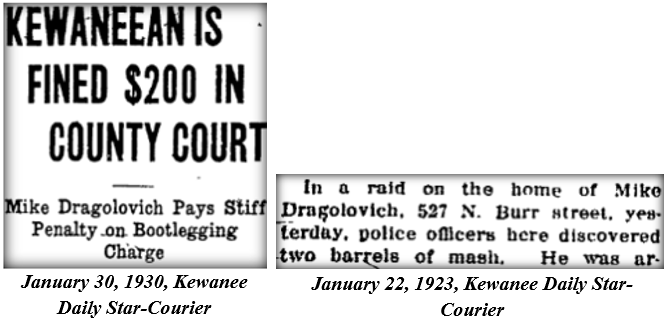
On January 22, 1923, police found two barrels of mash at Grandpa’s home at 527 N. Burr Street. He subsequently pleaded guilty to a liquor law violation and was assessed a fine of $100 and costs.
On September 29, 1925, police raided 711 N. Walnut Street, found a still and a quantity of mash, and arrested Grandpa, who was eventually fined $100 and costs.
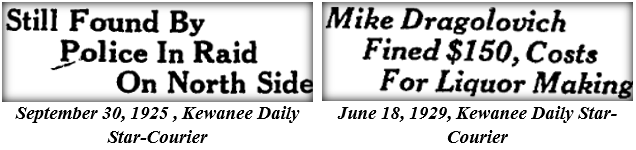
On June 17, 1929, Grandpa pleaded guilty to possession of a still and manufacture of liquor and was fined $150 and costs, based on a police raid occurring a week earlier which found about a quart of whiskey in the making in a wash-boiler still.
Yet again, on July 11, 1930, Grandpa was arrested in Kewanee for another liquor law violation. He was jailed in Cambridge to await trial.
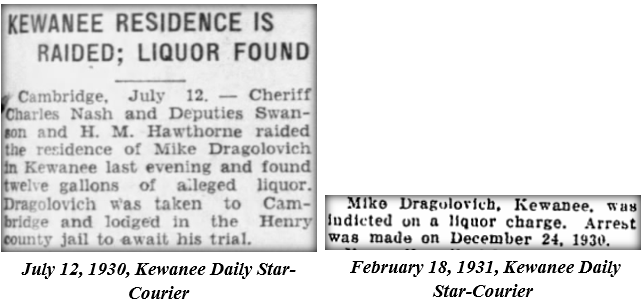
On December 24, 1930, Grandpa was arrested yet again for another liquor law violation. Under the February 12, 1931, headline “Henry County Grand Jury Returns Indictments for Alpha Bank Robbery Trio,” the paper also reported that Grandpa was indicted by the same Cambridge grand jury for his 1930 Christmas Eve arrest. He was tried and fined $150 plus costs. Christmas in 1930 likely was not a happy time in the Dragolovich family.
I found one other article which may have involved Grandpa. According to an April 12, 1920, Kewanee Daily Star-Courier article, two men posing as government prohibition officers entered the boarding house at 527 N. Burr St., found and then left with the residents’ money.
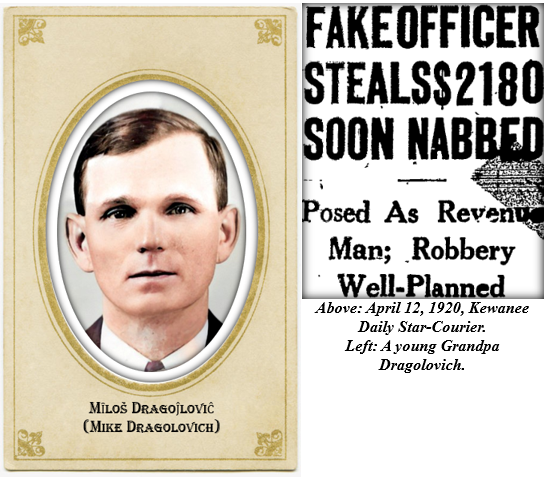
Grandpa’s “criminal” career had to have started somewhere, and if others at that address were known liquor-makers, Grandpa could have been exposed early to ways around the newly-enacted Volstead Act, passed on October 28, 1919, to enforce the terms of the Twenty-First Amendment. The country had gone dry on January 17, 1920.
Were Grandpa’s liquor law transgressions unusual? Not really. For many immigrants, alcohol, in the form of beer, whiskey, or wine, was a part of daily life, and integral to the culture of the community. Among many other nationalities, Slavic immigrants of the late nineteenth century found saloons a major source of sociability, financial aid, and news and food, and often an important avenue of economic mobility and support for the urban political machine. One scholar described the effect of prohibition on the Slavs in Chicago:
“[The] onset of prohibition meant the loss of one of the single most important institutions within the South Slavic community in Chicago. For them, their neighborhood taverns and saloons were much more than just a place to drink and evolved during the four decades prior to prohibition to serve vital functions within the community. Despite the obvious concerns of drunkenness and sloth associated with excessive drinking, prohibition created a new problem for the South Slavs to contend with. The loss of a historically male environment forced many saloon owners, bartenders and patrons to retreat into “hundreds of thousands of homes [that] have become like the saloons of former days.” Despite alcohol being abolished, it continued to be used widely throughout the South Slav community. Its most important effect was simply removing a fundamental immigrant institution from the community and depriving women and children what had traditionally been their own space within the community–their homes.”
Kralj Dejan, Balkan Minds: Transnational Nationalism and the Transformation of South Slavic Immigrant Identity in Chicago, 1890-1941 (Loyola University Chicago 2012).
Was Grandpa a “bootlegger?” Probably not as we think of that term today. And a further review of the Kewanee Daily Star-Courier archives and a review of Kewanee police records would likely show that Grandpa’s transgressions were probably on the low end of the scale, not only among Slavs but among the entire immigrant population in Kewanee.
Still, Grandpa’s story may be one of my family’s skeletons in the closet, and. . .
“If you cannot get rid of the family skeleton, you may as well make it dance.”
George Bernard Shaw
(You’re reading this story today because of LeeAnn Bailleu and Marianne Culver. LeeAnn and Marianne are getting ready to launch a new podcast, Kewanee Memory Lane, produced by Jon Looney. They describe their effort as “a podcast for the historical weirdos in Kewanee, Illinois.”
LeeAnn contacted me this weekend with a legal question relating to the Prohibition. I couldn’t help much since I never practiced criminal law. But her question reminded me of this story which I had written for a book for my family. So I dusted it off, cleaned it up, and, voila!
Kewanee Memory Lane sounds like an exciting new take on Kewanee history, and I can’t wait to begin listening to the podcasts when they start dropping on their YouTube and Facebook pages. Podcasts about Kewanee and Prohibition are in the works.)