When named his high school football team’s captain in his senior year in 1911, a Decatur newspaper ran a brief story under the heading “Fat Player Is Elected Captain.” It wrote that, at 245 pounds, he was “the heaviest high school football player in Illinois.” But he embraced “Fat” as a nickname (he previously carried the moniker, “Sarah”), and it stuck with him through college. Then, later, his nickname changed to “Doc.” We’ll see why.
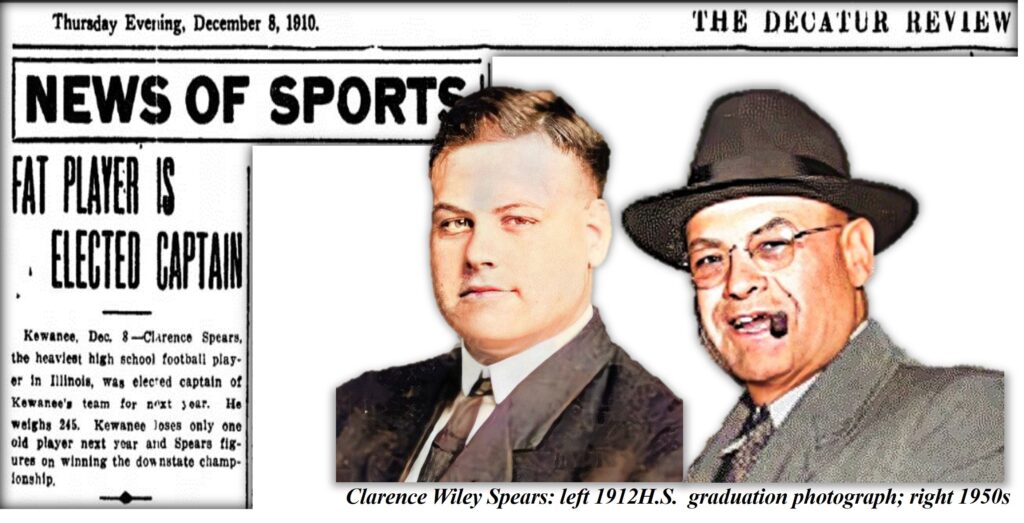
Kewaneean Clarence Wiley Spears was torn between two mistresses – football and medicine. He was a Kewanee High School star athlete in multiple sports. Spears then became an All-American football player at Dartmouth. Following that, he became one of the gridiron’s most-respected college coaches, from Dartmouth to West Virginia, Minnesota, Oregon, Wisconsin, Toledo, and Maryland.
But as he accrued football fame, during off-seasons Spears also studied medicine at the University of Chicago and Rush Medical School, graduating in 1921. Spears, however, continued coaching. Only after 30 years in football did he finally settle down to a full-time medical practice.
Clarence Spears was born near DeWitt, Arkansas, in 1894, but his father died three weeks after he was born. His mother soon moved back to her parents’ farm in Illinois, and then eventually made her way to Kewanee in the first years of the 20th century.
Clarence had learned about demanding work on his grandparents’ farm. In Kewanee, he worked for a plow manufacturer and at the Boiler company. By age 16, he weighed 228 pounds and had the physique of a grown man.
Clarence’s mother emphasized the importance of responsibility and of education. But he also played multiple sports growing up and excelled in all of them.
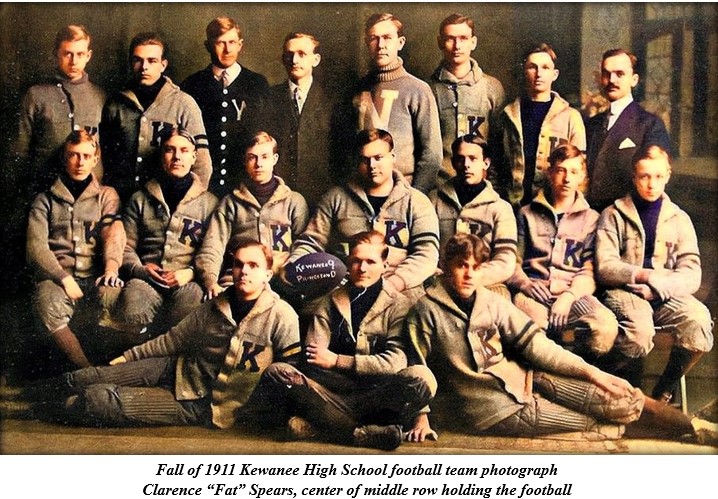
Clarence entered Kewanee High School in 1908. He displayed his talent in the classroom and soon became a favorite of his teachers. But he again showed his athleticism. Clarence soon became the athletic hero of the school, playing baseball, basketball, track, and football, excelling in the latter two.
At the 1912 state high school track meet, Clarence shattered two records, spinning the discus out 133 feet and pushing the shot 53 feet 10 inches.
Yet football was where Clarence’s star shined the brightest. He was remarkably fast and agile for his size, often fooling his opponents. In his senior year, Clarence was named to two places, fullback and tackle, on the all-state team. Of the 179 points Kewanee scored that season, Clarence scored all but nine of them.
By this time, Clarence was dreaming of becoming a doctor. Eschewing other Midwest schools so as to further that goal, Clarence went to Knox College in Galesburg, intent on garnering the necessary courses he needed in order to enter Dartmouth the following year. At Knox, he worked as a janitor while attending classes and playing every position on the football team at least once.
When Clarence walked onto the Dartmouth campus in Hanover, New Hampshire, in the fall of 1913, it was another step in his dream of becoming a doctor while continuing with football. The pre-med work was hard, and he had to compete with equally-skilled footballers for a spot on the squad. In the 1914 season, Clarence switched from tackle to guard, but he still occasionally played in the backfield and handled punting duties. His most memorable punt was on a day with gale-like winds. Kicking from the shadows of his own goal post, Clarence booted the ball to the other one-yard line, a 99-yard punt.
Playing varsity football was time-consuming, but Clarence stood high in the estimation of his professors, one of their outstanding students.
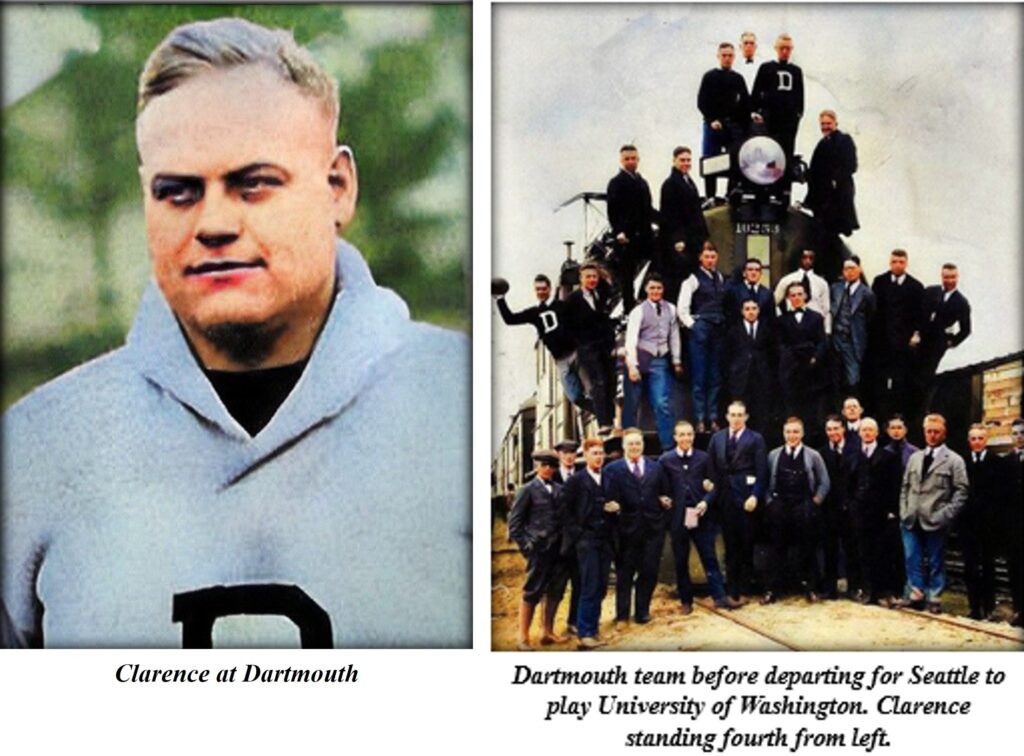
In 1914 and 1915, Clarence was named an All-American by the most prestigious expert in football, the most prestigious of the slew of awards he won in his playing career. During those two seasons, Spears helped Dartmouth to a 16-2-1 mark.
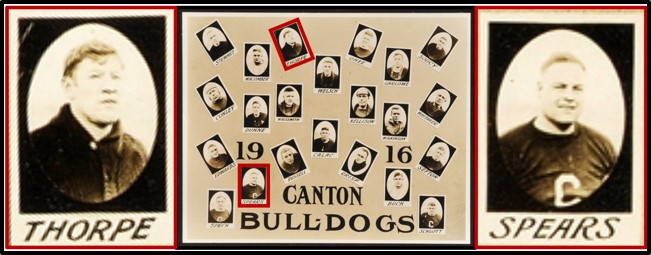
Clarence’s eligibility had ended, but he had one more year of pre-med studies to complete. His football coach, not wanting to lose Clarence’s talent, hired him to coach the freshman team. But it was conditioned on Clarence’s ability to continue his pre-med work. Clarence started down the path to becoming a legend among football coaches. He also played professionally that season with legend Jim Thorpe and the Canton Bulldogs.
Spears returned to Dartmouth in 1917, serving as the Green’s head coach for the next four seasons, compiling a record of 21-9-1.
In his final two years as Dartmouth’s coach, the team lost only three games and defeated the University of Pennsylvania in a 1919 matchup which the New York Times called the “most spectacular game ever seen” at the Polo Grounds. In Clarence’s final game at Dartmouth, the team defeated the University of Washington in the first game played in the just-completed Husky Stadium in Seattle.
Clarence was approaching the goal line on his medical degree. He wanted to practice medicine in addition to coaching, but Dartmouth was unwilling to let him. So, Clarence accepted an offer to coach the West Virginia University Mountaineers.
Before moving to Morgantown, Clarence married Cornelia McConnell, from Oak Park, Illinois, whom he had met while he was in medical school and she was in nursing school.
At West Virginia, Clarence had a small medical practice, thus earning his lifelong nickname, “Doc.” As coach, he developed the Mountaineers’ football fortunes in the early 1920s. In 1922, the school played in its first bowl game (East-West), had its first unbeaten season, defeated Pitt, 9-6 (considered among the greatest wins in school history) and helped build a football stadium.
Doc Spears then went to the University of Minnesota in 1925, because he had difficulty establishing a medical practice and wanted the opportunity to work at the nearby Mayo Clinic. He took a pay cut but added to his income by working at the university’s health services. In addition, Minnesota had a bigger football program and played in the Big Ten conference. Doc had a 28-9-3 with the Gophers, in part due to the 18-4-2 record built with his recruit, Bronko Nagurski.
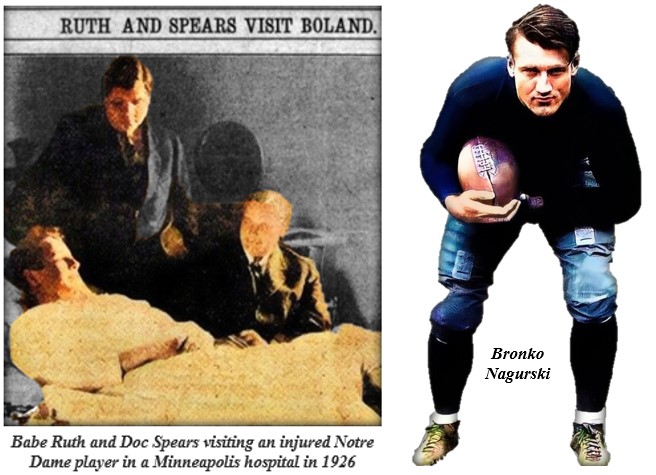
Doc Spears had been driving through rural Minnesota when he stopped at a farm for directions. A strong young man was plowing a field – without a tractor or horse. When he pointed Doc – with the plow – in the direction he was seeking, Doc knew he needed him on his football team.
Nagurski, excelled as a fullback, tackle, and linebacker, becoming a legend throughout the Midwest before joining the Chicago Bears for a Hall of Fame career. Many believed that Nagurski was the greatest all-around player who ever stepped on a football field.
After five years at Minnesota, Doc left for the University of Oregon, unhappy that he had to simultaneously recruit players, coach a team, and “fight a hostile faculty attitude toward athletes.” (Only later did the pendulum swing to the lofty position football occupies today in intercollegiate athletics.)
Doc was at Oregon for only two years, where he had a respectable 13-4-2 record. But that belied the clashes he had over his tough regimen, which Bill Bowerman, a freshman receiver and later Nike co-founder, called dictatorial and “cruel.” In addition, Doc was living alone in Eugene, away from his family, which took its toll on him.
Therefore, in March 1932, Doc accepted the head-coaching position at the University of Wisconsin, becoming the highest-paid coach in the school’s history. However, Doc soon was in the middle of a maelstrom.
Doc believed he had been promised the position of athletic director when it opened up. But when it did in 1934, the university president, worried over Doc’s advocacy of “bigtime football,” named the basketball coach instead. Alumni were indignant and promised to oust the new athletic director.
But the football team had only won one game the previous year, and there were rumors that Doc would be fired. There also were allegations that Doc gave his players liquor at a local roadhouse and that he was continuing to abuse his players. Allegations against the athletic director circulated as well. Eventually, the regents fired both Doc and the athletic director “in the interests of harmony.”
Doc landed on his feet, becoming both head football coach and athletic director at the University of Toledo. While there, Doc coached Emlen Tunnell, who left after his freshman year to fight in World War II and then played at the University of Iowa. After graduating, Tunnell played defensive back for the New York Giants and in 1967 became the first Black American elected to the Pro Football Hall of Fame.
After seven years at Toledo, Doc became head coach and athletic director at University of Maryland, while also working in student health services.
When Doc left Maryland after the 1944 season, he decided to give up coaching. He and Cornelia moved to Ypsilanti, Michigan, where he practiced medicine full-time. (Future Alabama head coach Paul “Bear” Bryant replaced Doc at Maryland.)

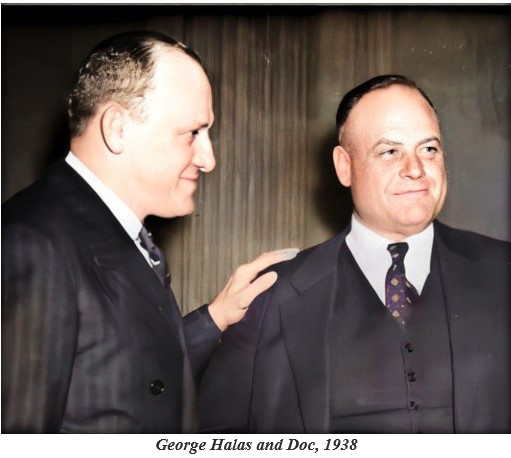
Clarence Wiley Spears died in Juniper, Florida, in 1964. He was one of the most famous coaches in the first half of the 20th century, friends with Jim Thorpe, Bronko Nagurski, Emlen Tunnell, Knute Rockne, George Halas, and many other illustrious names in college and professional football. And, Doc’s name ranks right up there in the pantheon of the gridiron.
Not bad for a boy from Kewanee High School.
(Steve Morrison, President of the Henry County Genealogical Society, kindly shared his file on Clarence Spears with me. Included in the file was Steve’s transcription of a series of articles on Spears which were published in the Kewanee Star Courier in 1932. I also relied on Timothy B. Spears’ book, “Spirals: A Family’s Education in Football” (2018 University of Nebraska Press).)