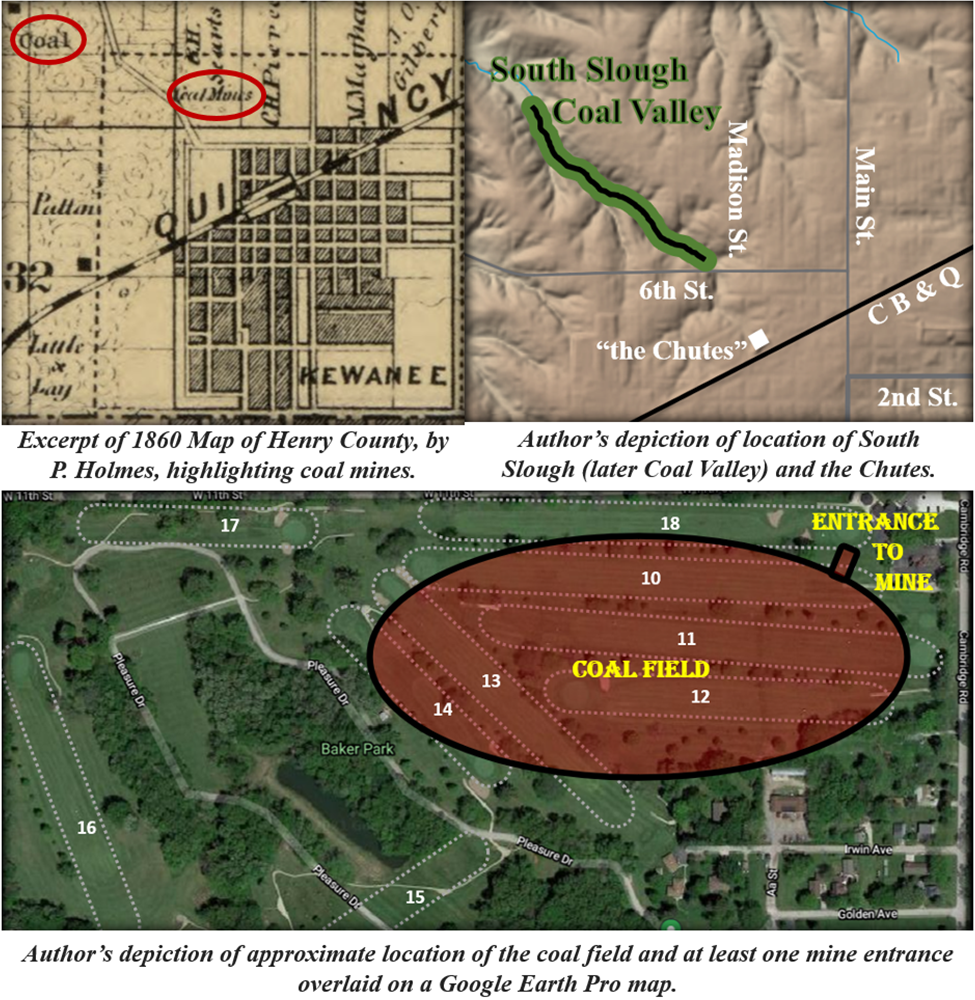
One of the very first industries in Kewanee was coal mining. Even before the village was founded in 1854, Wethersfielders knew of the existence of coal in and around what became known as the “South Slough” in today’s Baker Park, and at least a few folks were mining coal there before Kewanee was born.
That coal field likely played a role in the route followed by the Central Military Tract Railroad (later the Chicago, Burlington & Quincy Railroad), as well as the location for its depot in what became Kewanee. Legend also has it that as the CMTR completed its route through our hometown, coal miner Thomas Galloway convinced the railroad to burn coal instead of wood, spurring the development of the fledgling coal mining industry.
The South Slough, later renamed “Coal Valley,” ran from a little west of the corner of today’s Sixth Street and Madison Avenue to the northwest. Soon “the chutes” were built along the northside of the tracks into which the mined coal was dumped for loading onto the trains. From the southeast end of the valley to the northwest, the undulating terrain rose and fell some 80 ft. Situated at the edge of Big Barren Grove, the higher ground was wooded while the lower levels were marshy and wet. The area which became Baker Park was at the center of the mining activities in those early years.
In 1859, Kewanee’s Henry County Dial newspaper reported that
“the Railroad Company takes from five to seven car loads a day for the supply of their locomotives, and would gladly take double that quantity if miners could furnish it . . .. A still larger quantity – some fifteen car loads a day – is sent to . . . towns along the line of the road eastward. Very considerable quantities are also consumed here, as, notwithstanding the abundance and cheapness of wood, most persons give coal the preference . . .”
In the 1970s, Dean Bates, who was a descendant of one of the early mine owners and a mining expert himself, explained the early mining:
“Most of the [early] mines were ‘slopes’ or ‘drifts,’ indicating a tunnel-like opening dug into the hillside. If the opening started on the hillside at a level higher than the level of the vein of coal, it was called a ‘slope,’ since it pitched downward until it reached the level of the coal. Where the ravine was cut deeper than the vein of coal, it permitted starting the opening on a level with the coal, thus approaching the vein horizontally. This type of mine was known as a ‘drift’ and was much preferred to a ‘slope,’ where mine water disposal and the wheeling out of the mined coal created more of a problem.”
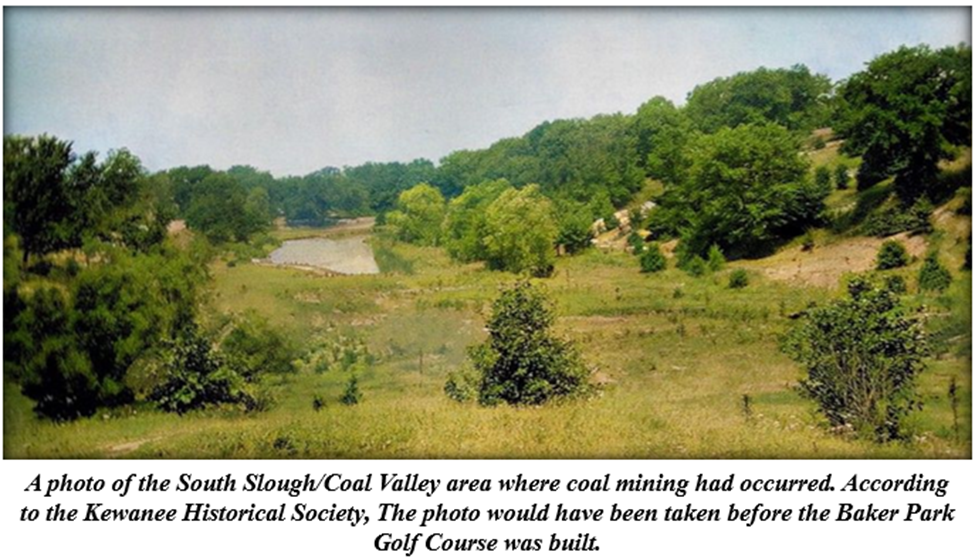
There are a number of stories about those early coal mines including this one from Bates:
“Two [miners] build for themselves what we would now call a duplex miner’s shack, with a partition across the middle and with a door in each half, so that each could have some privacy. After a time, a quarrel developed between them, so one evening as one of them home from his day’s work in the mine, he was astonished to find only one-half of the shack — his half — remaining on the premises, with an open end exposed to the elements. The other occupant had stayed home from work and had sawed the building in two, taking the partition wall with his half and had moved it away.”
Another story relates to miners’ fondness for alcohol. Not too long after Kewanee was founded, a man named Jack Hill built a small saloon on the west side of Cambridge Road across from today’s 8th green on the Baker Park Golf Course. Because Kewanee was a temperance-tending village, he originally put it down in a hollow along the South Slough. But Jack soon moved it up to the road for easier access. The saloon catered to, among others, the miners who worked up Coal Valley during mining’s short-lived heyday. The place became a landmark, known as “The Place that Jack Built.” It finally burned down in 1911.
When the Civil War began, coal mining was a vital part of Kewanee’s economy, and it played an important role in the conflict.
By mid-1862, Kewanee had formed two companies of Union soldiers that eventually became part of the 124th Illinois Infantry Regiment. (Other Kewaneeans had earlier joined other Illinois regiments as well. Also, as formerly enslaved persons made their way to Kewanee, a number of them joined the Union army, albeit in the segregated “Colored Troops.”)
Eventually, those Kewanee companies found themselves in the middle of the war and at the location of one of the most crucial battles of the war. Many of those Kewaneeans came from the coal mines, and they helped turn the tide of the war.
Confederate President Jefferson Davis had called Vicksburg the “nail head that holds the South’s two halves together.” President Abraham Lincoln acknowledged that “Vicksburg is the key! The war can never be brought to a close until that key is in our pocket.” The reason? The Mississippi River served as the preeminent pipeline for supplies and communication through the South as well as a vital lifeline for goods going north.
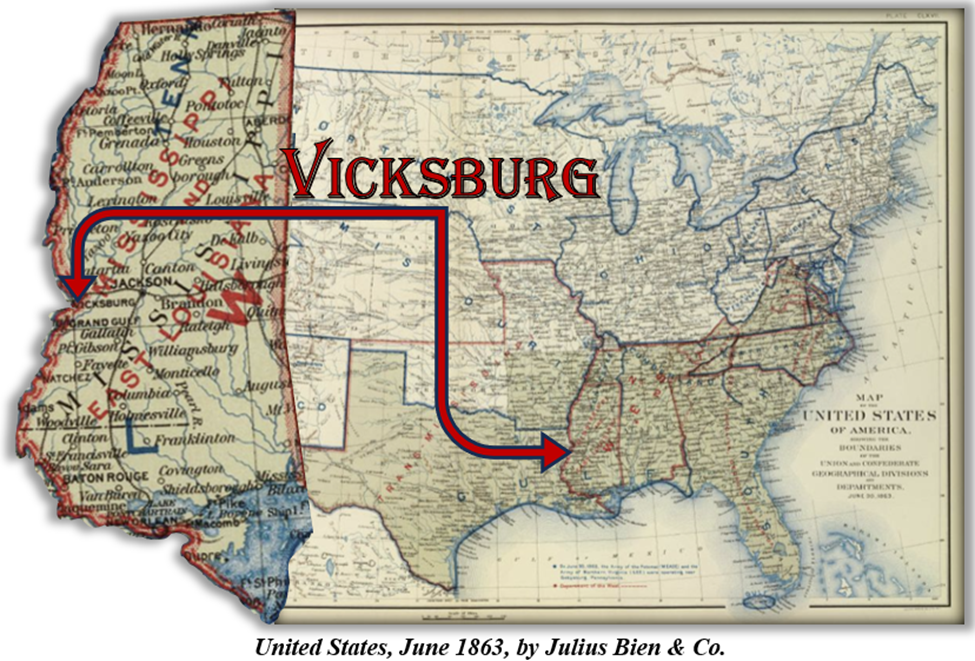
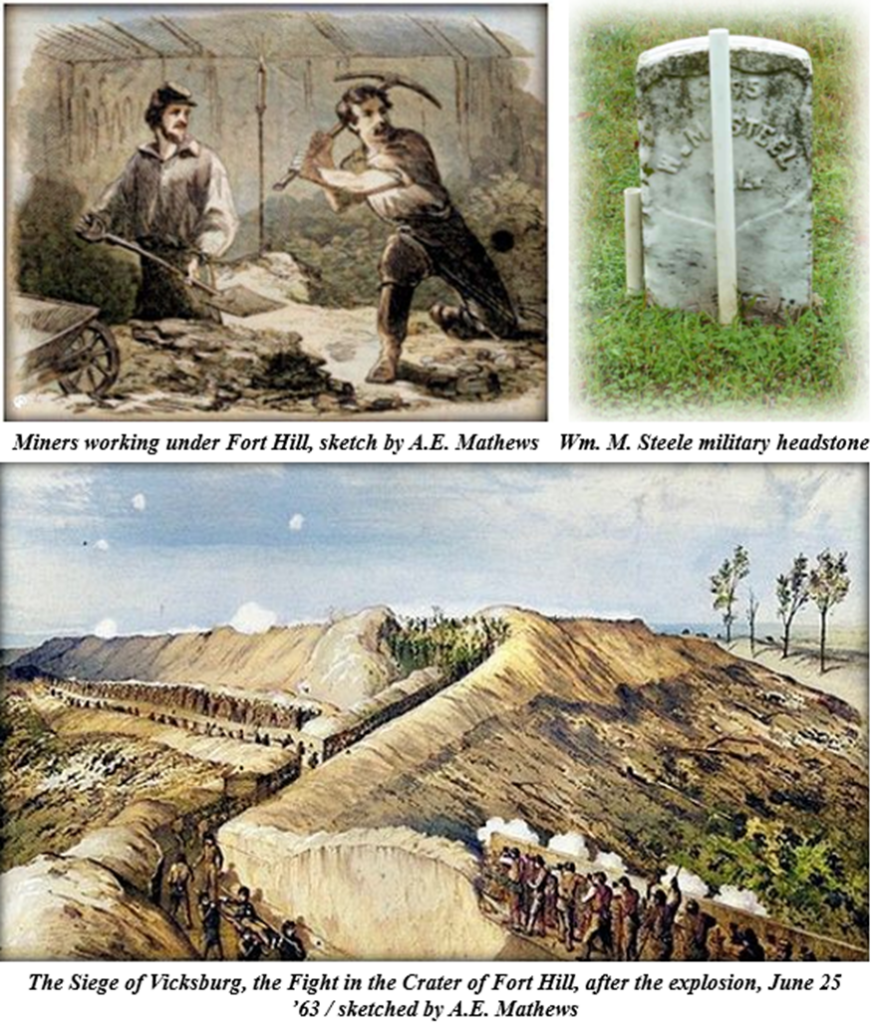
The Vicksburg campaign had begun in 1862, but in late spring 1863, it was reaching a turning point. Standing in the way, however, were Confederate fortifications at Fort Hill. The Illinois 124th, which included Kewanee’s two companies, were at the forefront of the battle. In late June, and led by Kewanee Colonel John H. Howe (later promoted to become Kewanee’s only Civil War general), plans were hatched for taking the fort.
The Union’s success at Fort Hill was directly attributable to soldiers from Kewanee who had been miners in the coal mines along the South Slough and elsewhere north of the village. Those experienced miners labored to dig tunnels under Fort Hill. They then planted 2,200 pounds of explosives. On June 26, the explosives were set off, causing the fort to collapse and create a great crater. Howe called the miners’ work “of more than usual hardship and peril, it is due to the brave men [who deserved] especial mention . . . .”
The siege of Vicksburg ended when the Confederates surrendered on July 4, 1863. Combined with a Union victory at Port Hudson five days later, the Union controlled the entire Mississippi River, splitting the Confederacy in half.
Those, however, were not the only Kewanee coal miners to make news in 1863. The September 1, 1863, Chicago Tribune reported this story.
That same summer, because the war had led to an escalating cost of living, miners in various areas of the country went on strike. Kewanee miners still working in the mines along the South Slough and to the north of the village joined them.
The Kewanee miners demanded an increase in wages and full employment. But the employers recruited scabs to try to keep the mines operating.
After they had been on strike for some time, 40 to 50 of the wives of the miners, armed with sticks, stones, lumps of coal and other weapons, marched to the coal banks still being mined. The women protested at the coal operations of Weiseker & Co., Binks & Bradbury, John Patrick & Co., William Martin, William Bates, and Beadle & Steele, and teamsters carrying coal were stopped. The women pelted the owners with coal, overturned coal cars, and otherwise wreaked havoc. The male coal miners stood by watching and encouraging the women.
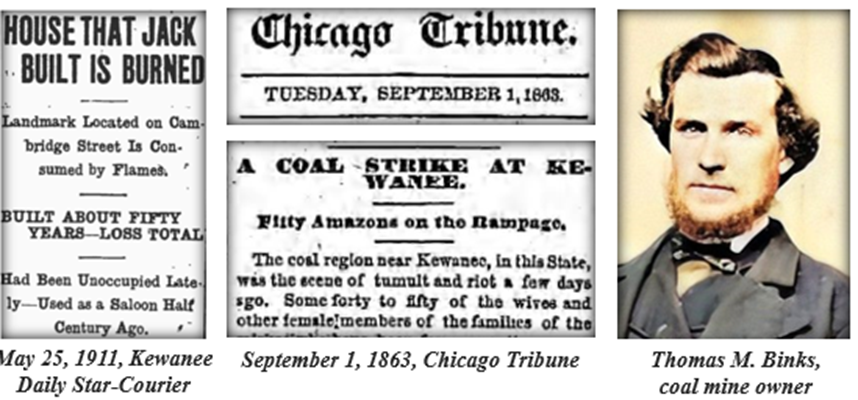
Unfortunately, other than the Tribune article describing the event and others repeating the Tribune report, I could find no additional information about the strike or its outcome. But I doubt that it was the first or the last coal strike in the Kewanee mines.
Mining ended along Coal Valley by the end of the 1860s as more productive mines were found to the north and east of Kewanee. But the mines and the men working them – along with their wives and sweethearts – contributed memorably to our country, Kewanee, and our hometown’s lore.