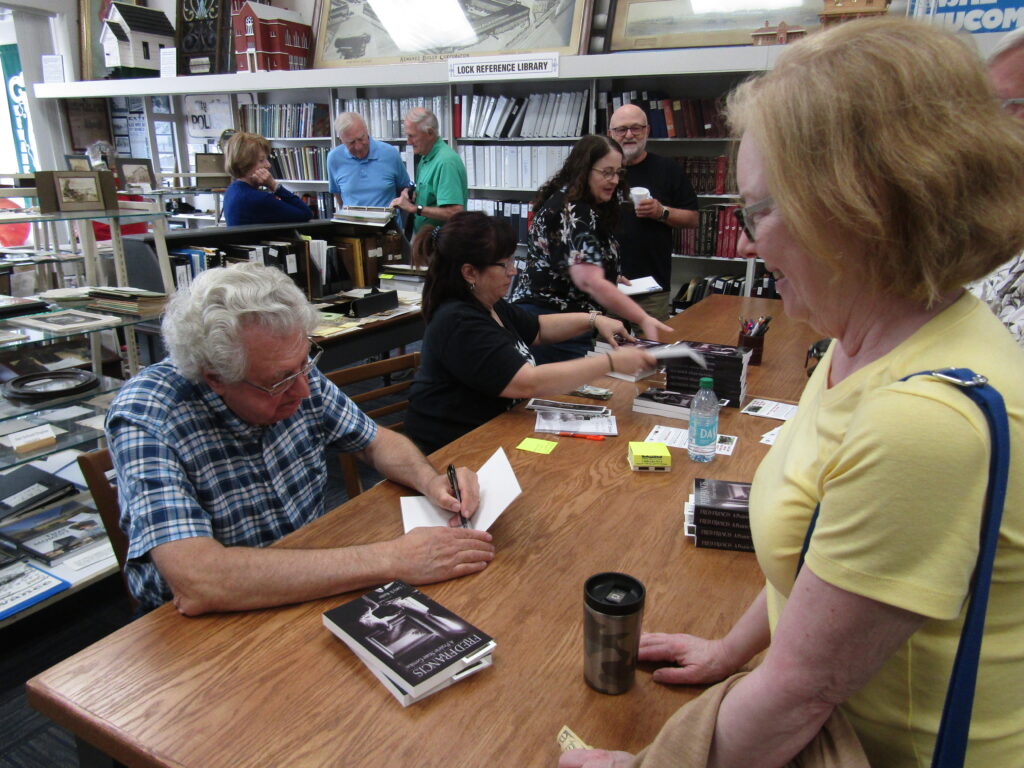
The title is “Fred Francis: A Prairie State Genius.”
The book was written by Larry Kuster, who spoke on Fred Francis, the man and the myth and took questions from the standing room only audience at the Kewanee Historical Society Museum Saturday.

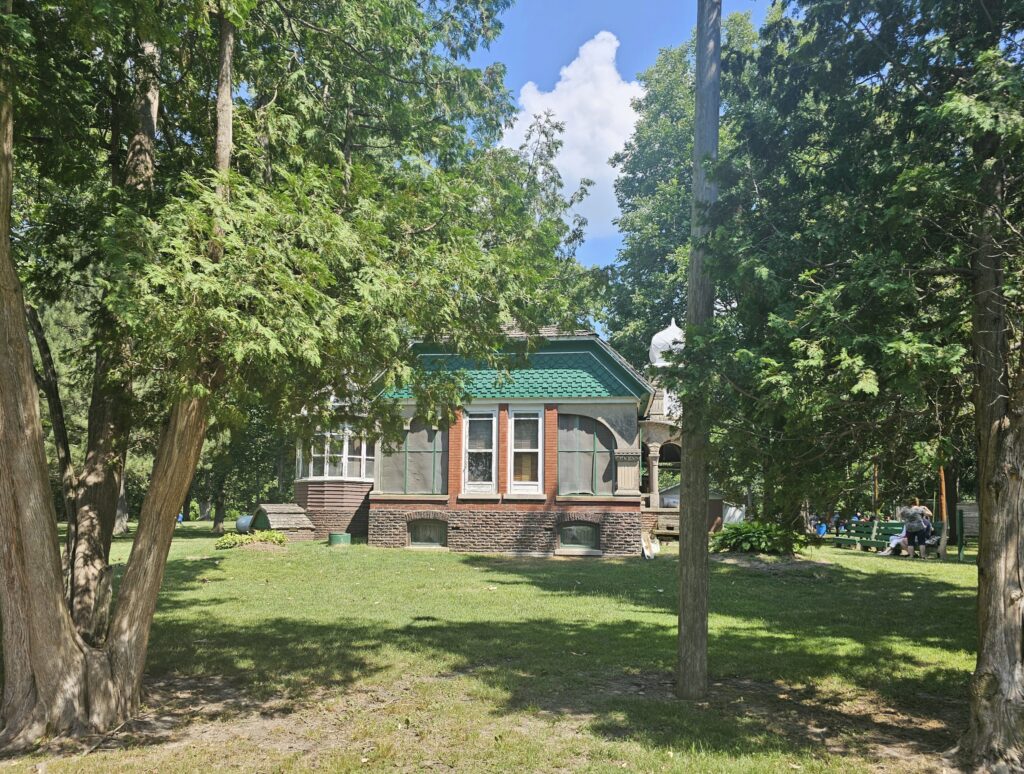
Kuster, a retired attorney now living in Jacksonville, grew up on a farm just west of what is now Francis Park. His grandfather and great grandfather knew their neighbor well and the latter shared many stories about him with Kuster when he was a boy. His parents, Don and Rosemary Kuster, were heavily involved in restoring Francis’ home, known as the “Woodland Palace,” in the early 70’s as a project in preparation for America’s Bicentennial in 1976.

The home, unique architecturally, contains many inventions ahead of their time and was placed on the National Registry of Historic Places after being approved as a State Historic Site in 1974.
Kuster said many questions have circulated throughout the community over the years about Francis and his wife, Jeanie, their supposedly unorthodox lifestyle and unusual home surrounded by acres of timber.
Did Francis actually carry bricks from Kewanee on his bicycle to build the unusual looking home? Was he an atheist? Was his death in 1926 at age 70 the result of suicide? How did the City of Kewanee come to own the property? The answers to those questions, and more, are answered in “Fred Francis: A Prairie State Genius.”

Kuster said he had planned to write a book on Francis including memories of stories told by his father and grandfather about him, when his mother, Rosemary, died, but never had the time.
Now, retired, he has spent several years digging into records, newspaper archives, Francis’ actual writings, and doing interviews to seek out the real story of Mr. Francis.
For instance, Francis has been described as reclusive and eccentric, but Kuster said he found him just the opposite.
Certainly, possessing the mind of a genius and a prolific inventor, Kuster said Francis had a sense of humor, loved to have people come and enjoy his wooded surroundings, and had traveled often with his wife, Jeanie, for whom he had unlimited love. He also became a noted speaker often giving lectures on nature in the environs around his home.
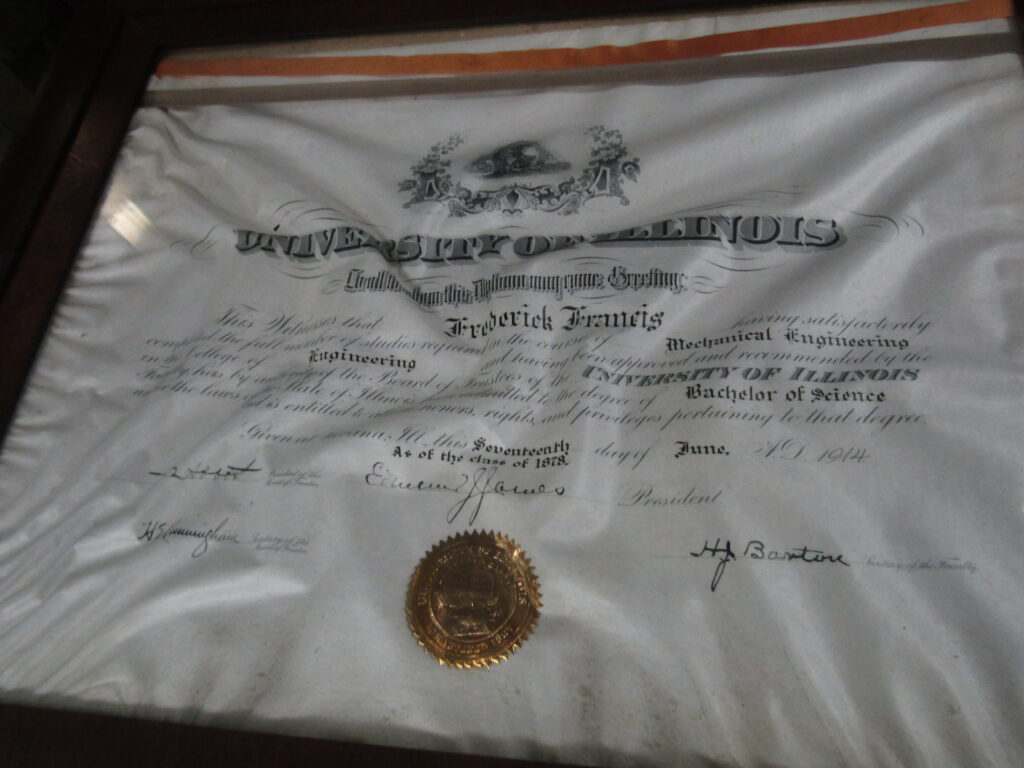
Growing up on a farm near the park, he was tutored at home by a brother before being accepted at the University of Illinois where he graduated in 1878 with a certificate in mechanical engineering. He went to work for the Elgin Watch Company, in Elgin, Ill. and received several patents. He also invented a tool used to install a main spring in a watch which supported him financially until, at age 34, he wrote the watch company and told them to stop sending him royalty checks since he “had all the money a man will ever need.”
In his bachelor days in Elgin, Kuster said Francis was considered quite a lady’s man, but in 1890 he married Jeanie Crowfoot in Elgin, and they returned to Kewanee where he began to build their home in the timber near his father’s farm.
Kuster said his research revealed that the inspiration behind most of his inventions, which made life easier in their home, came from Jeanie. When she contracted tuberculosis Francis built a solarium where the air was recycled to keep it fresh until she died in 1921.
Kuster said the Woodland Palace is a “truly a national treasure” and encouraged support of efforts to repair and restore the historic structure.
A year ago, a group of volunteers formed the Friends of Woodland Palace under the 501 c (3) umbrella of the Kewanee Preservation Society.
KPS is responsible for preserving and maintaining the Little Log Cabin, the Potter hedge tree, the Kewanee Boiler flagpole in Berrien Park and, most recently, the Kewanee Boiler Memorial Park on Rose Street.
Donations can be made to the Kewanee Preservation Society, 113 E. Second St., Kewanee, Ill., 61443, by writing “Woodland Palace” in the memo line.
Kuster said the proceeds from the sale of all books sold in Kewanee will go to the Woodland Palace fund. Books may be purchased locally at the Kewanee Historical Society Museum 125 N. Tremont St., which is open Thursdays and Saturdays from 1 to 4 p.m. through October.
***This copy has been edited to correct the title of the 501 c (3) group, which is Friends of Woodland Palace and not Friends of Francis Park as originally reported.