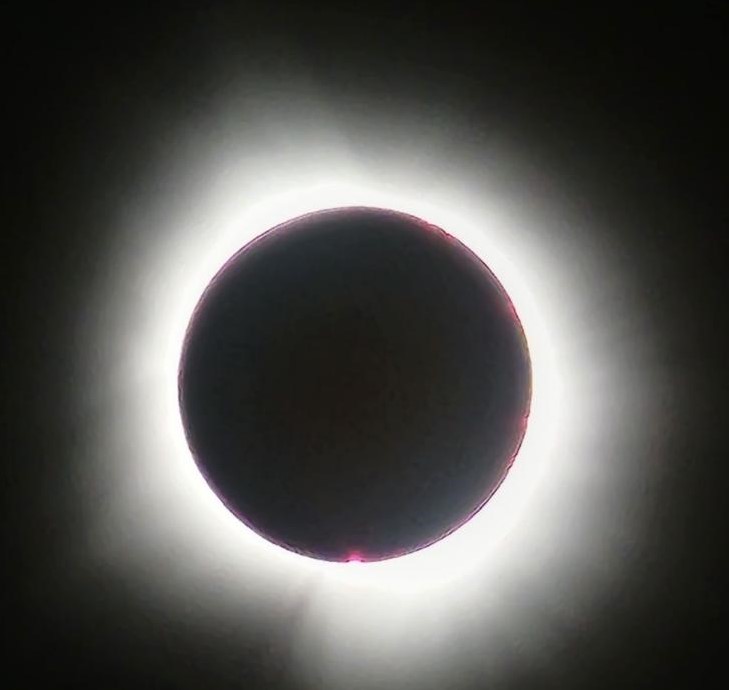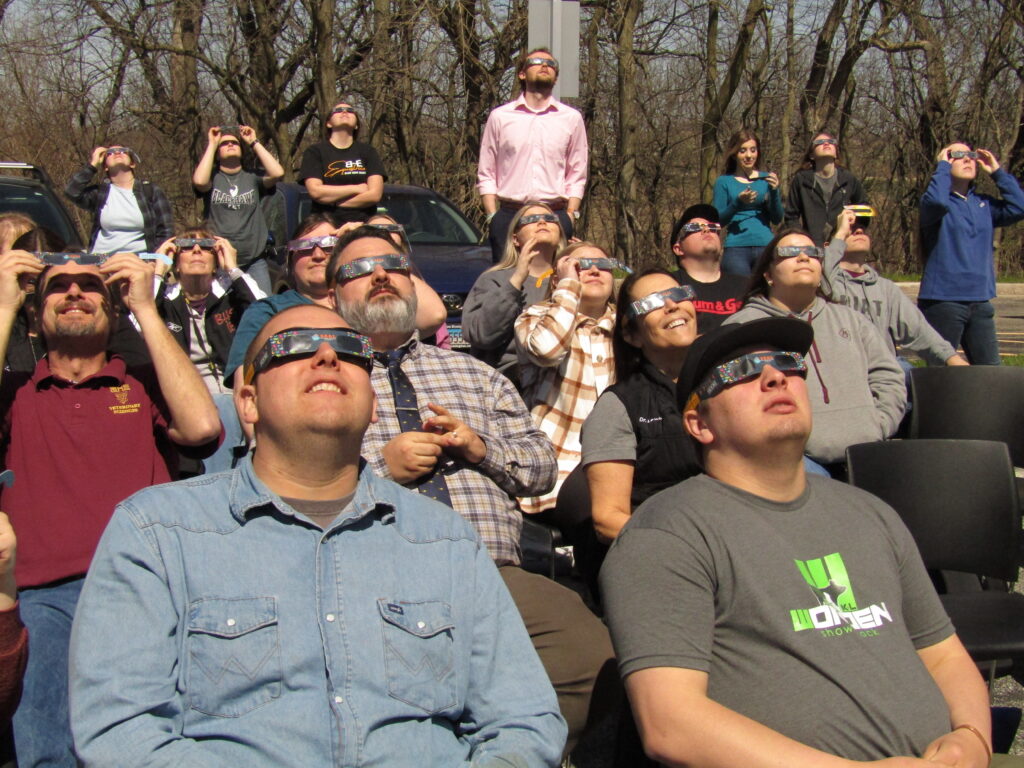
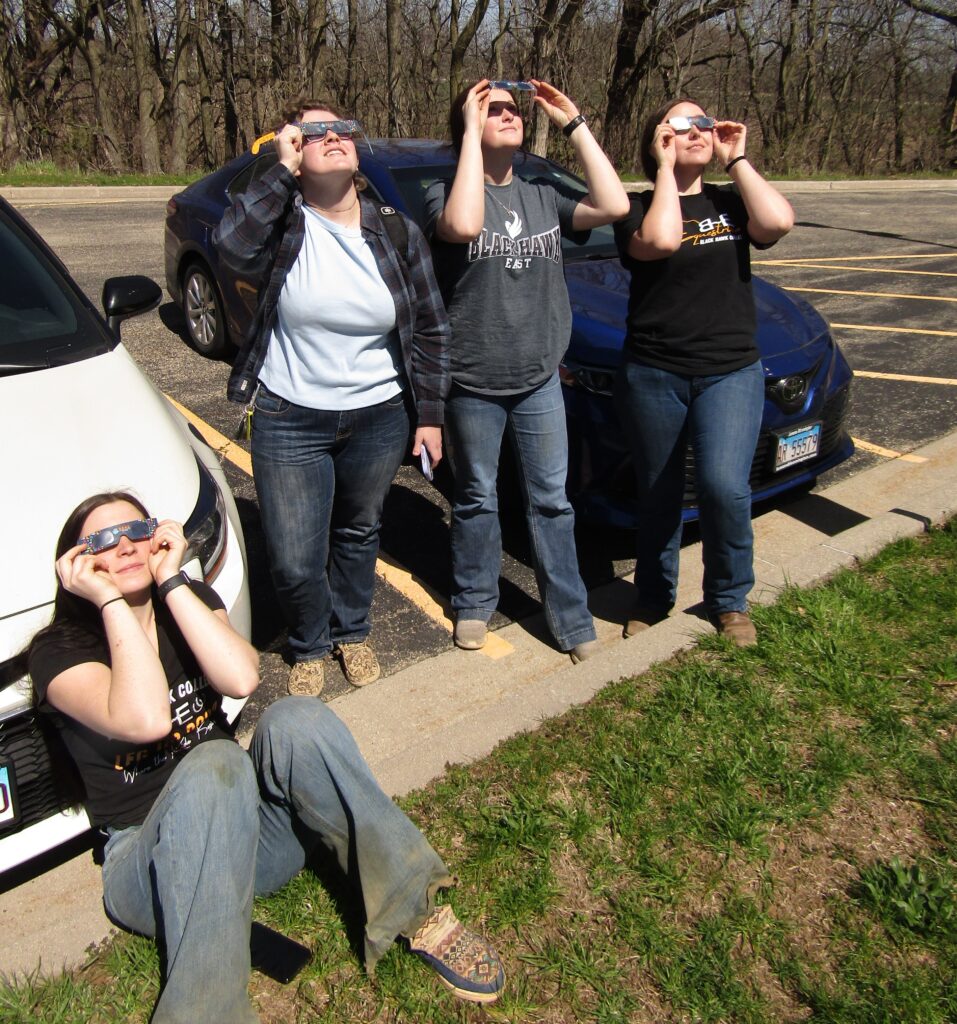
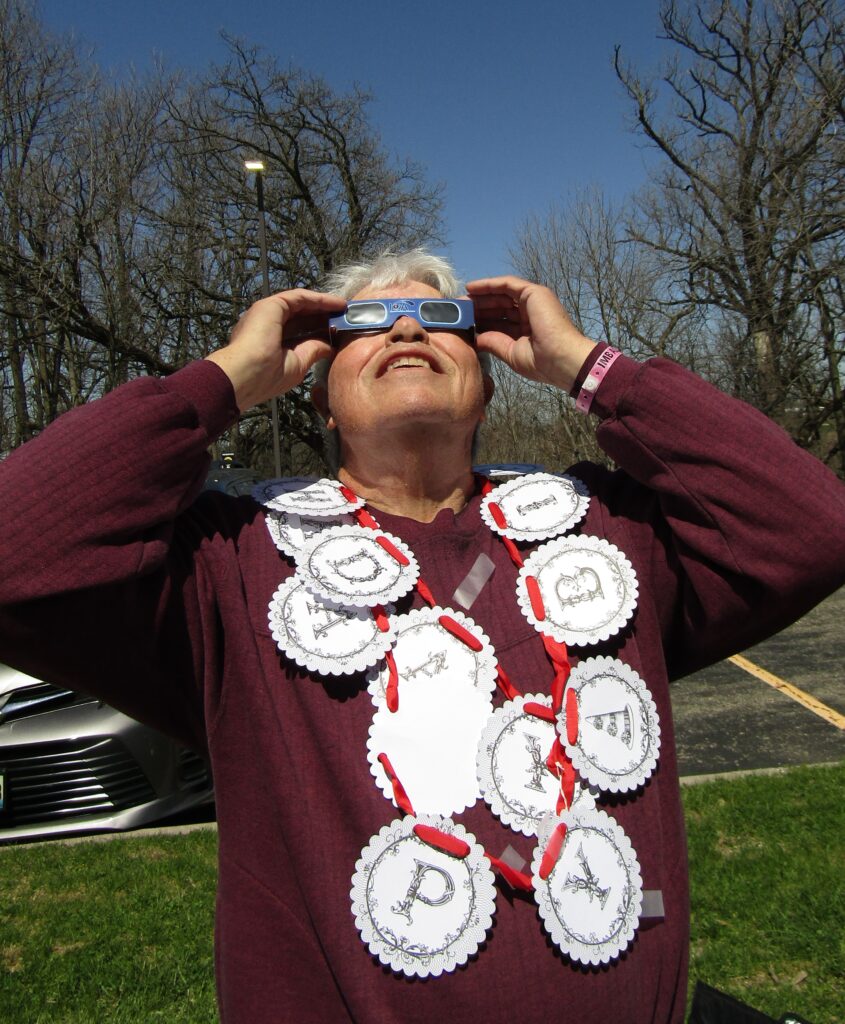
The only thing better than the weather was the view as a crowd of students, faculty and other spectators gathered in the sunny hilltop parking lot of Black Hawk College East Campus, Monday afternoon to witness a partial solar eclipse at a watch party hosted by the college.
While the path of the total eclipse passed some 190 miles south of here, local viewers donning special glasses were able to see the moon cover about 91.5% at exactly 2:03 p.m.
The eclipse began locally at 12:47 p.m. and ended at 3:18 p.m. At around 1:50 p.m. daylight dimmed enough to turn on the lights in the parking lot, usually lit at night as the moon covered about 80 percent of the sun. Winds were always blowing so any increase caused by the eclipse was negligible.
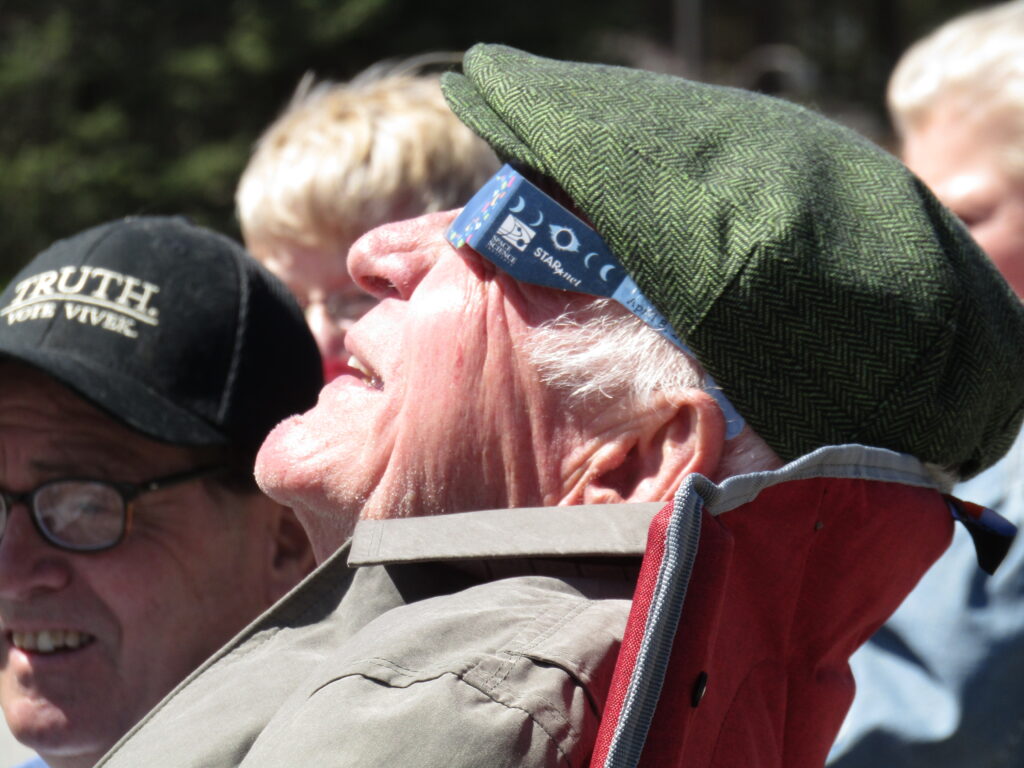
“It’s amazing. We won’t see anything like this again in our lifetime,” said Rose Humphrey of Galva.
For Beth Dolieslager, of Kewanee, seeing the partial eclipse was something she doesn’t take for granted.
“It’s amazing,” said Mrs. Dolieslager, as she gazed into the heavens with the protection of the protective glasses.
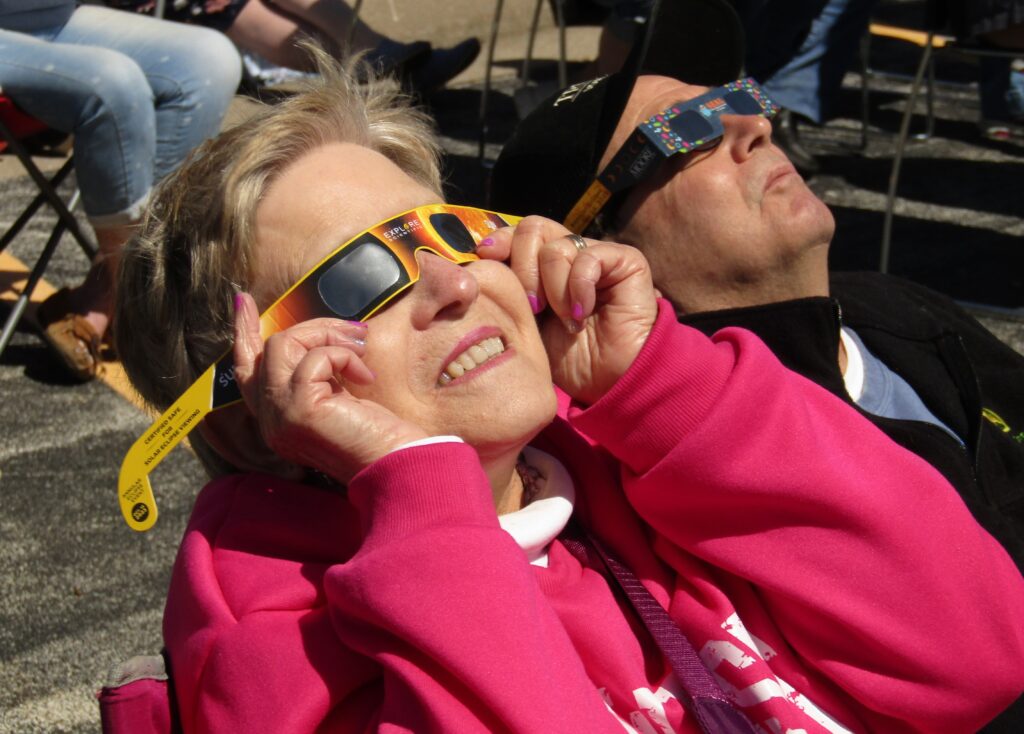
Dolieslager was featured in a 1995 “People Who Make a Difference” story in the Star Courier which told that she was born prematurely and sustained permanent damage to her retinas while in an incubator. Fortunately, she did not lose her sight completely but was left with impaired vision. Not allowing that to slow her down, Beth graduated from Kewanee High School, Black Hawk East and Illinois State University and became a teacher. For her, seeing the partial eclipse truly was an amazing experience.
Keith Majors, who drove from Oak Run near Dahinda, with a van full of family and friends, was celebrating his birthday Monday, with a trip to the watch party and said it was the first time he could remember that his birthday coincided with a solar eclipse.
Rain and overcast skies almost canceled the last solar eclipse to pass near the area on Aug. 21, 2017, but when the time came, the skies had cleared. The path of totality that year ran northwest to southeast across the U.S. from Oregon to South Carolina, entering Illinois at East St. Louis and moving on into Kentucky.
In Kewanee, a partial eclipse was visible beginning at 11:50 a.m., reaching maximum coverage at 1:16 p.m. and ending at 2:40 p.m. Carbondale, which experienced the longest duration of totality in Illinois this time, at 4 minutes 10 seconds, was also in the path of totality in 2017, but with a duration of only 2 minutes 37 seconds.
Cat Broady, Reference and Instructional Librarian at the East Campus, who coordinated the watch party, praised the “beautiful weather” for making their watch party, complete with cookies and pizza, a success.
The next time a solar eclipse passes through the U.S. will be Aug. 20, 2044.