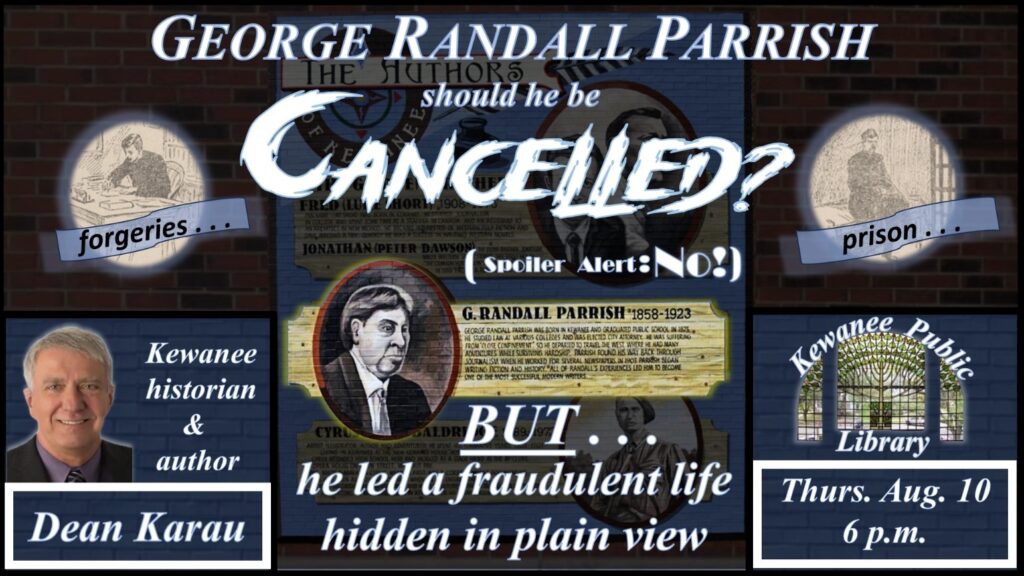
I’ve written before about G. Randall Parrish, one of four famous Kewanee authors depicted on a Walldogs’ mural now residing on the north side of the Kewanee Public Library. Specifically, I’ve written about another, darker side of Parrish’s life of which Kewanee today is unaware, and I’ll be talking about that life at the library on Thursday, August 10, at 6 p.m.
But today, I’ll focus on some of the early adventures Parrish said he experienced in his younger years. And even if they were not fully true, the adventures may have been part and parcel of the imagination of this Kewaneean which led to his successful literary career.
The limited biographical information of Parrish is succinctly summarized on the library’s mural:
“Born in Kewanee in 1858 the son of Kewanee pioneers Rufus P. and Frances A. Hollis Parrish, he graduated from the old Academy (Kewanee High School) in 1875. Four years and four schools later Parrish became a lawyer in Iowa. Before returning home, he experienced a variety of occupations, including law, itinerant railroading, sheepherding, gold mining, journalism and the ministry in several western states and Illinois.
His first novel, “When Wilderness was King,” was published in 1904 while he was working as a reporter in Chicago. Encouraged by his initial success, Randall Parrish (the name he used for his novels) came home accompanied by his second wife, Rose Tyrrell, to devote full-time to writing his stories.”
But Parrish himself filled in some details in his story in a letter he wrote before his death to fellow author Dr. Henry F. Hoyt, whose own book, “Frontier Doctor,” was published in 1929.
Here are excerpts of what Parrish wrote to Hoyt.
After Parrish had graduated from law school in 1879, he moved to Wichita, Kansas, to begin his practice. It was a rollicking Western town with a population of around 4,000.
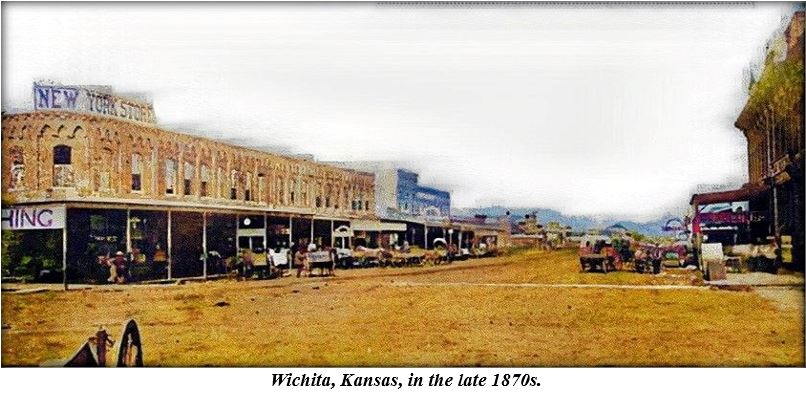
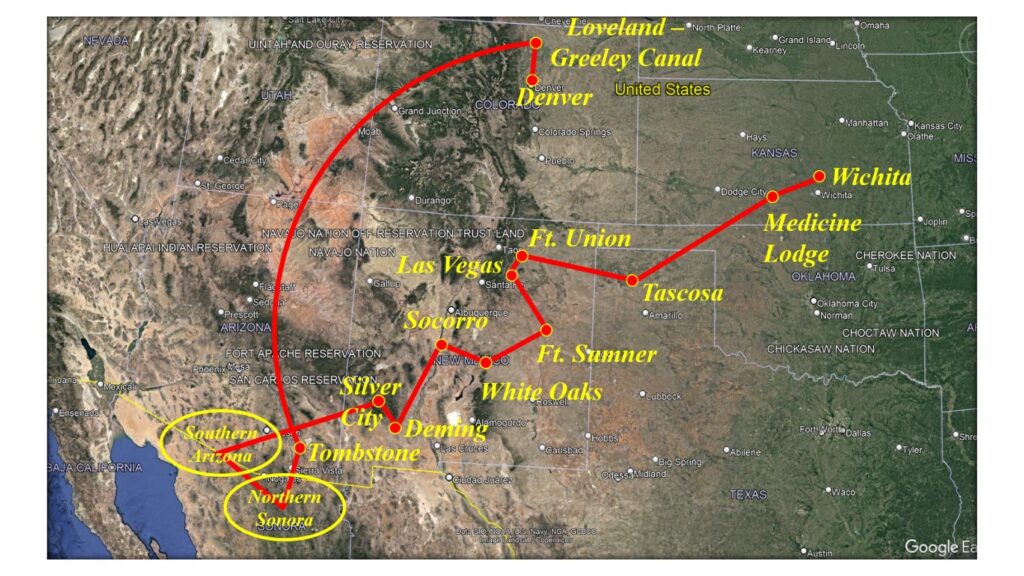
But in the spring of 1881, Parrish said he had “[s]tood the strain as long as I could and then joined a cattle party at Medicine Lodge bound for Santa Fé . . .” Medicine Lodge was located in western Kansas, the site of an early peace treaty reached with native Americans.
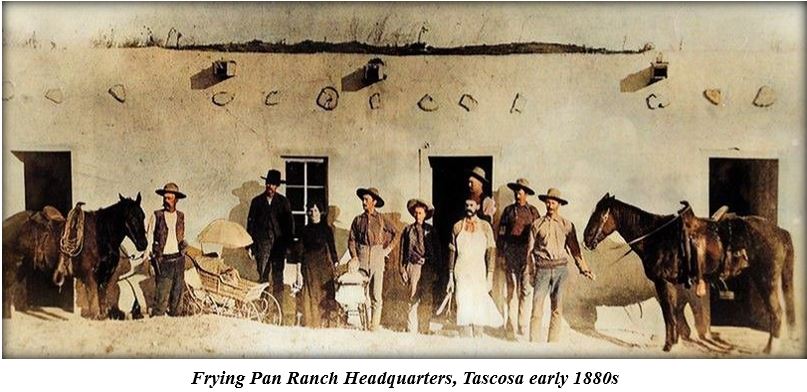
Parrish left the party at Tascosa in the Texas panhandle and “took up cow-punching as a diversion, landing a job with the Merrill & Cassett outfit . . .” Tascosa left a strong impression on Parrish – “you could smell the town four miles away when the wind was right, and when we first rode in we were behind a big cattle party who had cleaned the place entirely out of grub. All we could buy was whiskey and sardines.”
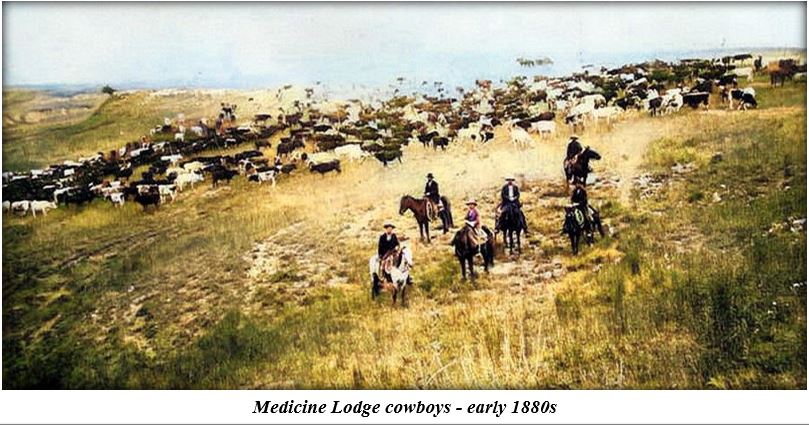
The next time he was in Tascosa, Parrish said he was accidentally shot: “I came in strapped on a bronc from a cow camp forty miles below . . . . Every time that bronc got scared and jumped sideways, I fainted, but the boys had heard there was a doctor . . . and were bound to get me there. He was there all right, but was a horse doctor, and he did a rotten job, but got the ball out after a fashion.”
Once Parrish recovered, he and another fellow started off for Las Vegas, New Mexico, a little northeast of Santa Fe. Parrish wrote that he “got there, broke flat, and took the first job that opened — washing dishes in a restaurant of rather unsavory reputation.
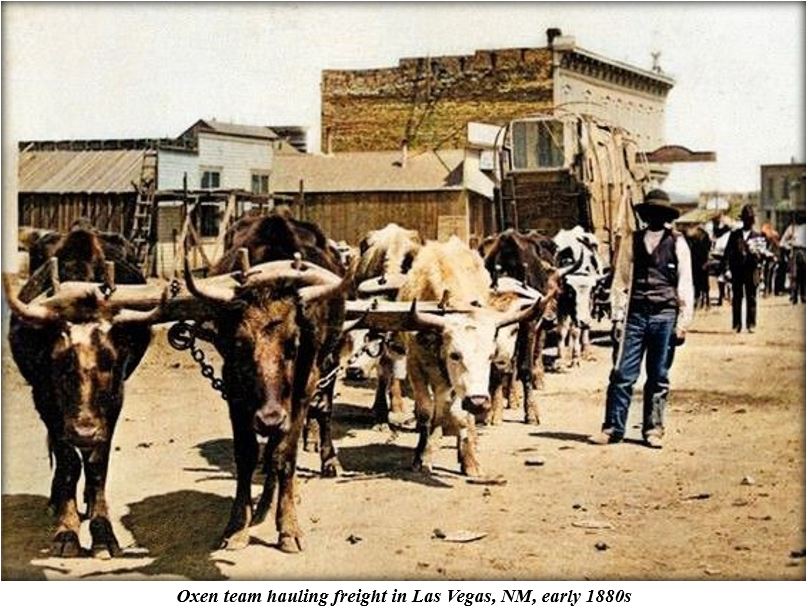
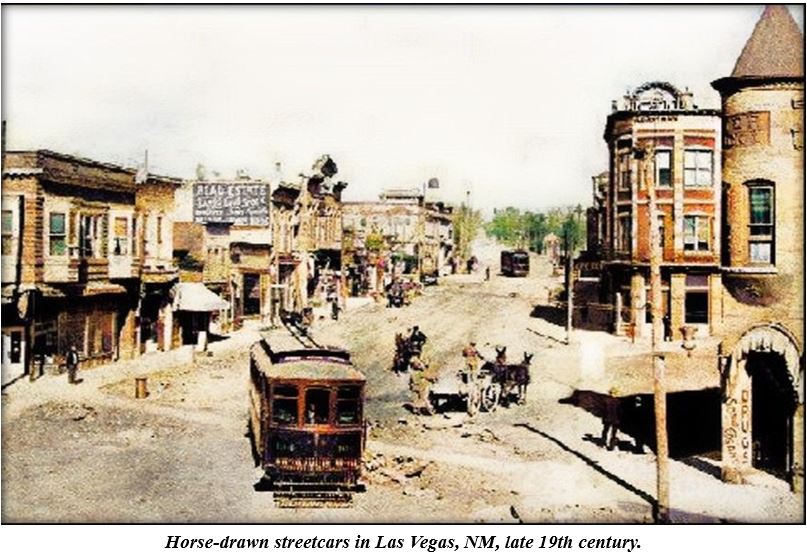
Confess I did not last long, but began an upward career which included helping to lay the first streetcar track in the place, wiping nights in the round house, a highball game at Raton . . . .”
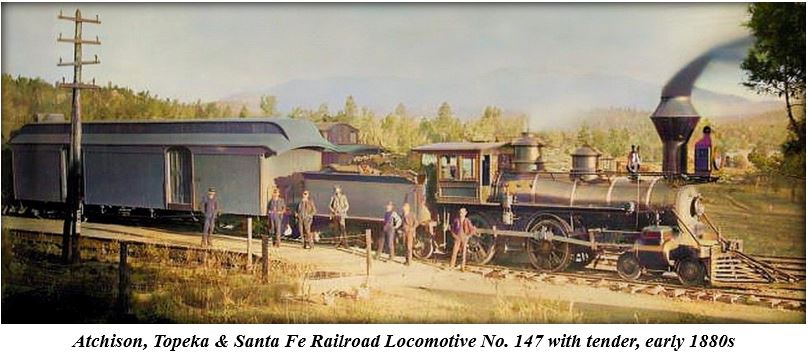
According to Parrish’s letter, he finally landed a more permanent position, “a fireman’s job on the Santa Fé, with a freight-train run from Vegas to Albuquerque. Say, that was a hard one, but I stuck for quite a while . . . .”
Parrish left Las Vegas “to join a bunch of sheepmen, who were intending to buy in southern New Mexico, and drive through to Colorado. That was what brought me to Fort Sumner [New Mexico] . . .” With them, he claimed another near-death experience: “One of our fellows went crazy — very common with sheepherding — on the trail going down, and tried his best to kill me — would have succeeded if his gun hadn’t jammed. We overpowered him, strapped him into a buckboard with the mail carrier, and sent him back to be looked after.”
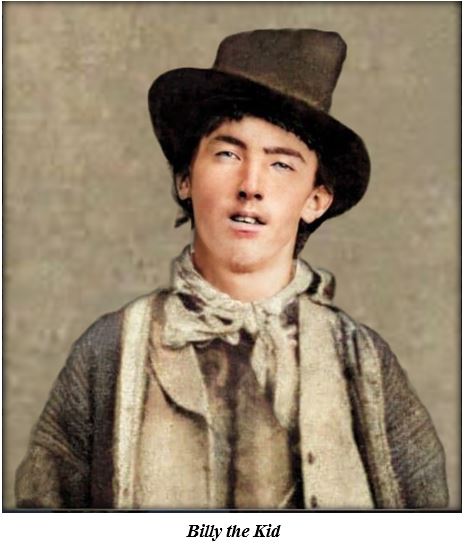
In Fort Sumner, Parrish claimed he made “a very slight acquaintance with the Kid. . . . I saw Billy . . . in the big general store beside the river. It was three days before he was shot, and he sure did give us the look over proper. I didn’t know who he was at the time, not until I saw him lying dead later. The night he was killed [July 14, 1881] we were camped seven miles out, but the news reached us.”
After the sheepherding failed, Parrish said he drifted through various New Mexico towns – White Oaks, Socorro, Deming, and Silver City – working at various jobs, “until I joined up with a party of prospectors. We had all degrees of luck, mostly bad, tramping across most of southern Arizona, and down into northern Sonora.”
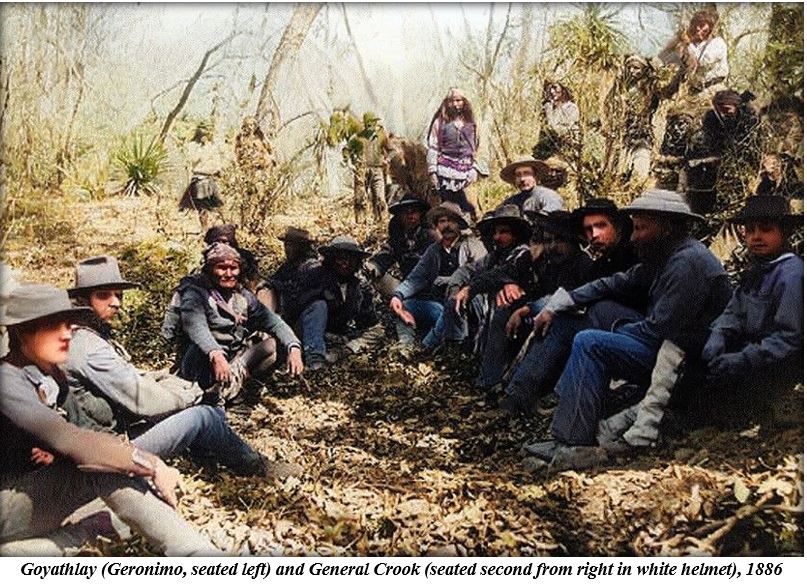
Once more, Parrish professed to have intersected with another famous historical figure: “It was rather unhealthy there at that time, as Geronimo was on the run, killing anything he found in his way. We had one set-to with him, and lost a pal, and found many a burned ranch home, and several dead bodies. For about two months it was hell in that country.”
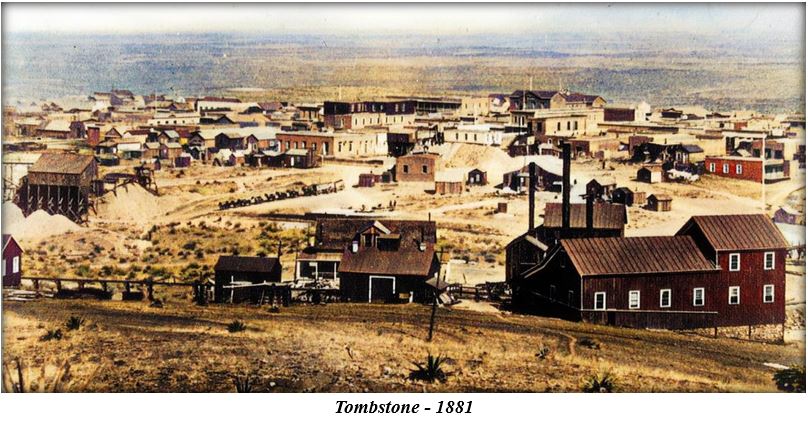
After those events, Parrish wrote that “I ended up with mountain fever, and only pulled through by accident. The boys managed to get me into Tombstone, where the Locomotive Fireman’s Union took care of me . . . .”
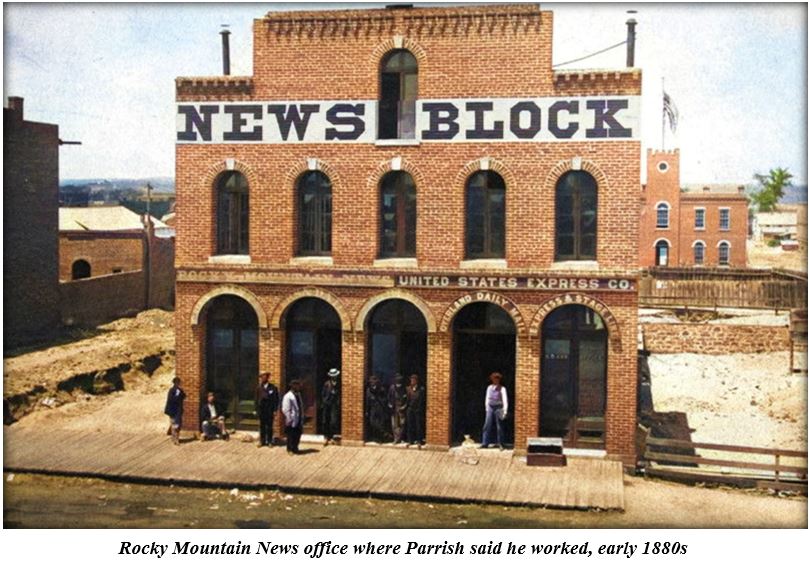
When Parrish recovered, he headed north into Colorado, where “I worked awhile as rodman on the ditch survey between Greeley and Loveland [the sixth enlargement began April 1, 1881]; then drifted into work in Denver.”
Parrish then closed his letter to Hoyt, saying “[a]ll I got out of the southwest was experience, but I got plenty of that, and have found it valuable.”
We already know that George Randall Parrish was a convicted forger. Is there anything else that would make us think that these stories of his Western adventures possibly were made up, too?
The answer is a resounding YES!
At my talk at the Kewanee Public Library on Thursday, August 10 at 6 p.m. I’ll share the information I found, including Parrish’s own words and those of his great-granddaughter, and you can be the judge of the character of this famous Kewanee author.