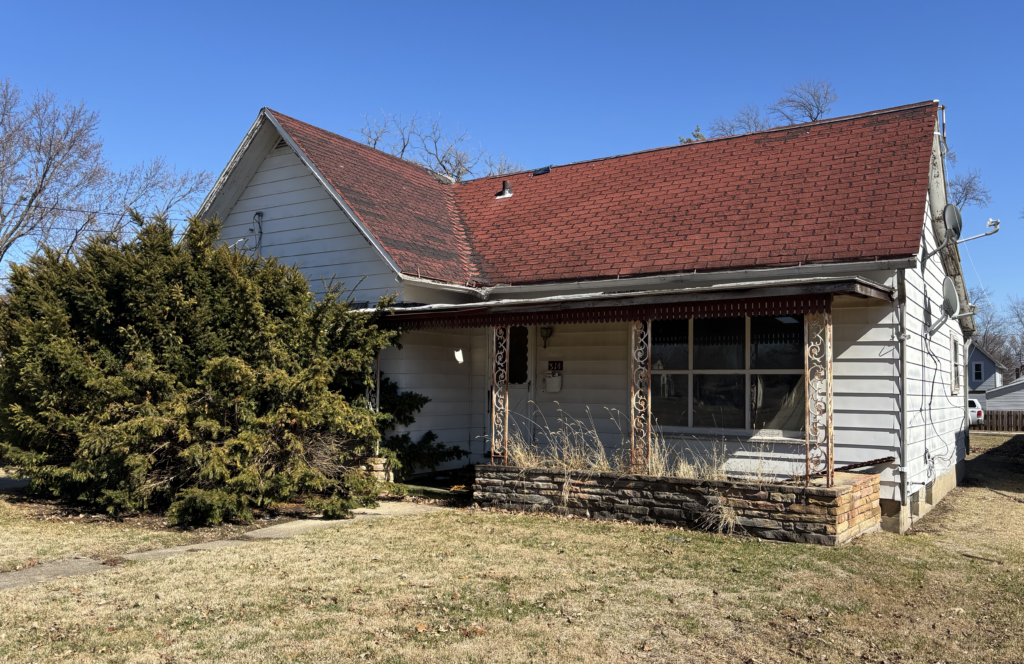
The city of Kewanee has demolished a number of condemned houses in recent years.
The City Council would like to see new houses built to replace the ones that were torn down. But that might not be easy.

In most cases, the demolished houses were old two-story units built on lots that were too small for a modern single-story home. In these cases, the city puts the lots up for bids, and the buyer is usually a neighbor who pays a few hundred dollars to have a new side yard.
But what if the house is on a buildable lot in an attractive neighborhood?
That’s the case with the house at 314 S. Cottage St., which is across the street from West Park.
As Keith Edwards, the city’s community development officer, said in a report to the council, the house looks good from the street.
But in the back of the house, there is a hole in the roof that has let in stormwater which has damaged the interior.
Edwards reported that the owner of the house has signed a consent to have it demolished. At Monday’s meeting, the City Council approved the bid of Martin Brothers to demolish it.
The city seeks bids on two demolition methods. In one, the contractor fills the basement of the house with debris from the demolition and covers it with enough dirt to level the lot.
In the other method, the contractor removes all the rubble from the demolition and fills the basement with dirt, leaving a lot where a new home can be built for less expense.
Martin Brothers bid $6,500 for the first option and $8,500 for the “clean fill” option. The council voted to accept the latter bid.
Council members also discussed ways to make it more desirable to build on lots where a house has been condemned, and to help property owners with the costs of rehabilitating a building that has deteriorated.
They suggested that grant funds be sought. Edwards said he applied for such a grant a few years ago but it wasn’t approved.
Also Monday, the council heard a proposal from a representative of a company that provides data on traffic in the city. This includes showing what parts of the city receive the most out-of-town visitors, and traffic patterns on local streets.
Such data could be useful to local business operators, and could help city officials determine which streets are the best candidates for repairs.
The service would cost around $13,000 the first year and $15,000 in each of the next two years.
No action was taken on the proposal.