
Many groups, organizations and families may be planning festivities to celebrate the upcoming Easter and spring holidays. The Henry and Stark County Health Departments remind residents that when celebrating keep these simple safety tips in mind.
Those planning Easter egg hunts should be aware that hard-boiled eggs require some special attention.

In years past, various instances of food borne illnesses have been associated with the consumption of improperly prepared Easter eggs; and the following guidelines are recommended to help insure a safe and enjoyable holiday.

● Use only fresh, clean, unbroken eggs that have been obtained from a reliable source and kept refrigerated.
● Eggs should be prepared by healthy persons who observe good hygienic practices such as frequent hand washing and proper cleaning of cooking utensils.
● Eggs should not be allowed to cool in standing water. They should be placed into the refrigerator immediately after cooking.
● Hard-boiled eggs must remain refrigerated after preparation and coloring, and used within seven days.
● It’s safe to keep the eggs outside for an hour or two during an Easter egg hunt, but any eggs that are not consumed right away must be returned to the refrigerator. Also, hide eggs so they stay clear of pets, dirt and other sources of bacteria. To be extra cautious, cook two sets of eggs: one for hiding and decorating with, and another for eating.
● Remember, hard-boiled eggs-in the shell or peeled-do not keep as well as raw eggs, so discard any leftover eggs after one week.
Whether preparing, serving, hunting or decorating with eggs, it’s easy for everyone to have a splendid Easter celebration while still staying safe from any “food borne unpleasantness.”
With the arrival of spring also comes many parties and get-togethers, where the importance of food safety is key to a happy celebration. Therefore, in conjunction with the UDSA, the health departments offer the following tips:
–Eggs should not sit out at room temperature for more than two hours. Keep hard-cooked eggs in the refrigerator until ready to serve.
–All cooked egg dishes should reach a safe minimum internal temperature of 160 degrees F, as measured by a food thermometer.
–If you plan to eat the Easter eggs you decorate, then be sure to use only food-grade dye. One suggestion is to make two sets of eggs, one for decorating and hiding that will not be consumed, and another set for eating. Consider using plastic eggs for your Easter egg hunt.
–During Passover, various kosher meats are consumed. Kosher meat and poultry are produced under rabbinical supervision. Verify the safety of meats by looking for the USDA mark of inspection to ensure the product was produced in an establishment inspected by the USDA.
–Be sure to allow plenty of time to thaw a frozen brisket. Thawing in the refrigerator can take about 24 hours for a trimmed, first-cut brisket. A whole brisket weighing about 10 pounds can take several days.
–Bake the brisket, fat side up in a baking dish, in an oven set no lower than 325 F. The brisket is safe to eat when it reaches an internal temperature of 145 F and is allowed to rest at that temperature for three minutes.
–Ham is a popular meat for the Easter table. Did you know that there are several types of ham, and they require different preparation methods? Ham is either ready-to-eat or requires cooking before eating. Be sure to read the package instructions carefully.
–Fresh, uncooked hams must be cooked to reach a safe minimum internal temperature of 160 degrees F.
–Ready-to-eat hams are cooked at the plant and can be safely eaten right out of the package and can be served cold or heated to serve warm.
–Lamb is another popular dish. For food safety, the USDA recommends cooking a leg of lamb and other cuts to a safe minimum internal temperature of 145 degrees F.
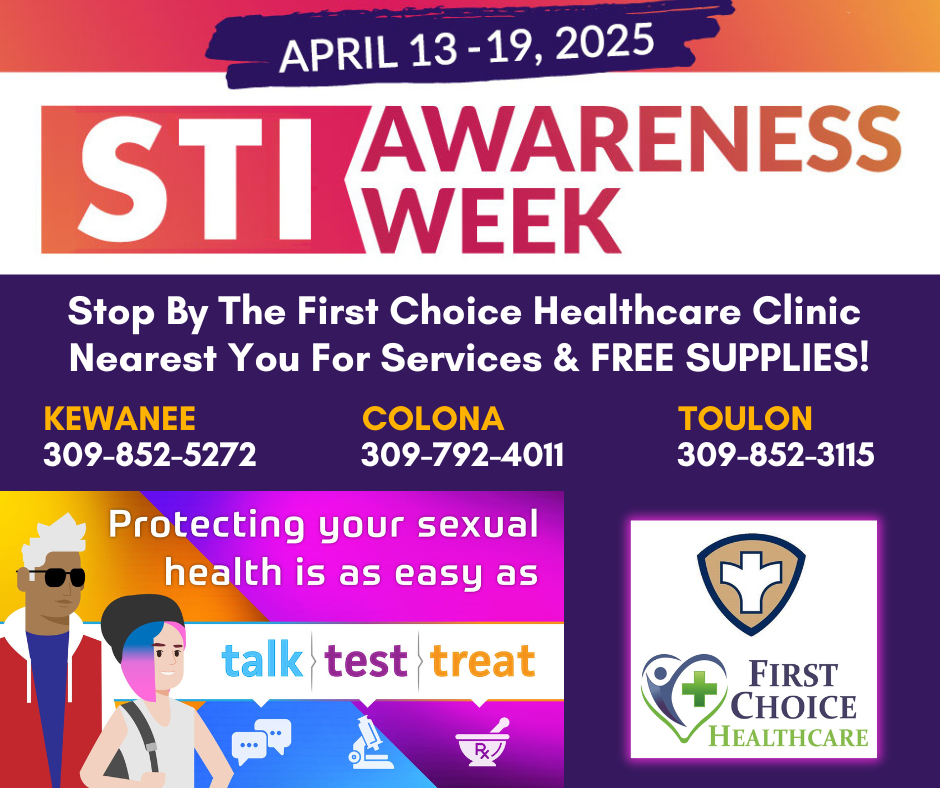
April is STI – Sexually Transmitted Infection Awareness Month and STI Awareness Week is April 13-19. This theme for STI Awareness Month 2025 is “Talk. Test. Treat.”
This year’s theme encourages individuals to learn about STIs and STI prevention, but just as importantly, to empower them to ask their healthcare provider what they can do – and how they can work together – to stay safe and healthy.
With an estimated 20 million new sexually transmitted infections occurring every year in the US, it is clear that STIs remain a widespread health threat in this country.
In addition, STI infections cost the American healthcare system nearly $16 billion in direct medical costs alone. And it’s America’s youth that is shouldering the substantial burden of these infections. The Centers for Disease Control and Prevention -CDC estimates that half of all new STIs in the country occur among young men and women aged 15 to 24.
With all these disturbing statistics it is obvious that STI Awareness Month is an opportune time to remind area residents that the First Choice Healthcare Clinics offer confidential:
~ STI Testing for Males and Females
~ Treatment of STIs
~ Contraceptive Supplies
~ PrEP/HIV Prevention Program
~ Preventative immunizations against such STDs as Hepatitis B and HPV ~ Counseling, Education, and Referral
~ Expedited Partner Treatment
Testing and knowledge of infection are vital to reducing the incidence and spread of STIs. Because many infections have no symptoms, those at risk need to get tested and find out if they are infected.
There are many actions you can take to protect yourself and others from STIs:
● Abstinence – The most reliable ways to avoid infection with an STD are to abstain from sex or to be in a long-term mutually monogamous relationship with an uninfected partner.
● Correct and consistent use of condoms – Consistent use of latex condoms reduces the risk of HIV and other STIs. Free Supplies are available through First Choice Healthcare clinics in Kewanee, Colona & Toulon.
● Screening – Getting tested and treated for STIs can protect you from serious health consequences caused by STIs. STI Testing available at all First Choice Healthcare Clinics.
● Immunizations – Receiving recommended Hepatitis B and HPV immunizations can almost completely prevent infections covered by the vaccines.
Though the subject of STIs may not be a comfortable healthcare issue to discuss, The health department wants people to remember that their First Choice Healthcare locations in Kewanee, Colona and Toulon are sources of confidential testing, treatment, and education. And they are literally just a phone call away. People should know they offer the tools and services people need to stay healthy.
For more information or appointments call First Choice Healthcare at Kewanee 309-852-5272; Colona 309-792-4011; or Toulon 309-852-3115.

Preventative care is the key to a healthy and independent lifestyle.
Many may not realize that in order to help maintain personal wellness, Medicare covers an annual wellness visit for patients. What is an annual wellness visit and what does it include for the participant?
During an annual wellness visit, the health department’s First Choice Healthcare staff will discuss your medical history; review your medication with you; assess your current health and safety; develop a personalized preventative healthcare plan; and answer any questions you may have about your health.
Medicare pays 100 percent of the cost of annual wellness exams with no “out-of-pocket” expense to participants. For more information or to schedule your annual wellness exam call the First Choice Healthcare clinic nearest you: Kewanee 309-852-5272; Colona 309-792-4011; or Toulon 309-852-3115.