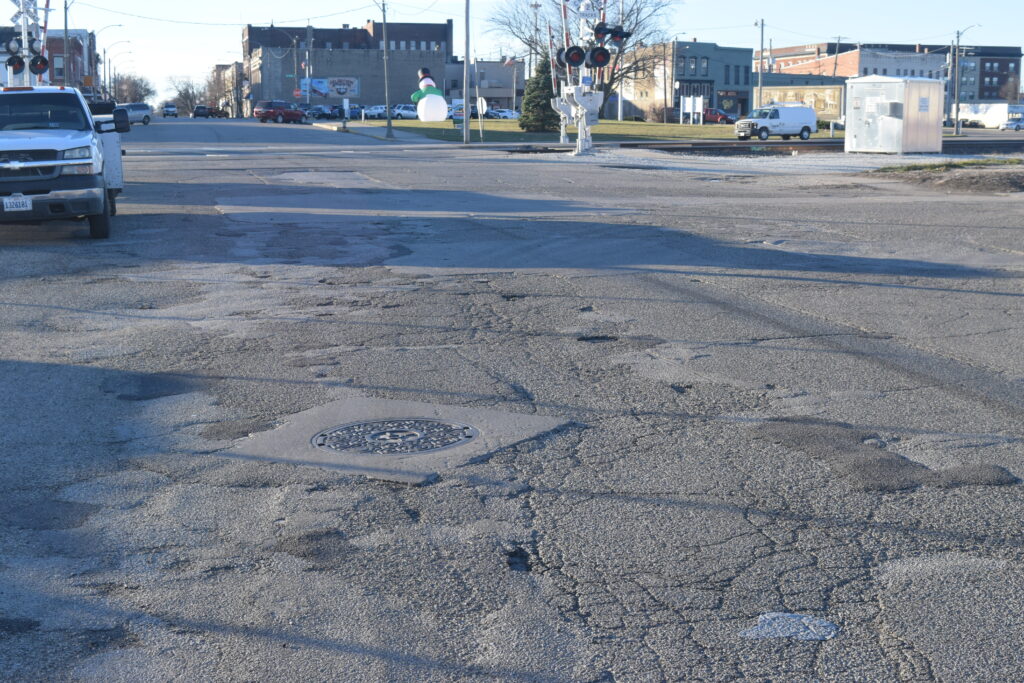
(This article is the first in a four-part series examining the state of Kewanee streets; the scope of the problem; the cost of fixing them and the cost if we don’t. Mike Berry and Susan DeVilder contributed to this series.)
For decades, the condition of the streets in Kewanee has been a thorn in the side of city officials and criticisms about the size and depth of potholes have become a constant refrain from Kewanee drivers who are forced to dodge them on a daily basis. The issue has persisted for so long that residents have been left to wonder why the problem hasn’t been addressed more fully by city officials and how the roads got into such a state of disrepair in the first place.
Kewanee City Manager Gary Bradley said the question of how the streets got to this point could be the subject of a book about Kewanee’s history.
“When the Wethersfield Colony was established, it was laid out in an area that has been described as having marshes and a high water table. It was an area with rich soil, which is great for agriculture but bad for roads if a suitable roadbed isn’t established,” said Bradley in an email interview with The Kewanee Voice.
The town grew rapidly on all fronts and Wethersfield and Kewanee were united in 1921. The next census reflected the highest population in the city’s history at a little over 17,000.
“The community had not just the population but the infrastructure to support that population, as well,” said Bradley.
Since that time, subdivisions have been developed outside the city with infrastructure that wouldn’t have been acceptable if they had been inside the city limits at the time. Other subdivisions were added inside the city limits, yielding the infrastructure to serve a population of about 20,000 residents. Now that infrastructure is maintained by a population of just over 12,000 people, he said.
“Much of the infrastructure that was in place when the city peaked in size is still in place 100 years later, and it’s failing,” said Bradley. “Even when they aren’t failing, lead lines aren’t safe and are mandated to be replaced. These people replacing them now are just trying to provide better water service, but when they replace a lead connection, it puts another patch in the street.”
Those necessary patches come with a set of new problems, Bradley noted. Not only do they create a noticeable transition between the patch and the original surfaces, more importantly those patches have seams and water finds its way into the seams and creates potholes.
In a rush to put in infrastructure to support the growing demand for buildable home sites in the community, Bradley said, early builders constructed roadways without a stable roadbed or proper drainage. As the city continued to develop, a number of streets received a thin asphalt overlay on top of the brick surfaces that had been laid down, and that wasn’t ideal.
“Those streets are prone to issues with their surface when water works its way down,” he said.
Conditions such as freezing and thawing between and under the bricks below lends to the problem. Bradley said if the city can seal a street to keep water out, there will be far fewer potholes, but sealing isn’t popular.
“When we seal a street, people don’t like that their street got sealed instead of having new asphalt, and we understand that,” he said. “We can’t afford to replace all of the streets, so we’re trying to extend the lives of streets for as long as we can, but we need more funds to actually replace streets.”
The biggest issue facing Kewanee is the enormous scope of the street problems combined with the dilemma of how to fund repairs. But Kewanee isn’t alone. According to the American Society of Civil Engineers (ASCE), “the condition of the roads in the United States is a matter of concern.” Their 2021 report card grades the country’s roads as a D. The U.S. will need to invest almost $3 trillion to address the necessary road repairs and the report also states that 43% of the public roadways are in poor or mediocre condition.
While the price for fixing Kewanee’s road doesn’t number in the trillions, making the streets serviceable again will cost tens of millions. The biggest reason is that Kewanee has lots of streets. When assessing the status of local roads, engineers calculate lane-miles. The number of lane-miles for a street is calculated by multiplying the length of the street in miles by the number of lanes on the street.
Since a large majority of Kewanee’s streets are two-lane, those lane-miles would be calculated by multiplying the length of the street by two. The length of Main and Tenney streets from Central Boulevard to the south city limits would be multiplied by four. And Kewanee’s few one-way streets would not be multiplied at all.
So how many lane-miles of streets are there in Kewanee? Bradley said that according to calculations, the number of lane-miles in Kewanee is around 200.
And in many of those miles (except for streets that have been recently resurfaced) there are imperfections that can make for a rough ride for drivers and their passengers. That many miles of streets, combined with the condition of most of those streets, makes street repairs a massive — and hugely expensive — undertaking. Bradley said a conservative estimate for the cost of all the street work Kewanee needs is $80 million.
To fund street repair, the City Council has placed a question on the March 19 election ballot, asking voters to approve an additional half-cent per dollar to the local sales tax to pay for street repairs.
Bradley said that breaks down to about $8.40 a month for residents, based on the median household income. If someone spends $100 at a store, the additional cost for the purchase with the proposed tax would be $0.50.
Perhaps the biggest benefit to the use of a sales tax, Bradley said, is that between 15 and 20% of the city’s sales comes from people who reside outside the city limits, removing a portion of the tax burden from the residents of Kewanee.
“As our retail market grows, so will the outside revenue that’s helping to fix our streets,” he said.
Critics of the new tax point to the fact that Kewanee already has an infrastructure tax in place, but those funds are already accounted for and cover the bond payments on previously completed sewer and water projects. That tax, Bradley said, brings in about $800,000 a year, compared to the $706,000 in Motor Fuel Tax funds the city received last year. But even at that level of annual revenue, it will take decades to repair the roads. But Bradley said improving the roads over time is better than doing nothing at all.
“You have to start somewhere,” he said.
Some voters are on the fence when it comes to supporting the proposed sales tax increase but have expressed a willingness to vote yes on the ballot question if certain conditions can be met. Those conditions often mentioned are a sunset on the tax (or a deadline as to when the tax will be lifted) and guarantees that the money raised from the tax will be strictly used for roads.
Bradley said the ballot language that was approved by the ordinance was intentionally specific.
“The funds can only be spent for transportation purposes, which means the streets, sidewalks and storm drainage that helps to preserve the life of those pieces of infrastructure, along with signage, striping and lighting that make them safe and functional,” he said, and only where those things are needed.
Bradley said the funds can’t and won’t be spent on personnel or equipment for police, fire, water, community development or anything else not related to transportation. In addition, the tax would sunset after a decade, and voters would be allowed to decide where to go from there.
As far as auditing the process to ensure the funds are being spent for street repair, the city manager said the process is similar to the revenues from the motor fuel tax and that the state would deposit the funds into a specific account.
“Those revenues would be kept in their own individual fund, separate from other funds and spent only on transportation related expenses,” said Bradley.
When the city approves payment of the bills, they’re included in the city council packet, which is available online for anyone to see.
“Anybody can see what was bought, how much it cost, who was paid and where the money came from and the fund would be audited annually like our other expenditures,” he said.
With so many Kewanee residents advocating for a more aggressive street repair program, the question is: Will a majority of those people be willing to foot the extra $8.40 a month to get it?