The Henry and Stark County Health Department along with their First Choice Healthcare and its Behavioral Health staff would like to address what many refer to as the “Winter Blues.”
The winter blues are very common, with many experiencing a mood shift during the colder, darker days of winter. Many may find themselves feeling more lethargic and down overall. Although they may feel more unhappy than usual, the winter blues typically do not affect your ability to enjoy life.
But if your winter blues start permeating all aspects of your life – from work to personal relationships – you may be experiencing seasonal affective disorder, SAD. SAD is a subtype of major depression that is characterized by the onset of depression during winter months when there is less natural light. For many people, symptoms usually start in the fall and continue into the winter months.
Symptoms of Seasonal Affective Disorder may include:
● Feeling depressed most of the day, nearly every day
● Feeling hopeless or worthless
● Having low energy
● Losing interest in activities you once enjoyed
● Problems sleeping
● Changes in your appetite or weight
● Feeling sluggish or agitated
● Having difficulty concentrating
● Having frequent thoughts of death or suicide
How Do You Treat SAD? Treatment for SAD may include light therapy, phototherapy, psychotherapy and medication. In addition to your prescribed treatment plan for SAD, you may also try:
● Making your environment sunnier and brighter
● Spending more time outside
● Exercising regularly
In addition to SAD, some people with major depression, unrelated to the season, may experience an increase in symptoms during the late fall and winter; it is important that they discuss this with a behavioral/mental health professional. The most important take-home message is that SAD, just like other types of depression, is treatable and people should not suffer in silence; they should seek help
Mental Health Services are available at the health department’s First Choice Health Care. Their behavioral health staff are prepared to support patients aged five and over. For such issues as depression, anxiety, stress, substance use and addictions, behavior problems, bipolar disorder, attention deficit hyperactivity disorder, family/parenting issues, obsessive compulsive disorder, post-traumatic stress disorder, schizophrenia and other related disorders, sexual assault, suicide prevention, trauma, and loss. Services for counseling and therapy begin at age 5; and begin at age 6 for medication management.
Help and understanding are just a phone call away at all the Health Department’s First Choice Healthcare at 309-852-5272.
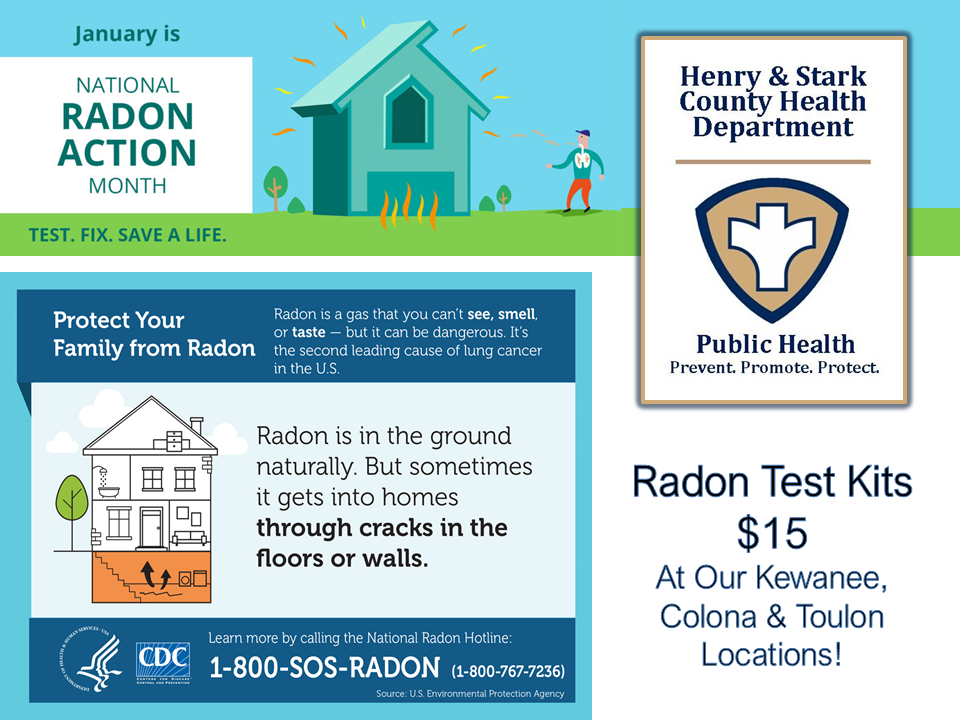
The Henry and Stark County Health Departments remind everyone that January has been proclaimed National Radon Action Month in Illinois, by calling attention to the fact that radon is the second-leading cause of lung cancer overall and the leading cause of lung cancer for non-smokers.
RaeAnn Tucker, health department director of Health Promotion said, “It really doesn’t matter where you live in Illinois or what type of home you live in, because we’ve seen excessive radon in every county in Illinois, and in every type of home – old, new, with basements, with a crawlspace or on a slab.”
Radon is a colorless, odorless, tasteless radioactive gas that comes from the radioactive decay of naturally occurring uranium in the soil. It can enter homes and buildings through small cracks in the foundation, sump pumps or soil in crawlspaces.
The Environmental Protection Agency (EPA) estimates that radon causes 21,000 deaths annually. That’s because when you breathe air containing radon, you can get lung cancer.
The state of Illinois has enacted the Illinois Radon Awareness Act. According to this law, anyone buying a home, condominium or other residential property in Illinois must be provided with information about indoor radon exposure and the fact that radon is the leading cause of lung cancer in non-smokers and the second leading cause overall.
Since radon gas is undetectable, specialized radon detectors must be used to measure the amount of radon gas present in the air. The Environmental Health Division of the Henry and Stark County Health Department announces that they now have radon home test kits available for purchase through their offices in Kewanee, Colona and Toulon. The kits are being offered at the low cost of $15 per kit.
“Radon gas is found in 66% of homes in Henry County and 92% of homes in Stark County. Testing your home is the only way to know if you have elevated levels of radon.” said Tucker.
If radon levels, above the U.S. Environmental Protection Agency’s, USEPA action level of 4 picocuries per liter of air, pCi/L, are detected in your home; the health department can provide you with information regarding radon mitigation on their website at www.henrystarkhealth.com.
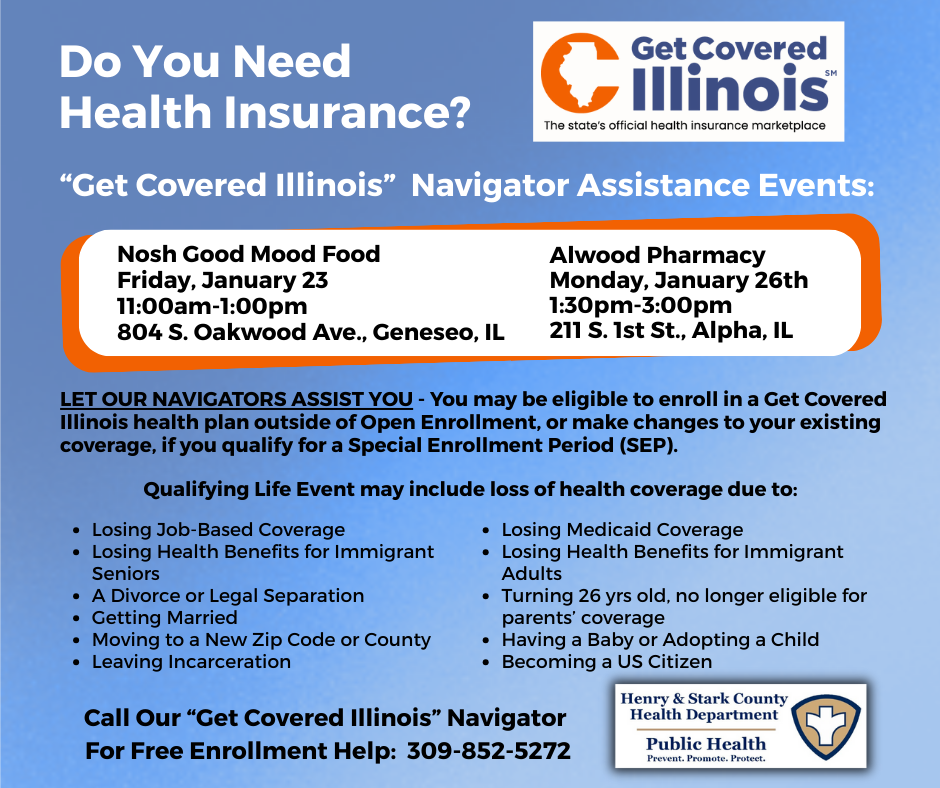
The Henry and Stark County Health Departments and the Get Covered Illinois Navigator Program asks, “Do You Need Health Insurance?” Their Health Insurance Navigators will be present at the upcoming local events to assist anyone looking to set up health insurance coverage:
Nosh Good Mood Food, 804 S. Oakwood Ave., Geneseo, Ill.
Friday, Jan. 23
11 a.m. -1 p.m.
Alwood Pharmacy, 211 S. 1st St., Alpha, Ill.
Monday, Jan. 26
1:30-3 p.m.
“Get Covered Illinois” Navigators can help you:
● Find affordable health coverage that meets your needs
● Fill out and submit your application
● Compare quality health plans side-by-side
● Find out if you qualify for financial help to lower your monthly premium
● Find out if you qualify for Medicaid or an affordability program
● Understand your benefits
● Understand health insurance terms
Remember you may be eligible to enroll in a Get Covered Illinois health plan outside of the usual Open Enrollment, or make changes to your existing coverage, if you qualify for a Special Enrollment Period – SEP. The SEP may require you to enroll within 60 days of a Qualifying Life Event.
A qualifying life event is a life change, such as:
Loss of Health Coverage, due to:
● Losing job-based coverage
● Losing Medicaid coverage
● Losing Health Benefits for Immigrant Seniors or Health Benefits For Immigrants Adult coverage
● A divorce or legal separation
● Turning 26 years old, no longer eligible for parents’ coverage
Other Qualifying Life Events include:
● Getting Married
● Having a baby or adopting a child
● Moving to a new ZIP code or county
● Becoming a US Citizen
● Leaving incarceration.
For more information on this Get Covered Illinois Navigator Event or assistance in enrolling in a Get Covered Illinois Healthcare Marketplace please call 309-852-5272.
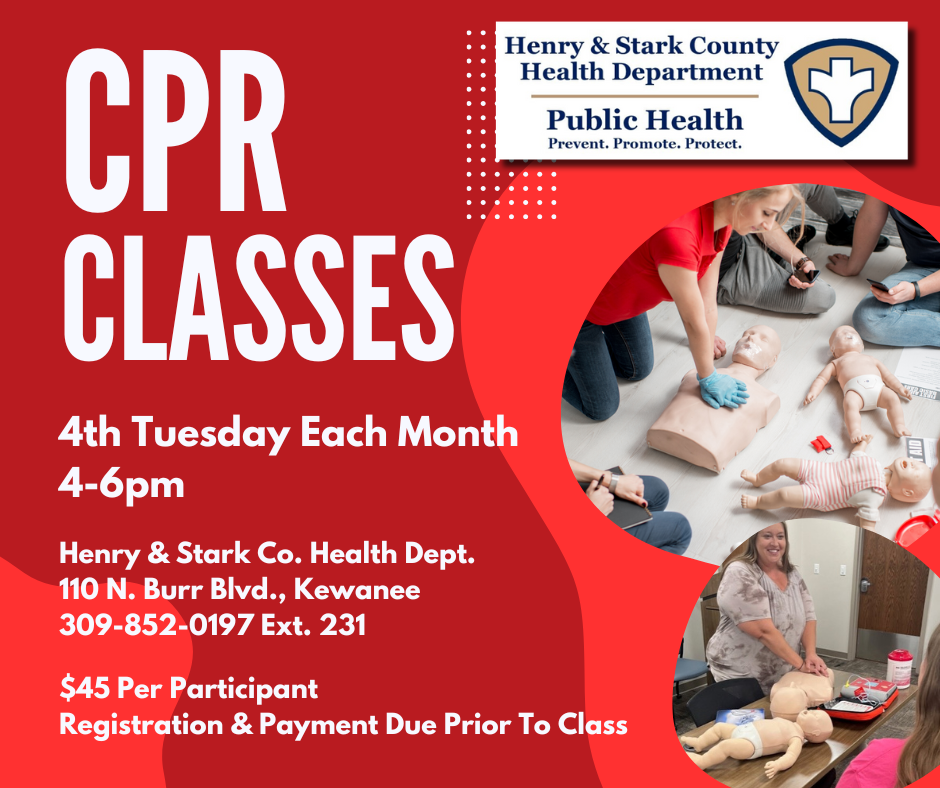
The Henry and Stark County Health Departments are offering monthly CPR – Cardiopulmonary Resuscitation certification classes.
Heart disease is the leading cause of death for men and women in the United States. That’s why they encourage people to take a CPR certification class. As the American Heart Association says, “Learn to save a life, learn CPR. The life you save could be that of a loved one.”
CPR training will teach participants to recognize and care for breathing and cardiac emergencies in infants, children, and adults. Instruction will also be given on how to recognize emergencies and actions to take, and understanding the role of AEDs – Automated External Defibrillators in the cardiac chain of survival.
CPR classes are held on the fourth Tuesday monthly. The class will be held at the health department offices, 110 N. Burr Blvd., Kewanee, IL. The classes will run from 4 to 6 p.m. The cost of the class is $45. Payment and registration are due prior to the class date. These rates are per participant.
There is a set participant “minimum” and “maximum” for classes; so, anyone interested should contact the health department at 309-852-0197, Ext. 231.