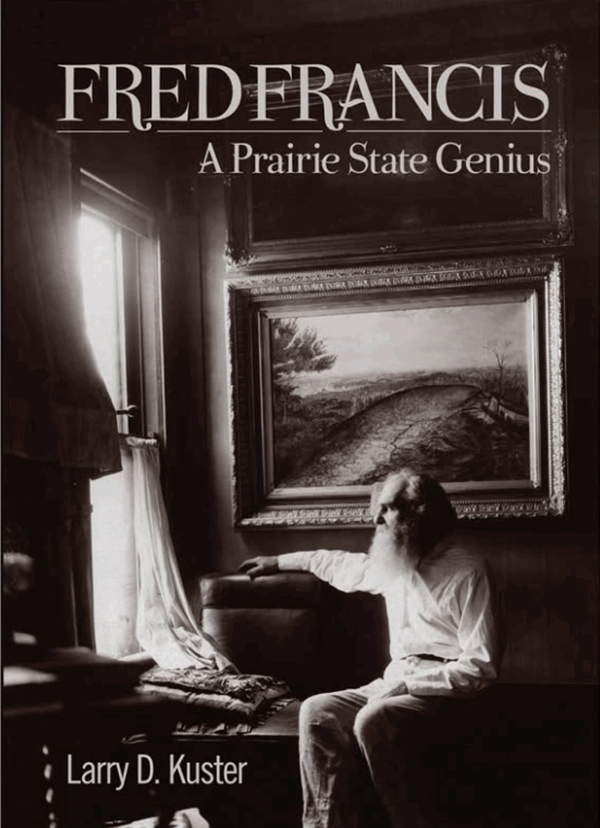
FRED FRANCIS
A PRAIRIE STATE GENIUS
By Larry D. Kuster
Reviewed by Dean R. Karau
(A version of this review will appear in a future issue of ILLINOIS HERITAGE, the magazine of the Illinois State Historical Society. You can learn more about ISHS at https://historyillinois.org.)
(If you’re looking for a special Christmas gift for someone who loves Kewanee, this is it. The book can be purchased at Our Town Books, 64 E. Central Park Plaza, Jacksonville, IL., 62650, phone 217-245-2665. Locally, the book can be purchased at B&B Printing in Kewanee.)
Then let us live for joy and good
Each moment here before ‘tis gone
And think we’ve done the best we could
While here on earth we travel on.
Fred Francis, from his poem, BRIEF MOMENTS
Many claim to admire the self-made, those who follow their own path without regard to the approbations of others. Yet, in real life, when we cross the paths of those who chart their own course, who are true to their beliefs, we often call them weird, eccentric, refer to them as oddballs out of touch with reality.
Larry D. Kuster’s book, FRED FRANCIS, A PRAIRIE STATE GENIUS, is the long-awaited, definitive story of this man of curiosity and intellect; a man humble in nature but sure-footed in his beliefs; one who traveled his own path regardless of what others thought; one who understood that always searching for the questions to be asked, always doing the best one can, are the best aspirations for a life well-lived.
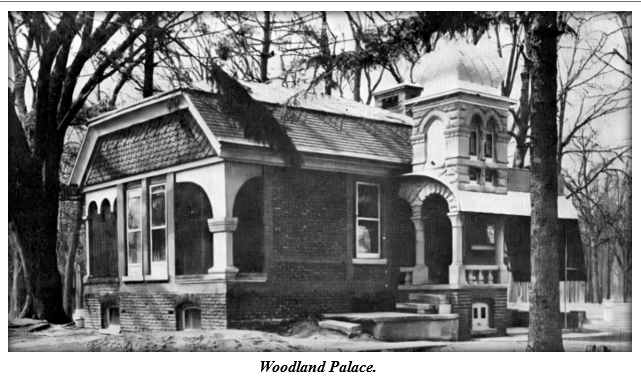
Larry provides us with detailed facts and true insight into why Fred was a remarkable man, truly a genius. Fred incorporated into his home, Woodland Palace, unique, science-based features – a form of baseboard heating; a cooling system which took advantage of the earth’s natural temperature; a unique sauna; a solarium which turned over the air in 60-second cycles; a concrete roof; special screens that automatically covered windows when opened; and so, so much more.
But as Larry explains, Fred’s genius extended far beyond mechanical things. Fred understood and practiced a healthy, science-based way of life. While very shy, he nevertheless found the love of his life, Jeanie, and doted on her until her death. Through her, Fred came out of his shell, at least a little, making his rural wonderland a gathering spot for groups small and large alike, and he later gave lectures to invited guests on his property. Though not an overtly religious man, Fred’s commitment to exploration of thoughts and ideas – and with Jeanie’s encouragement – led him to a closer relationship with, and reflections on, nature and its relationship to man. As Russell T. Neville, his longtime friend, attorney, author and amateur photographer, wrote, Fred was a
“deep student and thinker. He holds original ideas along many lines, and his speech is thought provoking. You may not agree with some of his theories, but you’ll admit that they are the result of much deep thought and study . . . . It has always seemed that here was a man capable of supplying about every material need by his own efforts. If he were cast away on a desert island with a pop bottle, we’d expect him to have a magnifying glass, clothes, and everything else he needed by the time he was rescued.”
Fred Francis was a polymath, a modern-day Da Vinci living in the heartland of America.
Larry begins his story with the birth of Frederick Francis in 1856 in Henry County, Illinois, in a log cabin at the edge of Big Barren Grove, a sprawling hardwood forest, and the riotous Illinois prairie, four miles northeast of Kewanee, the afterbirth of the railroad founded only two years earlier. Fred’s father was a strong-willed farmer, entrepreneur, a self-made man, while his mother never adapted to the rigors of the life away from others, eventually leaving her husband and family for a life in the nearby growing village.
Young Fred remained with his father in the country. Educated in both hard work and a more formal curriculum of the arts and sciences in rural schools, he took an interest in machinery. Seeing his wide range of interests and mechanical aptitude, a teacher gave Fred a catalog from the new Illinois Industrial University in Champaign (later to become the University of Illinois).
At age 18, Fred became the first from Kewanee Township to enroll at IIU. Naturally, he took up engineering. But he viewed himself as “a big greenhorn from the country,” while his classmates thought of him as “the odd genius of his class.” While generally avoiding social activities, Fred nevertheless participated in a myriad of endeavors, including attending the 1876 Philadelphia Centennial Exhibition, and leading his fellow students in constructing and installing a tower clock as a class graduation gift, a clock still ticking away on campus today.
In four years, Fred finished his studies, showing his life-long frugality by having spent only a total of $225 for his education. He made 10-horsepower steam engines in the University machine shop and sold them to pay for most of his materials and his semester fees. When he was short of funds his final semester, he sold the University an invention for a steam engine he had made.
After leaving the university, Fred found employment at the Elgin Watch Co. While there, he was instrumental in developing an improvement in the mainsprings in their watches. The company paid Fred a royalty for every watch sold with that feature. He soon became financially set for life, retiring at a mere 34-years-of-age. Years later, Fred told the company to stop paying the royalties, as he already had all the money he needed.
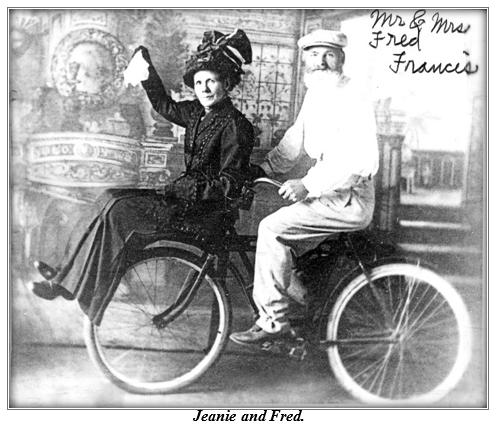
While in Elgin, he met Jeanette Rice Crowfoot, who became the love of his life and constant companion and partner in all until the end of her life. “Jeanie,” a widow with two grown children, and Fred traveled to the East for their honeymoon, before returning to Illinois to finish the unique home Fred had begun building on his timbered land northeast of Kewanee.
The Francis’s “Woodland Palace” was, as Russell T. Neville, described, “one of the most unique homes it has ever been our fortune to visit. . . . [N]ot only of odd design, but it has many interesting features of construction.” Those features included the brick and stone home with a poured concrete roof over part of it (“it is safe to say that he owns the only roof like this in the country”); unique mechanical entry doors (“an ingenious arrangement of ropes and pulleys and levers entirely too deep for a non-mechanical mind to fathom”); a clever fireplace; an intricately constructed, elaborate chandelier; and other “ingenious devices.” Fred carried home much of the material for the house, purchased in Kewanee, on his bicycle or in a borrowed horse and wagon (as a vegetarian, he eschewed owning livestock), spending years to have his home take the shape he wanted, and continuing to work on aspects of it for his entire life.
Early in life, Fred began to recognize the need for a healthy lifestyle and healthy diet. As an adult, he became a devotee of the “Physical Culture” movement. His friend Neville remarked on Fred’s different eating habits, which included using “no condiments, and also [he] does not eat many of the food stuffs we mostly depend on. The fruit he raises on his own place, preserved by his own hands supplemented by nuts and fruits and some rough fodder he buys are sufficient for this remarkable man.” Although Jeanie continued to eat meat, the two still shared meals together, albeit prepared differently and eating at different tables.
When Jeanie became ill with what was likely tuberculosis, Fred researched the malady and helped Jeanie find treatment. He doted on her throughout her illness. Fred built a glass-enclosed, domed room with intricate ventilation to help her. His friend Neville wrote “Mr. Francis built this glass room and tenderly nursed her for months, prolonging her life by his careful and loving attentions.”

After Jeanie’s death, Fred lived alone at Woodland Palace. But while still a recluse, he continued to travel into Kewanee. He even allowed groups large and small to use his grounds for picnics and other gatherings, and he hosted talks on a variety of topics dear to him.
Fred Francis died on December 22, 1926. His death was originally found to be as the result of natural causes, and he was cremated according to the terms of his will. After cremation, however, new evidence suggested that Francis had shot himself. But Larry thoroughly debunks that possibility.
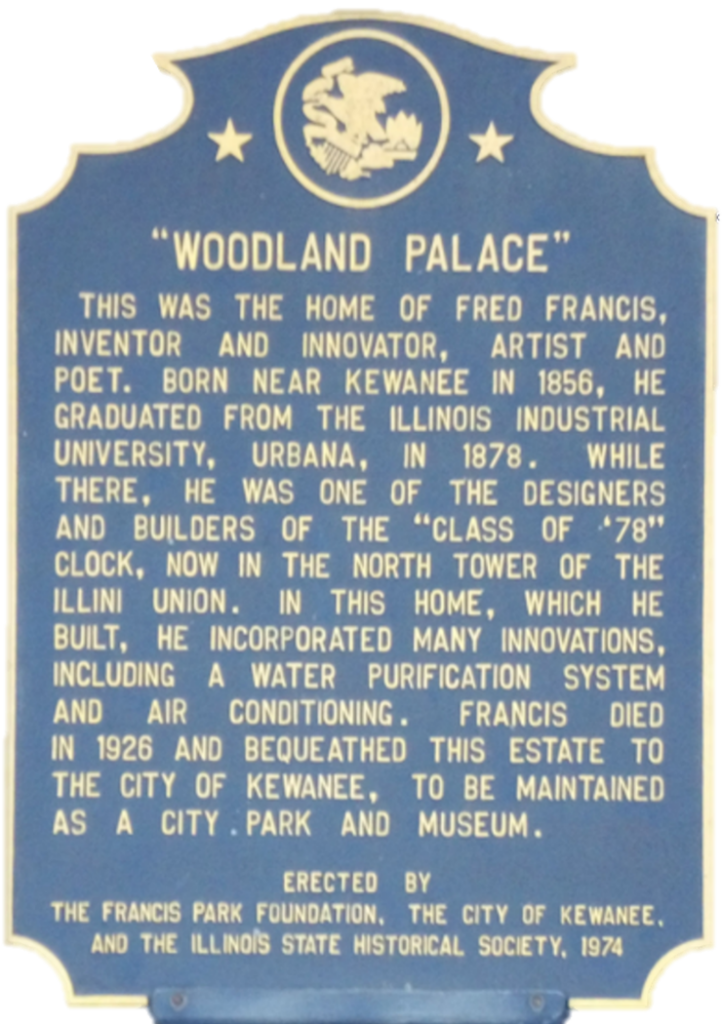
In his will, Francis left all of his land and his personal property to the city of Kewanee for use as a city park, to be called Francis Park. By 1930, an estimated 15,000 people were using the park annually. In the 1960s there were a number of renovations made. In 1974, the Illinois State Historical Society designated Woodland Palace as an Historical Site, and in 1975, Woodland Palace was placed on the National Register of Historic Places, both efforts in which Larry’s mother played a large role. Today, there are significant efforts underway to restore and preserve Woodland Palace and the legacy of Fred Francis, of which Larry is a part.
Larry has produced a masterpiece with his book, displaying an incredible amount of work to uncover and document virtually all known facts of the life of Fred Francis. It is an amazing contribution to preserve Fred’s legacy for future generations.
Larry’s comprehensive, well-written text makes for a fascinating read. He has knitted the facts he has discovered into a wondrous fabric of color and vibrance. For instance, in describing a train trip out West, Larry writes:
“Fred made his way to the platform of a car to get a better view. He stood there all day and most of the night, committing to memory the glorious sights unfolding before him. As darkness descended into night, the bright moonlight illuminated a glacier miles away causing the ice to sparkle and glisten. Tired, his eyes full of cinders, Fred retired to the sleeper car and immediately fell asleep.”
Once I had a chance to start reading the book, it was hard to put it down. By using endnotes rather than footnotes, the writing flows for the reader. Yet the researcher has quick access to hundreds upon hundreds of citations documenting Larry’s original sources.
Fred’s personal and professional accomplishments are indeed remarkable, especially given the times in which he lived starting well over a century-and-a-half ago. Although I was somewhat familiar with Fred Francis, my information was acquired mostly from childhood pig roasts my extended family held at Francis Park. When I moved from Kewanee at the age of 12 in 1960, I learned very little more, other than the occasional myth, which Larry so ably dispels. I now realize that my knowledge of Fred Francis was trivial at best, a shallow understanding of the man. Larry captures the essence of this man from the prairie. The book illuminates not only Fred’s curiosity and intellect, but his genuine, humble yet self-confident approach to life. As Fred wrote in another of his poems,
Tis not of gold or silver rare
Nor yet of jewels bright
But how to keep yourself supreme
By doing what is right.
Put simply, Larry’s book illuminates the life of Fred Francis in a way that no other publication has done to date. Moreover, the book has provided future researchers with a path to follow as they look for more insight into the extraordinary man. And it provides inspiration to those with curious souls who aspire to think, regardless of the consequences.
After reading Larry’s book, you will know so much more about Fred Francis and why he was, indeed, a prairie state genius.
(Roger Malcolm, a retired Kewanee High School science teacher and now a volunteer docent at Woodland Palace, kindly spoke with me about both Fred Francis and many of the unique features of Woodland Palace.)