Aug. 24-28 is designated World Water Week.
World Water Week 2025 is centered on water cooperation, for peace and security in its broadest sense. The theme, “Bridging Borders: Water for a Peaceful and Sustainable Future,” asks us to recognize the regional and global interconnectivity of communities and nations, and underscores the collaborative effort needed to achieve a peaceful and sustainable future.

Henry and Stark County Health Department officials note that World Water Week helps us view water in new and fascinating ways. We focus on the value of water, from many different perspectives. Life, as we know it, would be impossible without water. And, for our area residents – more specifically – ground water. It is the world’s most extracted natural resource. Don’t take groundwater for granted. Therefore, this designation is also a platform to encourage water well maintenance.
World Water Week was designed to urge each of us to consider various ways to protect our most valuable natural resource. So remember about not running water while you brush your teeth. Or about getting that leaking faucet fixed. Or about the farmers that rely on groundwater to grow the food we eat.
Health Department staff said, “Through World Water Week, we would like to recommend to area residents that maybe it’s time for your annual water well checkup.”
Why is it a good idea to have your water well checked annually? The truth is an annual checkup is the best way to ensure problem-free service and quality water. Also, preventative maintenance usually is less costly than emergency maintenance, and good well maintenance, like good car maintenance, can prolong the life of your well and related equipment. They further recommend you test your water whenever there is a change in taste, odor, or appearance, or when the system is serviced.
Wells can provide high-quality drinking water, and about half the U.S. population receives its drinking water from wells. But with well ownership comes the responsibility of keeping the water well in good working order.
Health Department recommendations:
● Keep hazardous chemicals, such as paint, fertilizer, pesticides, and motor oil far away from your well, and maintain a “clean” zone of at least 50 feet between your well and any kennels and livestock operations.
● Maintain proper separation between your well and buildings, waste systems, and chemical storage areas.
● Maintain your waste water systems.
● Periodically check the well cover or well cap on top of the casing (well) to ensure it is in good repair and securely attached. Its seal should keep out insects and rodents.
● Keep your well records in a safe place. These include the construction report, and annual water well system maintenance and water testing results.
● Make sure abandoned wells are sealed properly within 30 days of abandonment. Please note, you will need a permit from the Health Department before sealing of the well can begin.
For more information on the Health Departments’ Water Program and sealing abandoned wells, contact the Health Department’s main office at 309-852-0197. You can also visit their website at www.henrystarkhealth.com or find them on Facebook at Henry and Stark County Health Departments
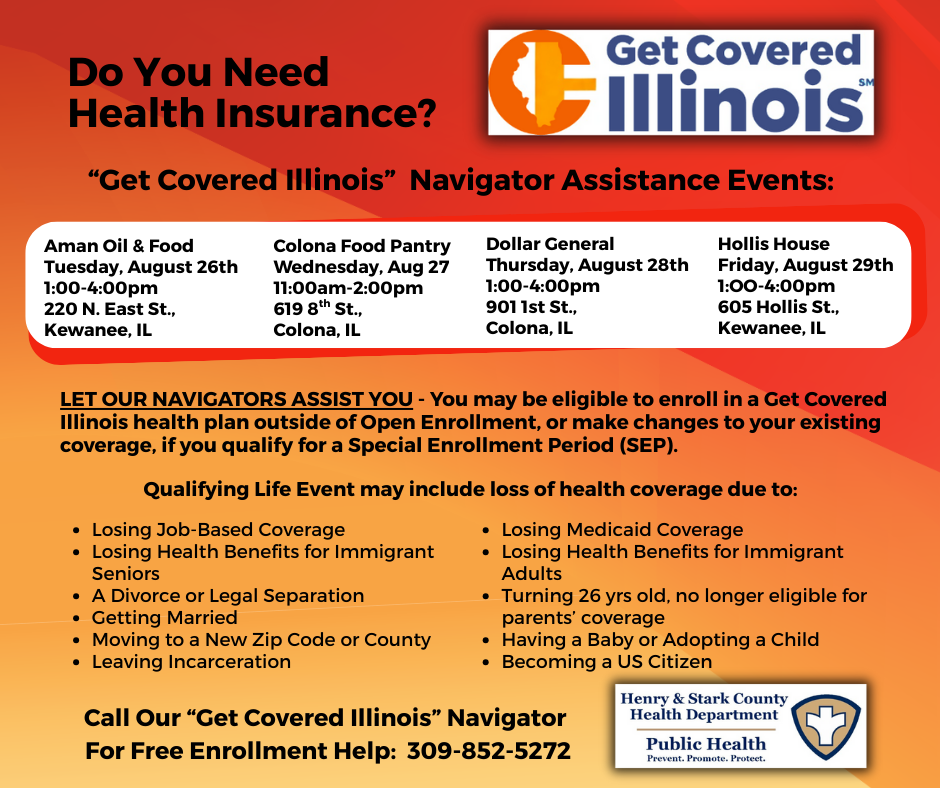
The Henry and Stark County Health Departments and the Get Covered Illinois Navigator Program asks, “Do You Need Health Insurance?” Their Health Insurance Navigators will be present at some upcoming local events to assist anyone looking to set up health insurance coverage:
Dollar General, 901 1st St., Colona, Ill.
Thursday, Aug. 28
1-4 p.m.
Hollis House, 605 Hollis St., Kewanee
Friday, Aug. 29
1-4 p.m.
“Get Covered Illinois” navigators can help you:
● Find affordable health coverage that meets your needs
● Fill out and submit your application
● Compare quality health plans side-by-side
● Find out if you qualify for financial help to lower your monthly premium
● Find out if you qualify for Medicaid or an affordability program
● Understand your benefits
● Understand health insurance terms
Remember you may be eligible to enroll in a Get Covered Illinois health plan outside of the usual Open Enrollment, or make changes to your existing coverage, if you qualify for a Special Enrollment Period (SEP). The SEP may require you to enroll within 60 days of a Qualifying Life Event. A qualifying life event is a life change, such as:
Loss of Health Coverage, due to:
● Losing job-based coverage
● Losing Medicaid coverage
● Losing Health Benefits for Immigrant Seniors or Health Benefits for Immigrants Adult coverage
● A divorce or legal separation
● Turning 26 years old, no longer eligible for parents’ coverage
Other Qualifying Life Events include:
● Getting Married
● Having a baby or adopting a child
● Moving to a new ZIP code or county
● Becoming a US Citizen
● Leaving incarceration.
For more information on this Get Covered Illinois Navigator Event or assistance in enrolling in a Get Covered Illinois Healthcare Marketplace please call 309-852-5272.
With the warm summer months comes the increase in bat activity, which means the possibility of exposure to rabies is increasing. Bats are the primary carrier of rabies in Illinois. The Illinois Department of Public Health – IDPH has already had 19 bats test positive for rabies this year.
According to the Illinois Department of Public Health, “You should never try to approach or catch a bat, or any wild animal, you find outside. Bats and wild animals that let people approach them are often not healthy. Instead, call your local animal control agency for its recommendations on how to handle the animal.”
It should be noted that typically less than 5% of bats tested for rabies are found to be rabid. In the bat population, as a whole, the percentage of rabid bats is much smaller – less than 1%. Also, any wild mammal, such as raccoons, skunks, foxes, coyotes and bats, can have rabies and transmit it to humans.
Rabies is a virus that affects the nervous system. People can get rabies after being bitten by an infected animal. Rabies can also be contracted when saliva from a rabid animal gets directly into a person’s eyes, nose, mouth or a wound. People usually do not know when they have been bitten by a bat, as bats have very small teeth and the bite mark may not be easy to see.
“If you find yourself in close proximity to a bat and are not sure if you were exposed, for example – you wake up and find a bat in your room, do not kill or release the bat before calling your doctor or local health department to help determine if you could have been exposed to rabies and need preventive treatment. If the bat is available for testing and test results are negative, preventive treatment is not needed.” said Henry and Stark Health Department officials
Without preventive treatment, rabies is typically fatal. If you have been bitten or have had direct contact with a bat, seek immediate medical attention. Treatment with rabies immune globulin and a vaccine series must begin quickly.
Health Department Communicable Disease staff said, “An animal does not have to be aggressive or exhibit other symptoms to have rabies. Changes in any animal’s normal behavior can be early signs of rabies. A bat that is active during the day, found on the ground or is unable to fly, is more likely than others to be rabid. Such bats are often easily approached, but should never be handled.”
The following tips can help prevent the spread of rabies:
For more information about possible bat exposure contact the Health Department Communicable Disease Nurse at 309-852-0197 or find them on Facebook at Henry and Stark County Health Departments. If you have a bat in your residence contact your local animal control officer.
In addition, Information about keeping bats out of your home or buildings can be found by logging on to www.idph.state.il.us/envhealth/pcbats.htm.
Information about rabies can be found at https://www.dph.illinois.gov/topics-services/diseases-and-conditions/diseases-a-z-list/rabies

It’s a small device that can save a life.
The Henry and Stark County Health Departments remind residents they have free gun locks available through their offices and clinics in Kewanee, Colona and Toulon. Recently the Illinois Department of Public Health – IDPH announced a major milestone in its effort to promote firearm safety: the agency, in cooperation with local health departments, has now provided more than 100,000 free gun locks since the statewide initiative began less than a year ago.
Every day, 64 Americans die by firearm suicide — one every 22 minutes. Also of note, households that locked both firearms and ammunition were associated with a 78 percent lower risk of self-inflicted firearm injuries and an 85 percent lower risk of unintentional firearm injuries among children and teens, compared to those that locked neither.
“These simple steps can be life saving for the adolescent or adult who reaches for a firearm in an impulsive gesture during a moment of crisis. Or for a school-age child who thinks the firearm is a toy,” said RaeAnn Tucker, director of Health Promotion with the Henry and Stark County Health Department.
The initiative, aimed at reducing the stigma of addressing gun safety, is part of a growing effort by public health and medical professionals who are treating the country’s gun violence epidemic as a public health crisis.
These gun locks are available through the Veterans Crisis Line. This is a 24/7 Confidential Crisis Support Network. Simply: Dial 988 the Press 1; or Chat at VeteransCrisisLine.net/Chat; or Text 838255.
“The purpose of this program is to limit young people having easy access to guns. In addition, this initiative is being used to prevent readily accessible guns being in the hands of the wrong people or individuals in mental crisis. Therefore, we encourage family members of and those with mental health concerns to take advantage of these free gun locks.” said Tucker
Residents can pick up free gun safety locks by stopping by the Henry and Stark County Health Department Offices and First Choice Healthcare clinic locations in Kewanee, 110 N. Burr Blvd; Colona, 103 1st St.; and Toulon, 120 E. Court St. Monday through Friday from 8 a.m. to 4 p.m.
For more information on Free Gun Safety Locks program, visit their website at www.henrystarkhealth.com or find them on Facebook at Henry and Stark County Health Departments
The Henry and Stark County Health Departments would like to inform area residents that their offices and First Choice Healthcare Clinics in Kewanee -110 N. Burr Blvd.; Colona -103 1st St.; and Toulon – 120 E. Court St. will be closed Monday, Sept.1 in observance of the Labor Day Holiday.
However, limited home services staff will be working on those days to provide necessary in-home care.
For more information, call the Health Department or First Choice Healthcare Clinic nearest you: Kewanee 309-852-0197; Colona 309-792-4011; or Toulon 309-852-3115; or visit their website at www.henrystarkhealth.com or find them on Facebook at Henry and Stark County Health Departments