World War I began in July 1914. It pitted the European Allied Powers’ military, economic, and industrial abilities against those of Germany and its allies. In fact, the Germans called the war “Materialschlachte” – a battle of materials.
The United States entered the war on April 6, 1917, almost three years after it began. Scientific American wrote that it was assumed by the citizens of both the Allied Powers and the U.S. that America’s “reputation for mechanical ingenuity and ability, and its great factories” would quickly provide an enormous advantage and would lead to victory.
But initially, the supposed American superiority did not produce as expected: “[T]he actual results have been a humiliating surprise, in many instances, both to the public and to many an optimistic contractor.” Why?
Many companies, looking for big profits, took on the manufacture of unfamiliar products, and many of those businesses failed. Fortunately, other companies stayed the course with their regular or related products but adapted to the needs of the war machinery.
Kewanee businesses generally fell into the latter category. Kewanee Boiler Co., Boss Mfg. Co., and Walworth Mfg. Co., along with others, did what they did best, and they did it well. Kewanee’s reputation for high quality work completed in a timely manner was appreciated by the nation on a war footing.
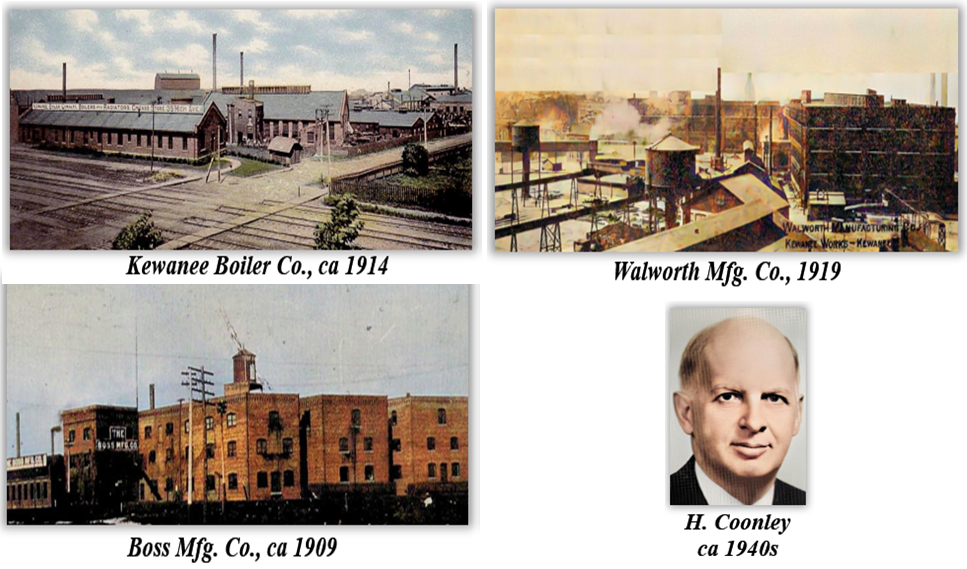
In 1912, Chicagoan Howard Coonley had become president of the Walworth Company of Boston. He initiated a reorganization of the company and started a campaign for extending its activities. As a result, in 19I7, Walworth purchased the National Tube Co.’s factory in Kewanee, trebling Walworth’s output. Coonley’s prowess was soon recognized by a country at war.
Shortly after the war began, the Emergency Fleet Corporation (“EFC”) was created to acquire, maintain, and operate merchant ships. Over the course of the first year, there was significant turnover at the top of the EFC. But slowly it developed into a smooth operating entity.
Though it began in three small, rented rooms with only six employees, within six months it had more than one thousand employees, had established sixteen offices in various parts of the country, had assumed supervision of the building of 1118 vessels in 116 yards, and had begun disbursing money at the rate of over one billion dollars annually. The EFC grew to be twice as large as the United States Steel Corporation. As a result, organizational skills were sorely needed.
In April 1918, at the request of the EFC’s new director general, President Woodrow Wilson appointed Walworth’s Coonley as EFC vice-president in charge of administration.
Earlier that year, Galesburg’s contribution to the war effort had been recognized by a new ship named after it. The Civic Club of Kewanee, not to be outdone, wrote to the EFC in June requesting that a new ship be named Kewanee in honor of the local factories which were contributing heavily and efficiently to the war effort.
In a July 15 letter, the EFC advised the Civic Club that “we have assigned to Moore & Son’s hull No. 117, now building at Elizabeth, N. J., the name Kewanee.” The Kewanee Daily Star Courier noted that “the fact that Howard Coonley of the Walworth Mfg. Co. is vice-president of the [EFC] no doubt helped Kewanee’s request for a ship.” Kewanee was elated.
The next task was to select a sponsor for the launch of the ship. The Civic Club asked the Kewanee Works of the Walworth Co. to choose the sponsor. It, in turn, asked the women who were actually engaged in work on war goods, doing the work of men off to war, to cast ballots. In mid-July, about 200 votes were recorded and Clara Dossche was elected the christening sponsor.
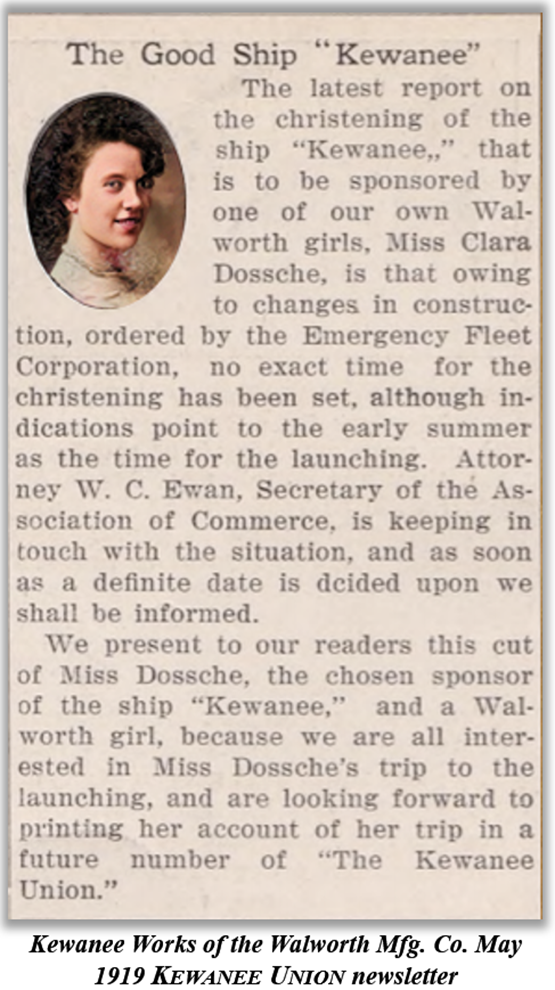
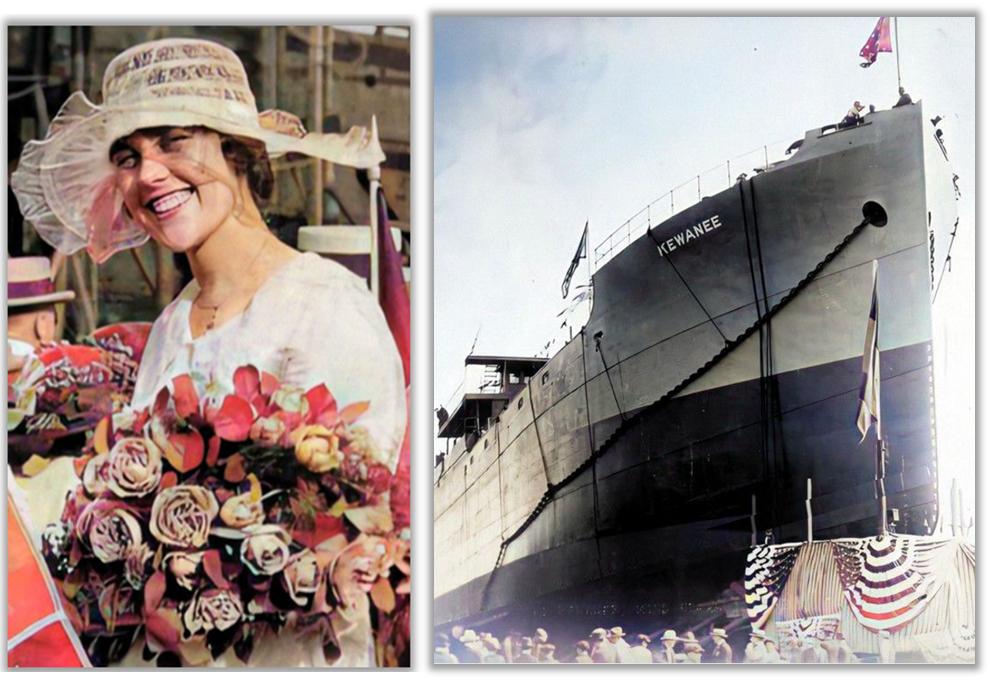
Miss Dossche was born, raised, and educated in Kewanee after her parents arrived from Belgium. She had many Belgian relatives “who are suffering under the yoke of German oppression,” making her one directly affected by the war. At that time, she worked in the gray iron foundry core room, manufacturing some of the very material used in a ship such as the S. S. Kewanee. In addition, she was an active member of the local Red Cross.
Walworth agreed to provide all expenses in connection with her trip to the shipyard. The city also decided to send a delegation to participate in the christening.
On June 7, 1919, at Elizabeth, New Jersey, Miss Dossche christened the S. S. Kewanee with a bottle of champagne and then the ship, 335 feet long with 5,000 tons of displacement, slid into the water.
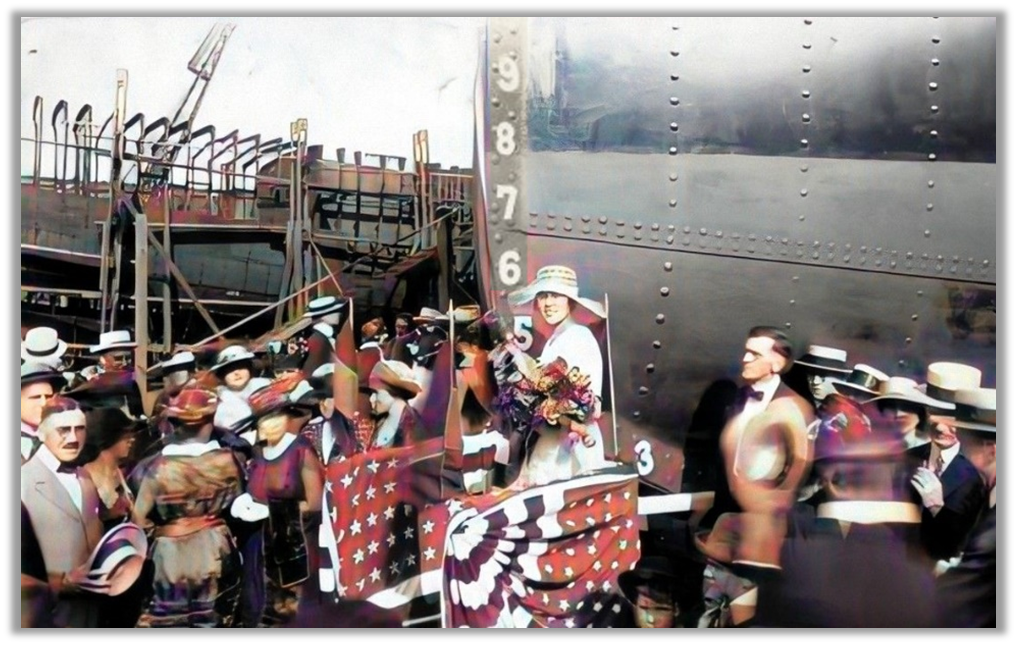
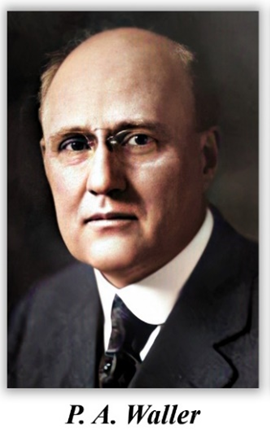
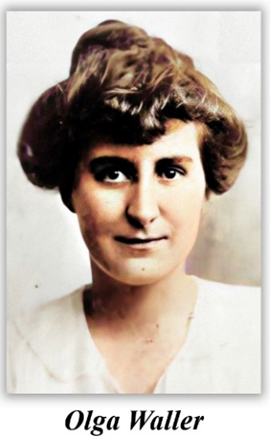
A delegation of 50 Kewaneeans, headed by Boss Co. president P. A. Waller, attended. Waller, accompanied by his daughter, spoke on behalf of Kewanee.
After the festivities, Miss Dossche returned home and to Walworth. According to the paper, while humbled by the experience, she remained otherwise unchanged and was still popular among her coworkers.
Miss Dossche remained with Walworth, becoming the plant nurse. The S. S. Kewanee continued to serve through the end of World War II until it was scrapped in 1946.
Oh, yes, the broken champagne bottle used to christen the ship remains and can be seen at the Kewanee Historical Society’s Museum.