Throughout history, Kewanee manufacturers have played a critical role amid times of national crisis. Often on short notice, they pivoted to churning out entirely new products to protect men and women in the military, producing much-needed supplies and support for the country’s defense.
Here’s a brief story of Boss Manufacturing Company’s incredible feats during World War I.
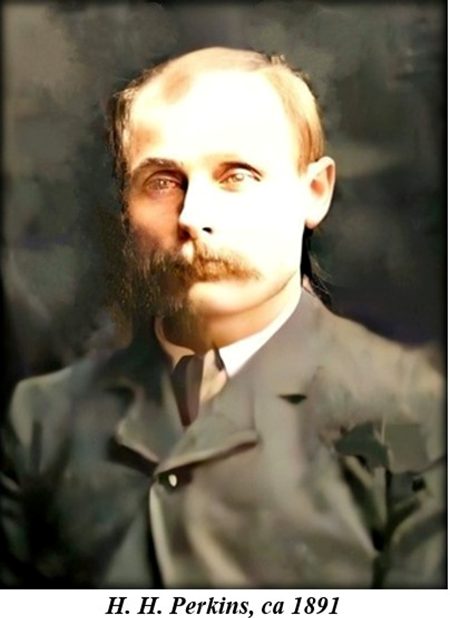
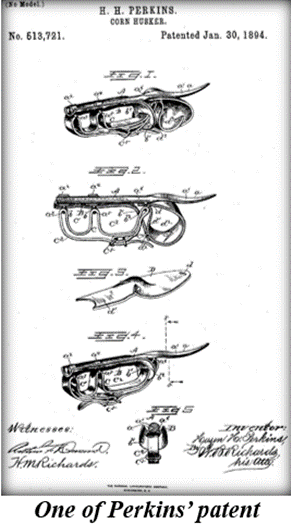
Hazen Hayes Perkins obtained his first patent for a cultivator in 1873, and by the mid-1870s, arrived in Kewanee where he continued making and selling farm implements. In 1887, Perkins obtained a patent for a metal pin for shucking corn, which he called the “Boss Husking Pin” or “Boss Husker,” and organized the H. H. Perkins Co.
In 1890, Perkins, Kewanee businessmen H. T. Lay, W. H. Lyman, and Henry Terry of the Lay & Lyman department store, and attorney C. C. Wilson, incorporated the H. H. Perkins Manufacturing Co. to exploit Perkins’ patents. In 1893, Perkins left the company, and his former partners created a new company, the Boss Manufacturing Company.
The company diversified into clothing, but soon discovered that its mittens and working gloves had become highly popular and in great demand. So, its equipment was soon devoted fulltime to making the popular mittens and gloves. The company then began expanding to manufacture specialty gloves for a variety of industries.
As it expanded its lines, Boss expanded production beyond Kewanee, with its first branch plant in Galesburg. It also started buying out smaller companies around the country, in places such as Bluffton and Fort Wayne, Indiana. Boss opened its first Eastern branch in New York City in 1906, which complemented a Midwest office in Chicago. In the early 1900s, Boss was sometimes referred to as the “U.S. Steel” of the cotton work glove and mitten industry.
Boss’ growth continued nearly unabated, and by the cusp of World War I, it was the premier glove manufacturer. It then became a key supplier in the war effort.
(You can learn more about Boss Mfg. Co. in two of my stories found here and here.)
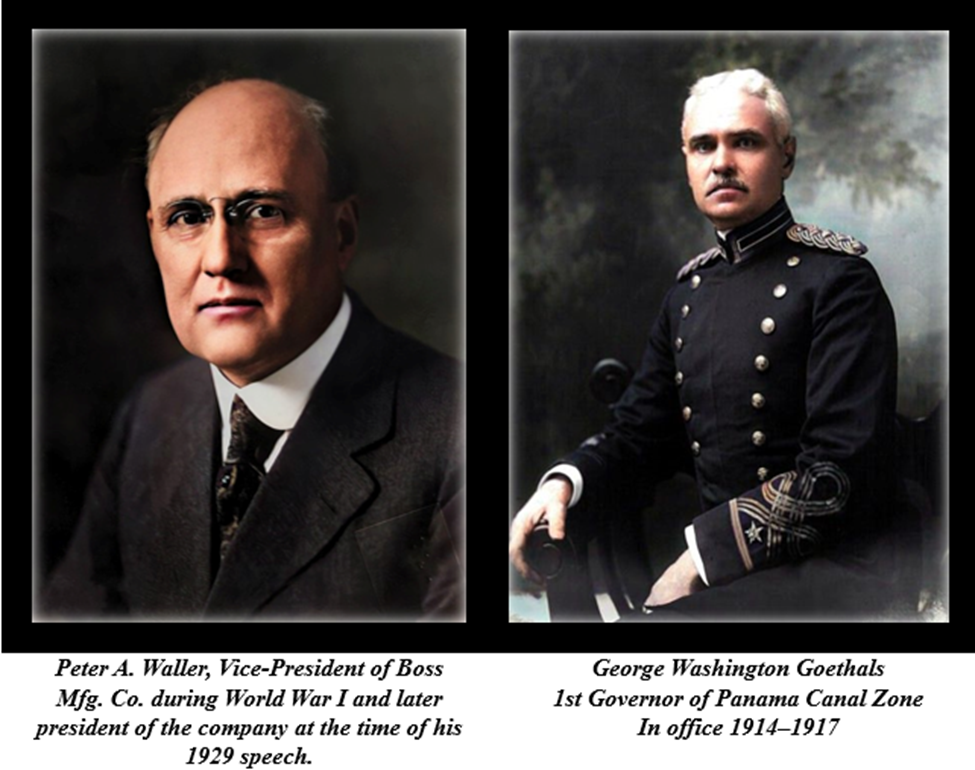
George Washington Goethals, a civil engineer and soldier, was best known for his administration and supervision of the construction and the opening of the Panama Canal. But after the U.S. entered WWI, Goethals was called out of retirement in December 1917 to become Acting Quartermaster General, but only after receiving assurances he would have full authority and that he would not be interfered with. Soon, from General Goethals down, practically everyone was on the job from early morning to late at night, seven days a week. He reorganized the corps along functional lines and by the end of January 1918, purchasing had been taken away from outside agencies, and placed under his control.
Then Boss Vice-president Peter A. Waller recalls what happened next as it pertained to Boss.
“In the winter of 1918 General Goethals called us down to Washington on a Sunday. He wanted gloves and he had learned that we could furnish large quantities on short notice. It was in January and very cold. Soldiers were being encamped on the various parts of the country and there was a shortage of clothing and supplies of that nature . . . . The Quartermaster’s Department called us on the telephone from Washington and gave us an order for 2,500,000 pairs of gloves to be shipped by express and asked, ‘How soon may we expect delivery?’ We answered, ‘Just as quickly as you can furnish us with express cars.’”
That call came on “fuelless [sic] Monday,” when the Boss factories were shut down. But the Quartermaster’s Department promised the transport at once, Boss completed the order and had it on its way within 48 hours. Two million five hundred thousand gloves made and loaded onto rail cars in two days flat!
Two weeks later, the government ordered another 2.5 million pairs of gloves and Boss provided the same turn-around, assuring its standing as a trusted supplier to the government’s war effort. According to Waller, “we had established a reputation which was quoted as a model to all manufacturers who furnished supplies to Uncle Sam.”
Boss went on to design specialized gloves for specialized military applications. Waller said that included “fireproof gloves for the gunners in the Navy; gas-proof gloves for the Chemical Warfare Service; barbed wire entanglement gloves and special one-fingered mittens for laying of mines in the North Sea.”
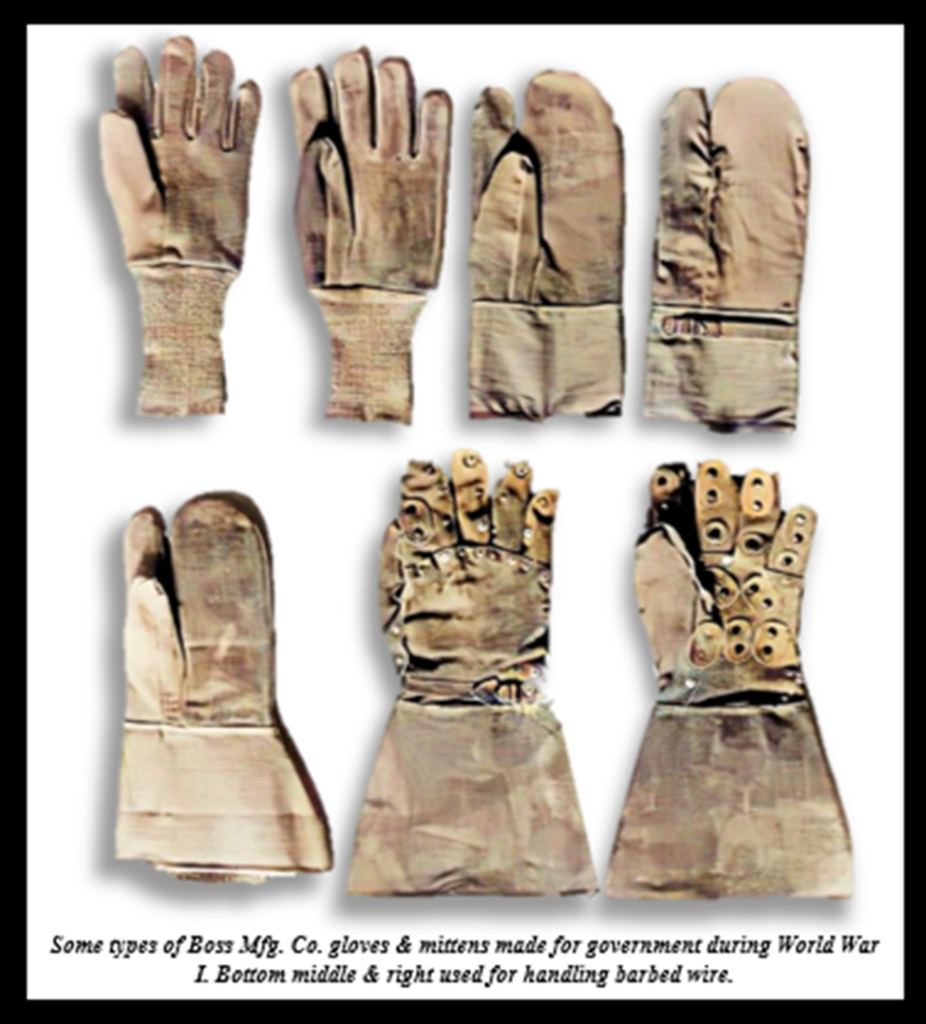
Waller later explained that “[o]ne day’s output during the war amounted to 300,000 pairs of gloves. If they were laid end-to-end they would make a continuous chain of 142 miles in one day and in one year would go around the earth at the equator nearly twice.”
This is just one of many stories of how Kewanee industries, leaders and citizens contributed. While Peter Waller is the only Kewaneean mentioned by name, Boss was made up of everyday Kewaneeans whose work ethic made any successes possible. Just as Kewanee was made up of everyday citizens who contributed in so many ways, including making the ultimate sacrifice on the battlefields of Europe. This story about one company is really a tribute to all of our ancestors and their understanding of the importance of family, friends, community and country, people who made us who we are.
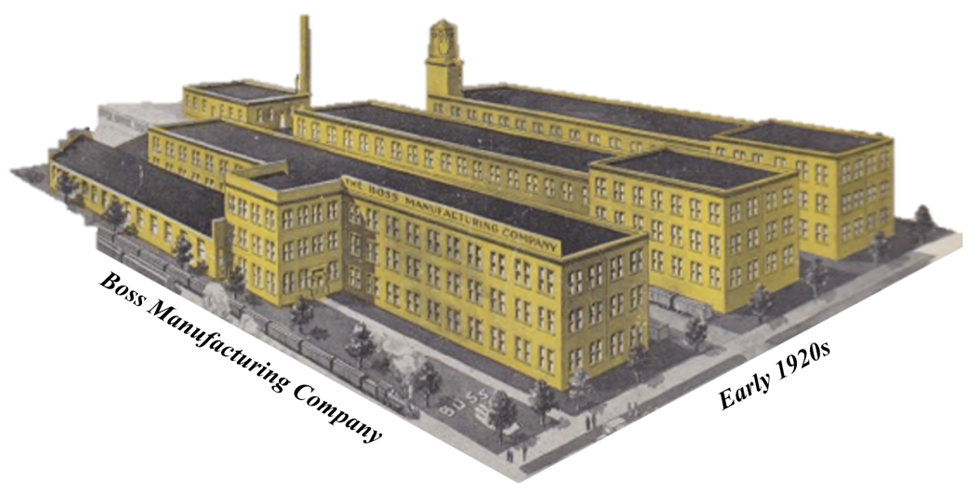
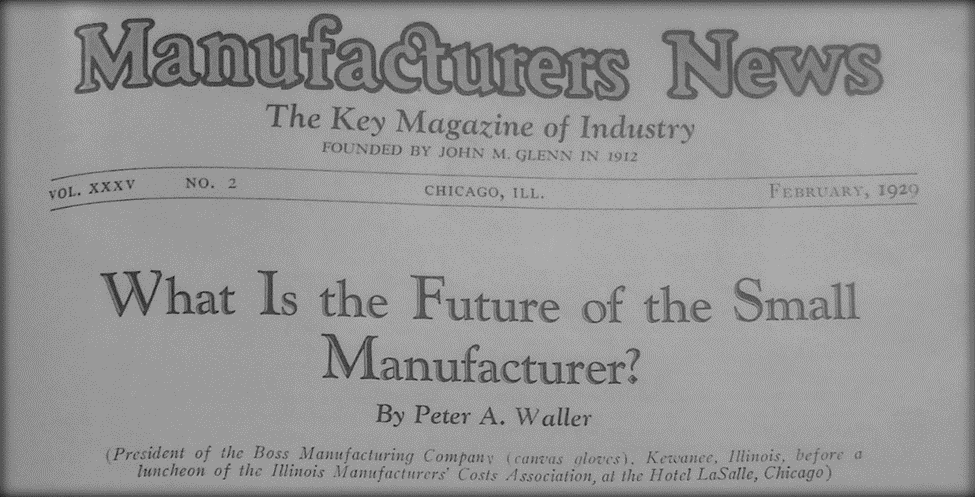
(I found this story in the February 1929 edition of the magazine Manufacturers’ News. It was reporting on a speech Waller, then President of Boss, gave at the Illinois Manufacturers’ Cost Association Luncheon at the Hotel LaSalle in Chicago.)