I have always been a tad jealous of other communities such as Galva, Cambridge and even Bartonville, where my daughter lives. They have something I have always coveted. I’m not ashamed to admit I love black squirrels. And all of those communities are flush with them.
I never imagined that Kewanee could get black squirrels because I figured that in order to get a large population roaming our yards, burying nuts and scurrying up our trees, a black squirrel or two would have to wander all the way from Galva or Cambridge or hitch a ride somehow because it took a black squirrel to make a black squirrel. I have since learned that’s not the way it works.
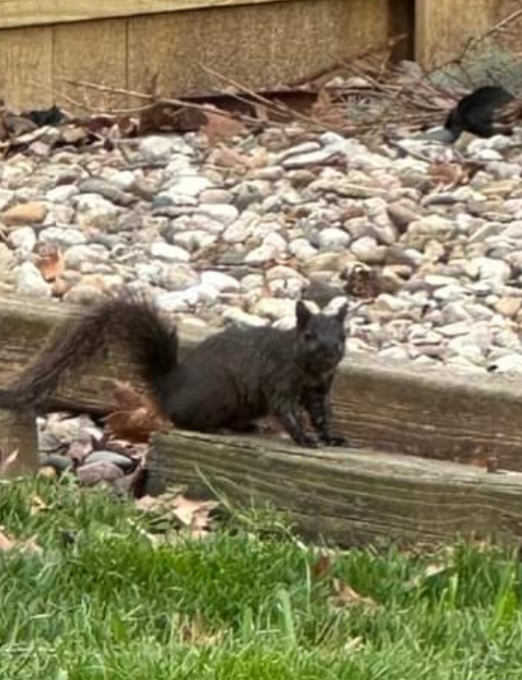
And then last week I was scrolling through Facebook and came upon a post by Dana Turley. Dana posted a photo taken from her yard over on Roosevelt Avenue by McKinley Park. The photo was of, you guessed it, a black squirrel minding its own business and looking pretty cute doing it. But Dana’s quick action led to the photographic proof we needed. Black squirrels are among us.
Dana was kind enough to allow me to share her photo with you. She also said that she saw the squirrel two days in a row and hasn’t seen it since, but she did see a baby black squirrel last year. In the comment section of Dana’s post, another resident said she also saw a black squirrel, but sadly, that squirrel was the unfortunate victim of a hit and run and won’t be passing on its genes.
So where did that black squirrel in Dana’s yard come from? Surely not Cambridge or Galva. A quick internet search provided me with some answers. According to the website AZ Animals, “while tree squirrels and ground squirrels are common throughout the world, for the most part, common squirrels are brown, gray, tan and even red.” But there are some color variants and that variant can be black.
How black squirrels came to be has been researched and scientists believe that their existence is caused by interspecies mating between fox squirrels and eastern gray squirrels, and those two species have been observed engaged in mating.
It would appear that the culprit to the color changing phenomenon is a defective pigment gene carried by fox squirrels that make the species’ fur appear darker. The phenomenon occurs when the fox and gray meet and decide to have kits or pups, whichever you prefer. Instead of presenting the brown-gray or reddish gray typically seen in the species, they are born with black fur.
Of course that’s just one theory. But scientists estimate that less than one percent of all squirrels are black squirrels. Why some areas are lucky enough to be more heavily populated with the cute critters isn’t known. I am looking at you Galva.
Being a black squirrel has its benefits, scientists say. In colder climates like ours, the black fur absorbs the sun’s rays and holds onto heat better, keeping the squirrel warmer during the frigid months. They can also hide better from predators, like hawks and eagles, that would like nothing more than to have them for dinner and they are less likely to be hit by cars “since gray squirrels tend to blend in with freshly laid asphalt on the road.” Black squirrels are more apt to be seen and avoided by drivers. Although we know of at least one black squirrel that wasn’t so lucky.
Black squirrels just aren’t adorable. Western cultures see them as a sign of good luck. But they are also considered “a positive symbol of change, fertility and prosperity,” and more so, a sign of good things to come.
It would be nice if sometime in the near future, Kewanee would become a community with their own population of black squirrels. We could certainly use some prosperity and good luck. All it takes is one, and according to the photographic evidence by Dana, we already have that. Fingers crossed Kewanee.