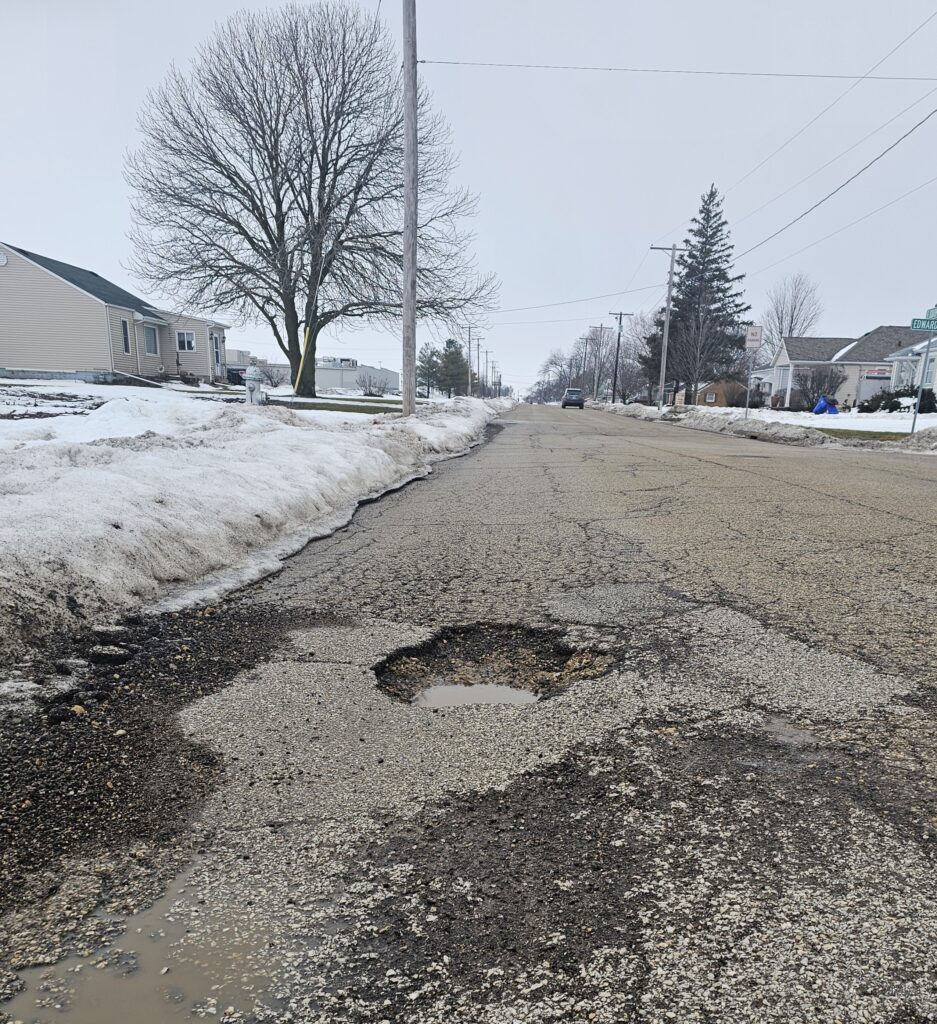
(This article is the third in a four-part series examining the state of the Kewanee streets; the scope of the problem; the cost of fixing them and the cost if we don’t. Mike Berry and Susan DeVilder contributed to this series.)
For seven years, the City of Kewanee has had a plan in place for addressing road repairs but the lack of funding has prevented that plan from moving forward. At the time the plan was formulated, there was no move made by the city council to fund such an undertaking, and the issue was put on the backburner.
Kewanee’s Public Works Director Kevin Newton would be responsible for overseeing the implementation of the street repairs. Newton is responsible for a number of the services the city provides — water and sewer, solid waste collection and disposal, and the cemeteries.
And maintaining the city’s streets. With some 200 lane-miles of streets to take care of, and limited funds available to pay for the work, Newton and other city leaders and workers face a tremendous challenge.
I don’t want to minimize the enormity of the amount of work in front of the department, but the first challenge to solve is funding these efforts.
Public Works Director Kevin Newton
In some cases, a complete overhaul will be needed, including digging up the existing street to repair the underlayment and any bad water or sewer lines. However much street work is necessary, and there is little chance that Kewanee’s city budget can provide nearly enough money to do all of it.
That’s why the City Council has voted to place a question on the March 19 ballot that will ask the voters to approve an additional half-cent sales tax to raise money for street repairs and maintenance. That sales tax increase would add about $.050 to every $100 purchase.
The Kewanee Voice asked Newton five questions about the challenges the city faces in maintaining the streets and the plan in place to fix them. Here are his answers:
What’s the biggest challenge Kewanee faces with fixing the roads?
The biggest challenge in my opinion is funding. Currently, the city relies on the money it receives annually from Motor Fuel Tax for its street maintenance program, but those funds alone cannot adequately fund the estimated $6.5 million in street repairs that are needed right now. It’s simply not enough considering the rate of degradation combined with increasing construction and material costs, and further delaying the maintenance of streets that we can’t afford to fix only increases the costs to repair them in the future.
On a scale of 1 to 10, with 1 being perfect streets and 10 being OH NO! If we don’t fix these streets, we’ll be driving on dust, where do Kewanee streets fit into that scale?
I’m not sure how it’s anything other than a 10 at this point. Yes, the condition of the streets varies, but overall, I’d say it’s a 10 because of the urgency to start addressing the situation as soon as possible, especially at today’s costs and not tomorrow’s.
What are the worst streets in Kewanee, those that need fixing as quickly as possible and what makes them priorities?
In all honesty, I could not provide a list since many are in poor condition. Right now, we annually rotate the street maintenance program around the four quadrants we’ve divided the city into. For example, last year’s program was performed in the Northwest quadrant, which is from West Prospect Street north, and Main Street west. The streets within the quadrant are numerically graded based on condition and traffic volume. From there, it’s determined which streets receive which repair, asphalt or a single- or double-layer sealcoat.
Main thoroughfares, or arterials, are considered priority for asphalt since they are the most heavily traveled, while collectors and local roads are usually candidates for sealcoat. The budget allotted for the program must be considered since addressing all the roads within a quadrant isn’t feasible within the same year.
The priority isn’t strictly road condition but maximizing the cost effectiveness of the repairs within the budget. There is obviously more involved regarding street repair and maintenance, but this would be a generalized approach.
If you had the funding to fix all of the streets, is there a plan in place to do so?
The city developed a plan in 2017 but did not seek a sales tax at that time. We have worked with an engineering firm to update that plan based on the work that has been done since 2017, changes in road conditions since the plan was developed, and increases in costs that have occurred since then. Even as it’s being implemented, the plan will continue to evolve to account for any changes in conditions that we’re aware of.
What are the challenges the street department faces in repairing the streets?
There are the basic overall challenges in facilitating any road construction program, and there are some areas where the water and sewer infrastructure is upwards of 100 years old and would need to be addressed in conjunction with road repairs.
Shifting our focus towards streets and sidewalks is a priority. As a department, this means focusing our efforts primarily on preventive maintenance, ensuring ditches are well established to handle runoff and not leave water to pool on the street surface creating potholes, implementing a crack sealing program, and even addressing trees within the right of way that cast shade preventing the street from drying are all examples of where we can focus our efforts.
I don’t want to minimize the enormity of the amount of work in front of the department, but the first challenge to solve is funding these efforts.