You can’t help but learn stuff in the news business.
For me, my “education” about the Model T Ford was “taught” by Ray Behnke, namesake of the 56th Ray Behnke Memorial Model T/Model A Rally held Sunday in conjunction with Hog Days.
Behnke was one of the “old guys” I had lunch with every day at McDonald’s with what was humorously referred to as “Rooster Row.”
At the time, Ray was a retired postal worker who had, over the years, become the “go-to” person for anything about Henry Ford’s popular model. I learned that there were Ford models “S’ and “N” before the “T” and that the latter was the first mass produced automobile with interchangeable parts made between 1908 and 1928. In addition to being affordable (About $290 in 1924)) just about anyone could do their own maintenance and make necessary repairs to their own car which is what appealed to mechanically inclined people like Ray.
Ray bought his first Model T in the mid-30s while a student at Kewanee High School for $12.50 and was immediately hooked by its simplicity and durability. Eventually he taught himself to build and rebuild engines and do the same with complete cars, a talent his son-in-law, Bill Scott also possesses.
In 1968, out of curiosity, he attended a meeting in Cambridge of a committee planning events in Henry County to celebrate the 150th anniversary of Illinois becoming a state. There was no one else there from Kewanee and, as far as the committee knew, nothing was planned in the city for the celebration.
Behnke had recently attended something called the Montana 500, a grueling, two-week-long, 500-mile Model T race in the Big Sky state. He suggested that Kewanee could host a shorter version of the event with a route that took the “tin lizzies” through every town in Henry County. The idea was well received. Behnke came home and, with Stuart Ruwe, the executive vice president of the Kewanee Chamber of Commerce, organized the race to be held during the annual Hog Capital of the World Festival Labor Day weekend. A 150-mile race was laid out for Sunday, and a shorter, 50-mile course was set for Monday.

Once again, people loved to see those old cars that most people thought were long gone, out there humming down the highway as if they just rolled off the line in Dearborn. The Model T race became an annual event during Hog Days and has been held every year since except 2020 when the COVID lockdown forced the cars to stay in the shed.
For many years the event was a timed race, with some cars recording speeds over 70 mph. There were two divisions…cast iron or aluminum pistons, the latter yielding better performance and resulting in less stress than the original cast iron pistons.
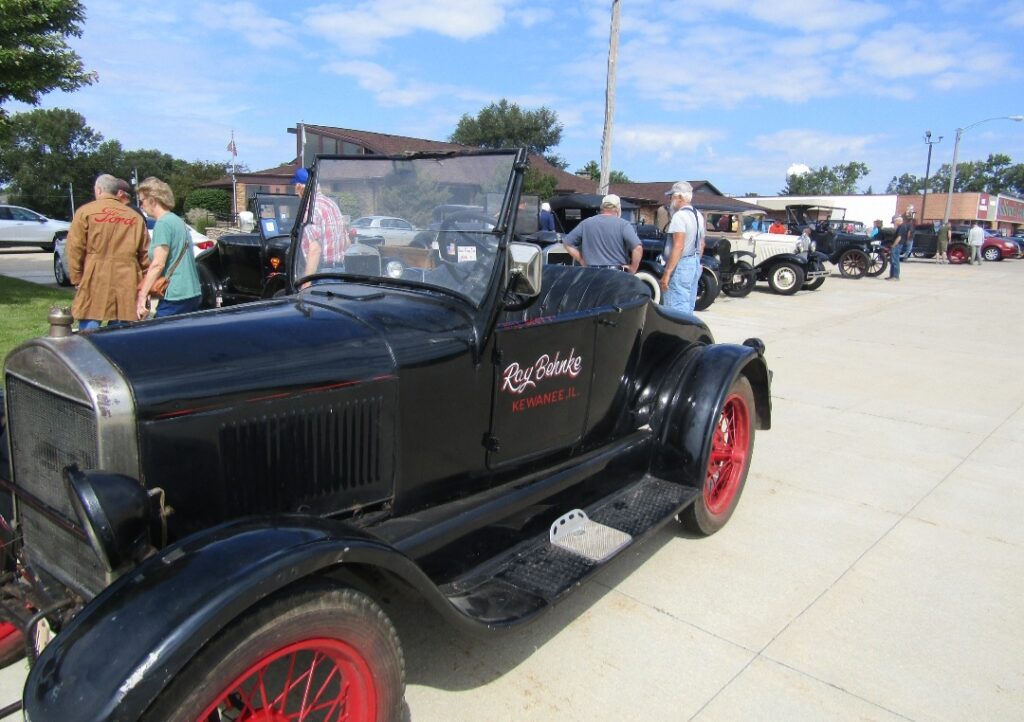
Over the years, the race was changed to an untimed rally, mainly for safety reasons, and Ford’s next car, the Model A, built between 1928 and 1932, was added since, as time went on, there were fewer Model T’s around.
The distance has also been shortened over the year and is now two 30-mile laps over backroads to Galva, Bishop Hill and back. Trophies for the fastest times have been replaced with prizes for the best cards from drawings held at four points along the route.
Ray died in 1994 after a long battle with Multiple Sclerosis, but shortly before his death he was able to make it to Montana for the sixth time to take part in his beloved “500.” Grandson Greg Scott drove the 1926 model Ray had always driven in the race with Behnke and daughter Ruth in the follow-up car.
Behnke’s passion for Model T’s spread to other locals including Howard O’Neill, George Cernovich, Don Tomsic, William “Bud” Johnson, Joe Ostrowski and others, swelling the number of cars showing up on Labor Day.
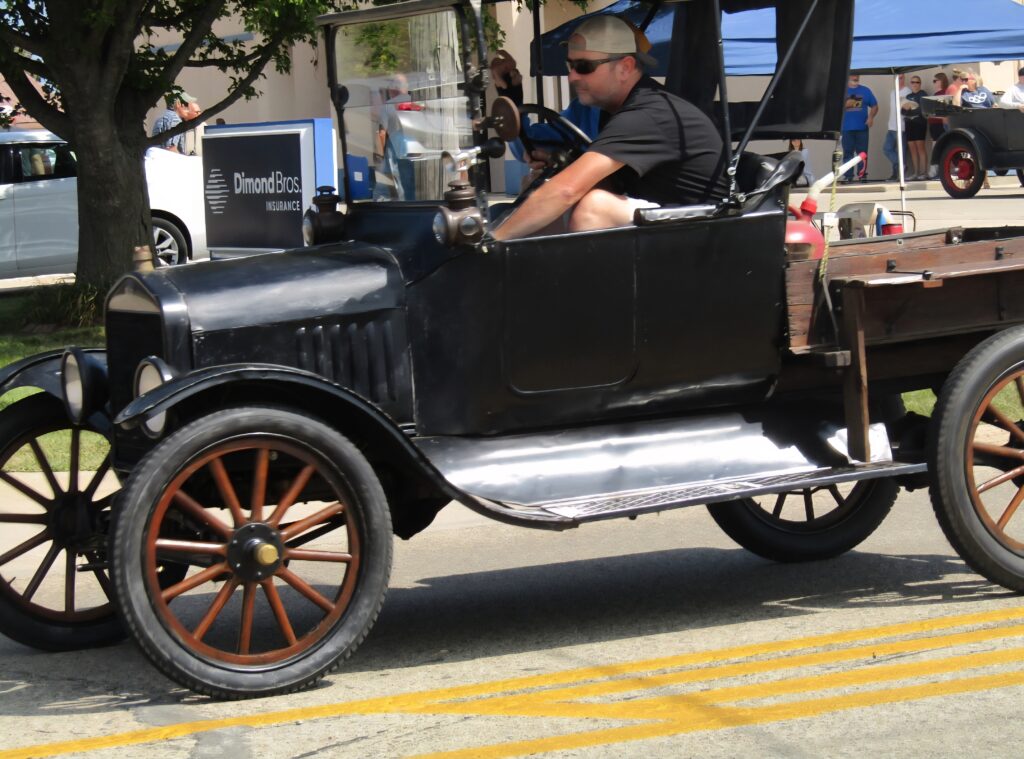
Drivers also trailered or drove their cars from other parts of the state, and beyond, and still do. Steve Paul drove his 1921 Model T touring car from Naperville again this year. Paul has driven every year since 1970, including 2020 when he showed up and drove around town with Bill Scott, even though the rally had been cancelled by COVID.
Before retiring, Bill and Ruth Scott spent most of their lives in Joliet, where Bill owned a Harley-Davidson dealership, but they came home every year for the race. Their son, Greg, who has now taken over the job of running the pre-rally driver’s meeting from his dad, said he was actually here (sort of) for the first race in 1968, carried by his pregnant mother. He was born in January of 1969.
Three generations of the Scott family either drove or rode in this year’s rally. Including Maci Scott, 13, of Joliet, Ray’s great-great granddaughter.
The participants gathered, as they do every year at the end of the rally, at the Elks Club for a potluck and prizes to the drivers who drew the best hand of cards. The cars are always parked out front for Hog Days celebrants to get one more look at cars from a bygone era that are still hitting the road today.