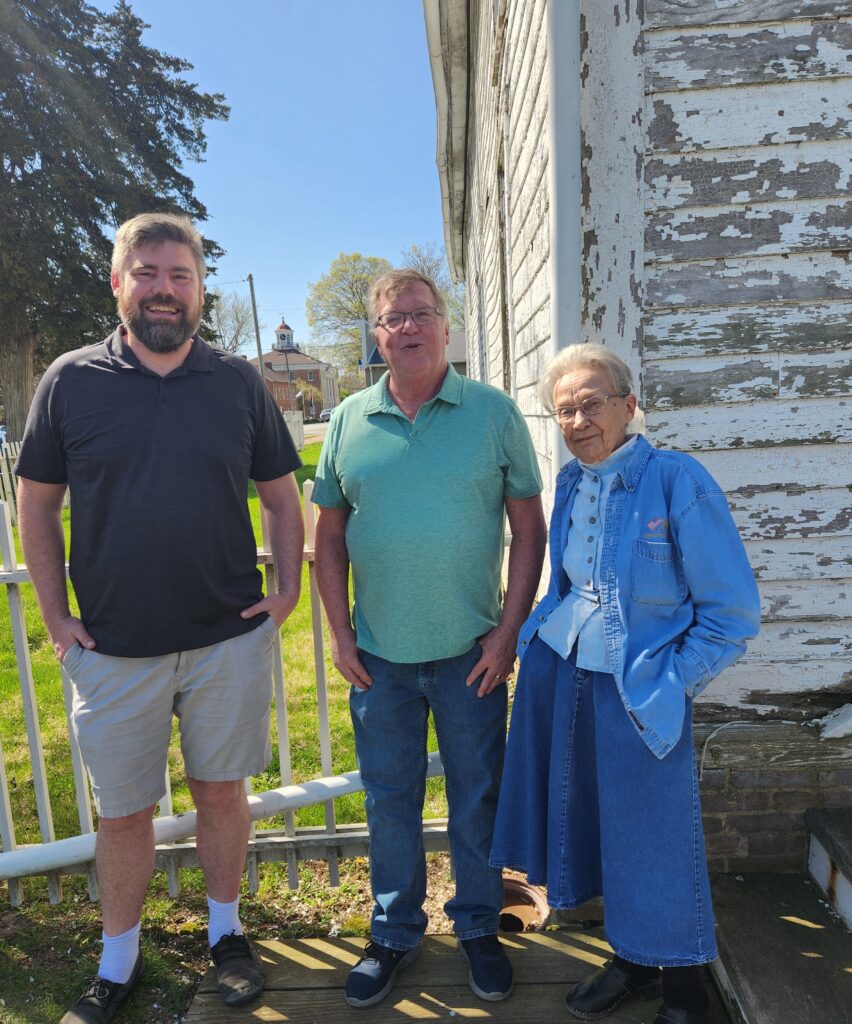
State Rep. Travis Weaver met with area residents of Bishop Hill on Sunday to discuss the fate of the crumbling structures in the center of the once-pristine village. Joella Krause and Eva Spets Harlan, both direct descendants of the original settlers who carved out a colony in the wilds of West Central Illinois nearly 200 years ago, shared much of the history of the village with Rep. Weaver.
They told him how the families that settled there came by boat from Sweden and then to the area by wagon and on foot, spending their first winter inside makeshift dugouts, then clearing the wooded area to make farms and homes they called a “Utopia on the Prairie.” Harlan told the group that her ancestor was the first child born in the village, several months after her pregnant mother walked all the way from Chicago in the fall of 1846.

Making bricks to build houses and pathways, they constructed other buildings including a hotel, a school, a hospital, a dairy barn, a dormitory for young male workers and a large, three-story church for worship. Krause said that “having escaped religious persecution in their homeland, the settlers found strength and solace in the graceful, three-story Colony Church. They worshiped there every day and three times on Sunday.”
It is still visited by many and features a candlelight celebration on Christmas morning, hosts weddings and is a big draw for tourists. Krause pointed to the damaged foundation, gutters and window sills and took the group to the second story to see the broken plaster and exposed lathe just above the original pews and flooring.
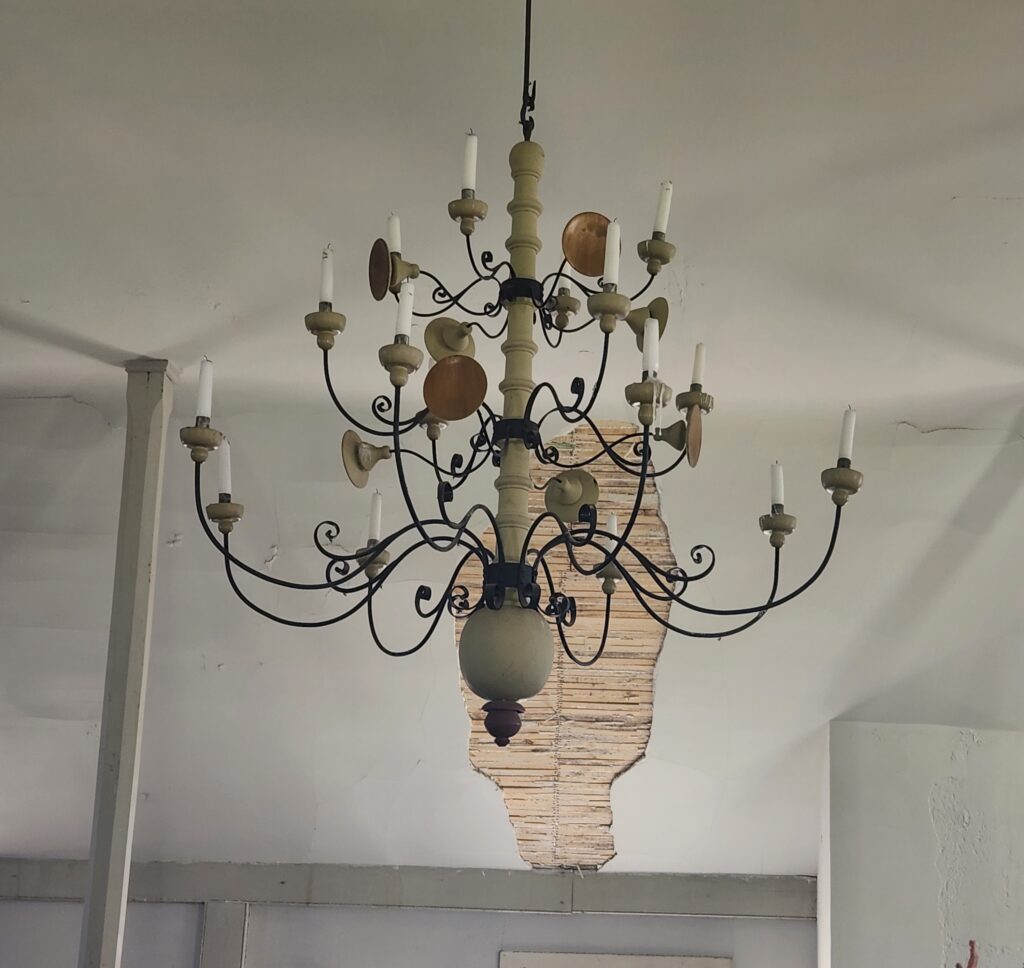
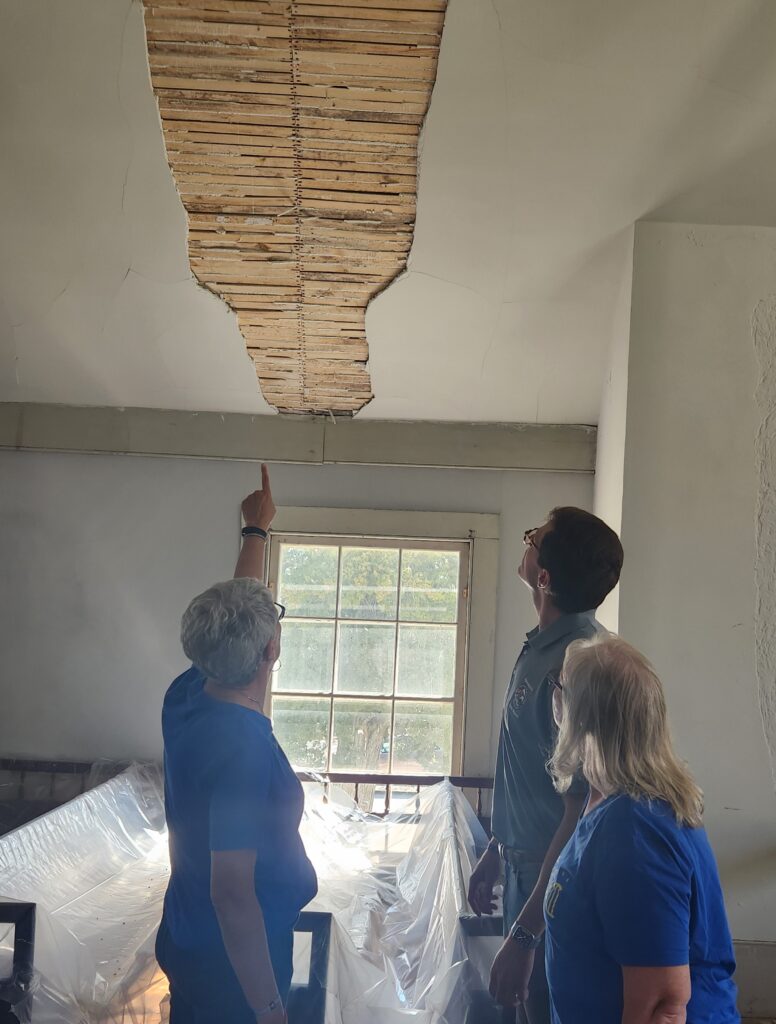
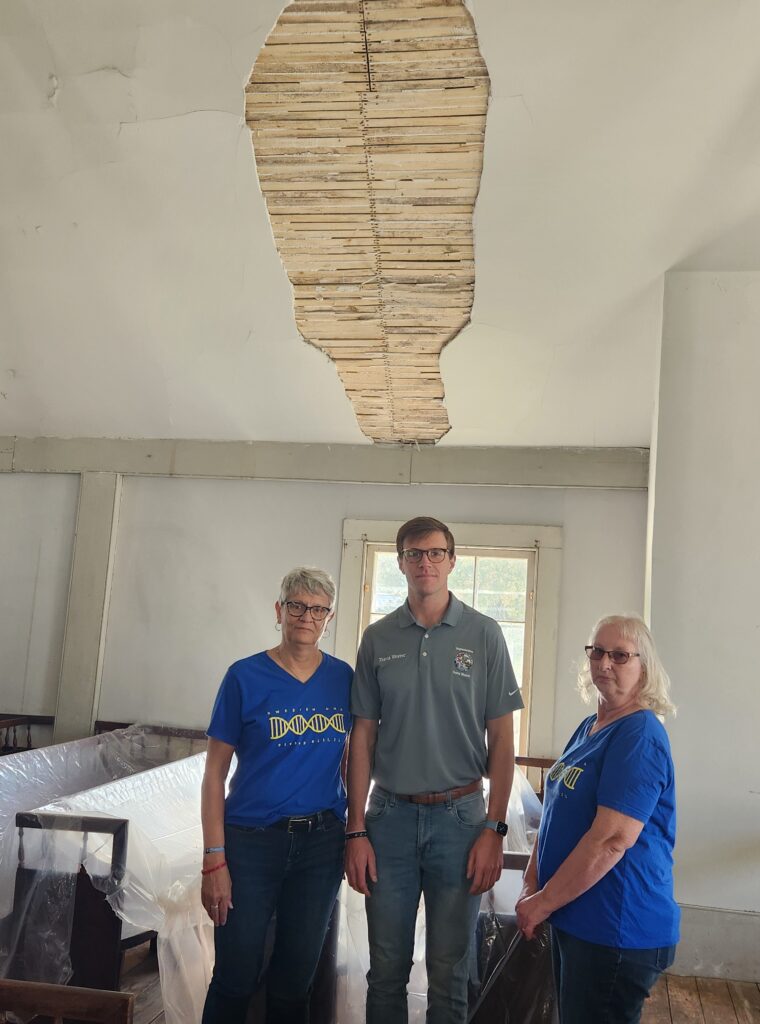
Harlan shared her concern for the future of the buildings that are owned by the State of Illinois, and under the management of the Illinois Department of Natural Resources (IDNR).
“Maintenance of the buildings has been little to nothing over the years. The weather and neglect have seen these beautiful buildings deteriorate,” she said.
Many of the other original buildings are privately owned or belong to non-profit organizations.
“They are not state property and therefore, not dependent on the state for upkeep”, said Harlan.
Megan Sloan, the widow of a descendent and concerned citizen, noted that last year, one of the buildings was partially covered by a tattered blue tarp.
“The IDNR’s only solution was to replace it with a silver one,” she said.
Sloan said that the number of state workers employed to monitor the large tourist trade has been reduced from four to two, making it difficult to cover all the attractions for the many visitors who come.
“This is a village preserved in time,” said Krause.
Visitors come from all over the world to see what life was like in the mid-1800s. She is quick to point out that the buildings are original, and not reproductions.
“They are the same as they were when they were first erected,” she said.
Lou Lourdeau, a Bishop Hill resident said that he tried to get the state’s attention for several years. “Once these buildings are gone, replacing them will be impossible”, he said.
John Taylor, a local business owner and advocate for the village, said that petitions, postcards, letters, emails and phone calls have been used to get the state’s attention. He, Krause, Sloan and Bishop Hill Heritage employee Todd DeDecker joined Rep. Weaver and Sen. Neil Anderson in Springfield recently, hoping to make the case for restoring Bishop Hill’s buildings.
“We keep trying,” said Taylor. “This is a great community, and we all want to see it treated fairly by the state.”
Rep. Weaver, who has taken the plight seriously, explained that the Historic Preservation Department was moved into the IDNR and it is now the entity in charge of funding.
“It’s political and shouldn’t be,” said Rep. Weaver. “The state should take care of the property it owns and keep its promise to the residents of Bishop Hill.”
Rep. Weaver praised the residents of the village who have continued to try to get the attention of the IDNR.
The newly appointed representative was raised in Dunlap, a small town not far from Bishop Hill. Elected to his post in January 2023, he grew up knowing about the Swedish village and has visited it many times in his life.
Weaver’s office is working on a memorandum with the IDNR to help the issue by allowing volunteer labor to make the repairs, hoping this will result in the restoration.
“The situation is critical,” said Rep. Weaver. “We need to keep on beating the drum so that change will happen.”
***The copy was edited to reflect the correct ancestor who walked from Chicago and the date of the candlelight service at the church.