Food banks and area pantries are scrambling to feed communities as government program cuts, rising food prices and increasing food insecurity make the task more challenging.
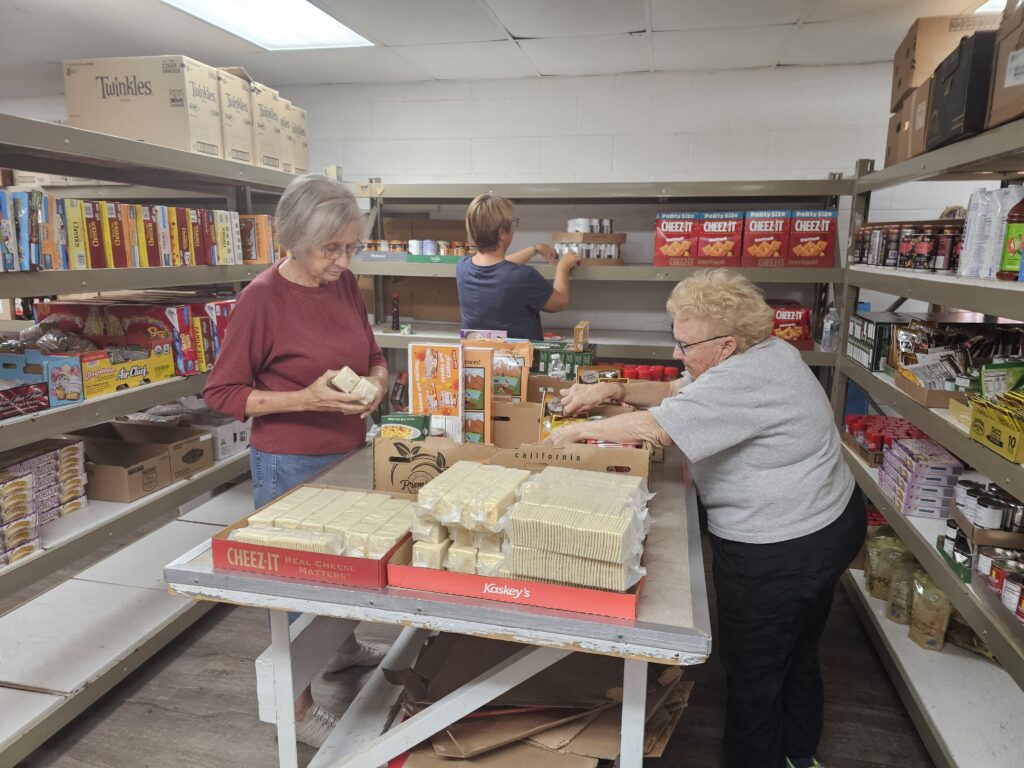
At the Kewanee Food Pantry, the number of families relying on assistance has grown significantly, said Director Lisa Janey. Over the past several months, the pantry has averaged 73 clients per month, up from about 40. Last month alone, the pantry distributed more than 530 boxes and sent 270 backpacks to area schools.
“Ten new families came through the door on Thursday,” Janey said. “And seven the time before.”
While the list of residents in need continues to grow, the amount of available food is shrinking, Janey said. Supplies from River Bend Food Bank have been limited, and government commodities that once supplemented the pantry with items such as beef stew, orange juice and canned vegetables have been reduced to bags of dried beans. Last month, it was dried garbanzo beans.
Vegetables, which are in high demand, are now difficult to obtain. The pantry can’t even order them from the food bank, said Sandy Hill, board member and volunteer.
“We’ve been spending a lot of money buying vegetables,” said Barb Gross, board president.
Janey said purchasing vegetables from stores has become necessary, but the pantry has found a reliable partner in at least one grocery chain.
“Save-a-Lot is a godsend,” she said, noting that management alerts them when products are available. Walmart also regularly donates baked goods.
Mike Sigwalt, director of the Geneseo-Atkinson Food Pantry, said his organization is also feeling the strain of rising food insecurity and dwindling resources. The pantry has no geographic restrictions on who it serves.
“We are serving 101 Kewanee families,” Sigwalt said. Recently, 426 families totaling 1,221 people, including 414 children, have used the pantry.
Sigwalt said the number of people served is up more than 60% from the previous year. With commodities and government programs on hold, River Bend Food Bank’s ability to distribute food has been severely impacted.
“We are scrambling to find other sources for food,” he said.
The Geneseo pantry operates on a 100% client-choice model, allowing clients to check in and shop for their own food. But federal program cuts have limited those choices.
“The commodity program was just counted on,” Sigwalt said.
Cuts to other government programs, including the Supplemental Nutrition Assistance Program (SNAP), have reduced the amount of food available and increased food insecurity.
“I told the board we’re going to top 500 before the year is out,” Sigwalt said, referring to the number of families served monthly.
Sigwalt said reinstating those programs would improve conditions but rising consumer prices, especially on food, are compounding the problem.
“It’s absolutely crazy,” he said.
Sigwalt expects the situation could worsen.
“People don’t want to come here. They want to be on their own. But people are living paycheck to paycheck with decisions between medicine, bills and food,” he said.
Chris Ford, president of River Bend Food Bank, oversees operations in the Quad Cities.
“We cover 23 counties in Iowa and 18 in Illinois. We feed over 1 million people,” Ford said.
In the food bank’s service area, 137,000 people are considered food insecure, a number that has increased by 13.2% over the past four years. River Bend works with 400 partners, including schools, churches and senior organizations, in a community-wide effort to end hunger in Eastern Iowa and Western Illinois.
Ford said demand for services has surged over the past two years, requiring more financial support from partners. But the loss of government food commodities has had the greatest impact.
A total of $850,000 in food commodities, including $200,000 in bonus food, has been lost, Ford said. By next year, cuts to SNAP benefits will place even more pressure on food banks and pantries.
“I don’t think most people understand that when these cuts get implemented people will be shocked, surprised and scared,” Ford said.
Media outlets are reporting that nearly 2 million Illinois residents could lose federal food benefits as of Nov. 1 due to the ongoing government shutdown. The Illinois Department of Human Services announced that the U.S. Department of Agriculture will not fund SNAP benefits if the shutdown continues into a second month.
Without those benefits, many families will turn to local food pantries.
Ford said River Bend’s approach to the crisis is strategic, starting with dividing available food among pantries. But for the first time this year, the food bank is running a deficit. Last year, River Bend lost $600,000; this year, Ford predicts losses will reach $750,000 to $800,000.
“We’re feeling it. We absolutely know our partners are feeling it too,” he said.
River Bend is implementing the roll out of a software system called Link2Feed, which will be placed in food pantries to collect valuable data that will help identify why people are in need of assistance.
Another strategy includes expanding the weekend backpack program, which sends food home with children facing food insecurity, by putting food pantries directly in schools.
With upcoming SNAP changes expected to reduce benefits or remove recipients from the program altogether, Ford said schools will play a critical role in food distribution.
“That transition is very strategic, and I think it will be a couple of years to get there,” he said.
Ford said River Bend has partnered with a program to provide reconditioned refrigerators, freezers and racks, essential equipment for launching school-based pantries.
“I feel like we’re in a pretty good spot,” he said.
Ford directed criticism to the recently passed One Big Beautiful Bill, saying it will have serious consequences for food-insecure families.
“About a year from now, people are going to have some stark realities,” he said, adding that the upcoming cuts will be the most significant in the history of the food assistance program.
He also expressed concern that Illinois and Iowa may not have the funds to support the program once federal cuts take effect.
“When I tell you I’m concerned, I’m very concerned that cuts to SNAP will have historical implications,” Ford said.
Eighty percent of the highest food insecurity in the United States is found in rural areas, Ford said.
“If you take SNAP money away from rural communities, you’ll put small grocery stores out of business,” he said. “The One Big Beautiful Bill has so many ramifications.”
At the Kewanee Food Pantry, staff, volunteers and board members are working to find solutions to feed the growing number of people in need.
Gross said the problem has escalated over the past six months and the fall out is trickling down to the local level.
The pantry’s director said the uncertainty is frustrating. Monthly meetings with River Bend officials have yielded little information.
“There’s no indication of how this is going to fly,” Janey said. “I think it’s going to get worse.”