The front page of the Saturday, March 15, 1947 Star Courier carried a dispatch from the newspaper’s Washington correspondent, Sam Tucker, reporting that the results of data gathered every five years by the Department of Commerce’s Census of Agriculture in 1945 had just been released showing that Henry County, Illinois, ranked No. 1 in hog produced in the U.S.
Even though Iowa remained the state producing the most hogs, Henry County’s 183,329 farm found porkers had beaten all Iowa counties, including the two highest counties in the previous national survey in 1940.

The revelation was apparently met by Kewaneeans with a wide yawn. That was until three months later, in mid-June, when Star Courier columnist Frank Preston Johnson called out the complacency of the Henry County populace towards the national honor in his front page Saturday column, “Window on the Week.” He pointed out that “If our lads had won the state basketball title we’d have painted the town red and boasted of it to generations now unborn. And rightly so. Washington announced that we have won a greater title, and we have done nothing about it. Why not set aside a day to celebrate this distinction?”
And thus was planted the seed for what we celebrate today as Hog Days.
Johnson was born July 21, 1889 in Cherokee, La. He attended Morningside College in Sioux City, and the University of Chicago. Most of his early life was spent working on newspaper staffs in Iowa and speaking on the Redpath Chautauqua Circuit. He was also on the publicity staff of the Century of Progress Exposition in 1933-34 in Chicago and in two similar centennial celebrations in Texas.
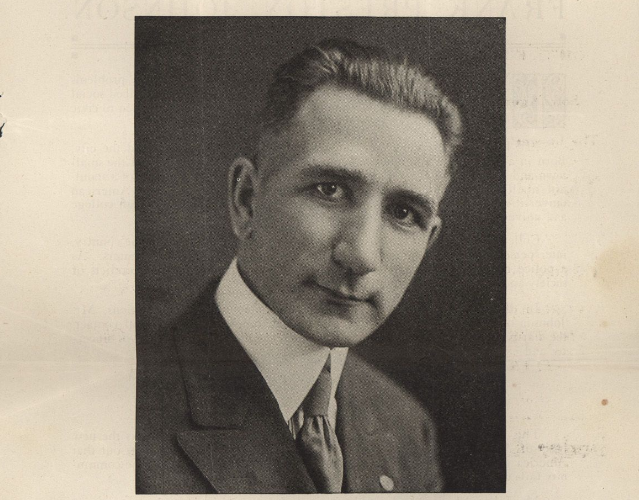
In 1942 he decided to “settle down” in Kewanee and married Irene Taylor, a professional artist employed at Marshall Field & Co., in Chicago, and the daughter of Albert C. Taylor, founder of Taylor & Son in Kewanee.
He went to work applying his writing skills at the Star Courier, taking over a front page column when its previous author, C. O. Schlaver, who took a job elsewhere. In 1944 he began publishing an annual booklet containing each week’s column called “Window on the Year,” just in time for Christmas gifting.
Place Photo 3 here, Windows on the Year. It could be wrapped in text.
It didn’t take long for Kewanee’s movers and shakers to get the message. A meeting was held in the Chamber of Commerce office on Tuesday, July 15, 1947. “Proper recognition of Kewanee as the ‘hog capital of the world’ was planned for mid-September and initially involved a hog show as the main feature. It was felt that due to Henry County’s recent notoriety, which had drawn national attention, that a ‘Hog Day’ would attract leading hog producers from all over America.”
It was also felt that the fact that neighboring Bureau County had been ranked 5th in the nation in hog production, and that Stark County produced a good many hogs, only added to the claim that Kewanee was “Hog Capital of the World.”
The first Hog Day was held on Saturday, Sept. 20, 1947 and drew over 150 entries to the judging ring which was set up in the intersection of Tremont and Second. streets. A carnival and concessions were also planned downtown in the “People’s Midway.” Similar September celebrations were held in 1948, 1949 and 1950, but including a pork barbecue had not yet caught on
In the fall of 1948, Johnson, tall, fair-sized man with a thick shock of snowy white hair and gift for communicating with people, was asked by local Republican leaders to run for a vacant seat in the Illinois House of Representatives from the 37th District, which included Henry, Bureau and Stark count At first, he declined. But finally agreed and was elected to represent the 37th District, which included Henry, Bureau and Stark counties when the 66th Illinois General Assembly convened on Jan. 1, 1949, in Springfield.

On Wednesday, March 23, Johnson, who had been referred to, along with other freshman as “not yet dry behind the ears,” during a heated debate on the floor, was growing tired of the parade of “courtesy” resolutions which are customarily read and routinely passed before the legislators go home at the end of each day. They usually congratulate football teams on their victories, couples on their 70th anniversaries, and recognize recipients of various awards from the sponsor’s home district. Rep. Johnson thought Kewanee and Henry County deserved as much recognition and drafted House Resolution 40 which congratulated the farmers of Henry County on their accomplishment, pointed out the many ways pork and its byproducts are beneficial to society, and that Kewanee, the center of pork production in the U.S., should rightfully be hailed as the “Hog Capital of the World.”
As the clerk read the resolution, several lawmakers “gave vent to hog grunts and pig squeals; others demonstrated their hog-calling technique.” Johnson, miffed by the disrespect, rose from his seat and addressed the House with a thundering speech that put the mockers in their place.
“Mr. Chairman, I had not planned to speak on this resolution since it speaks for itself, but I was deeply grieved and humiliated by the raucous laughter and derisive jeers which greeted this resolution.” He went on, off the cuff drawing on his elocutionary experience on the Chautauqua circuit, to drive home the important hogs, and the farmers who produce them, to everyone, even those from Chicago who were squealing the loudest. He concluded with a poem from one of his earlier columns which said:
Ships made Carthage,
The wars made Rome,
Beer built Milwaukee,
Gold built Nome,
Cotton built Atlanta,
The harbor makes New York,
But good old Chicago
Was built on pork!
The gallery silenced, HR 40 was passed on a unanimous vote and Kewanee would be officially known thereafter as the “Hog Capital of the World.”
Hog Day was held in the fall of 1947, 1948, 1949 and 1950, but, for some reason, it was not held in 1951 or 1952, and the barbecue was still not on the schedule.
In 1953, Kewanee High School agriculture teacher Jim Golby and his students were sitting in their classroom one day, as the story goes, trying to come up with a project. Someone said “How about doing Hog Day again?” Hog Day was held in 1953 and 1954 in the KHS stadium, still centered around the promotion of pork production and still did not include a barbecue.
That was about to change, however, since, in July of 1954, Kewanee celebrated its Centennial which included what was billed as the “World’s Largest Outdoor Barbecue.” Long pits were dug in the Peerless parking lot where large hams were cooked over an open fire, sliced and served in sandwiches free of charge. The Centennial, however, did not include a barrow show. Golby and his students held their second annual Hog Day on Saturday, Sept. 11, 1954 in the stadium.
The outdoor barbecue, however, gave folks an idea. In early April of the following year (1955) the feasibility of staging a Fall Hog Festival with a free pork barbecue was tentatively explored at a meeting of diversified groups…and the proposed project appears to have considerable merit, according to a Star Courier editorial.
“Taking a cue from the free pork barbecue held in conjunction with the Kewanee Centennial last year and one of the outstanding features of the big event, the representatives of 30 organizations assembled were enthusiastic over the possibility.”
That year the Hog Day barrow show and outdoor barbecue were combined, held downtown on Saturday, Nov. 19, and called the “Hog Capital Barbecue.” Hog prices were down that year and farmers were hurting. The plan was to give the local farm economy a boost by promoting pork with a big festival in the Hog Capital.
A main attraction was the addition of a Hog Stampede which featured over 100 live market hogs driven down North Chestnut Street from Third to First streets, a feat that was repeated only once more, in 1956, and then discontinued. In planning the second annual Hog Capital Barbecue in 1956, the committee decided to formalize the event setting up a non-profit corporation to be known as “Hog Capital Barbecue, Inc,” to sponsor and handle the finances of the promotion. Attorney R. Sheridan Welch prepared the necessary papers and submitted them to the Secretary of State.
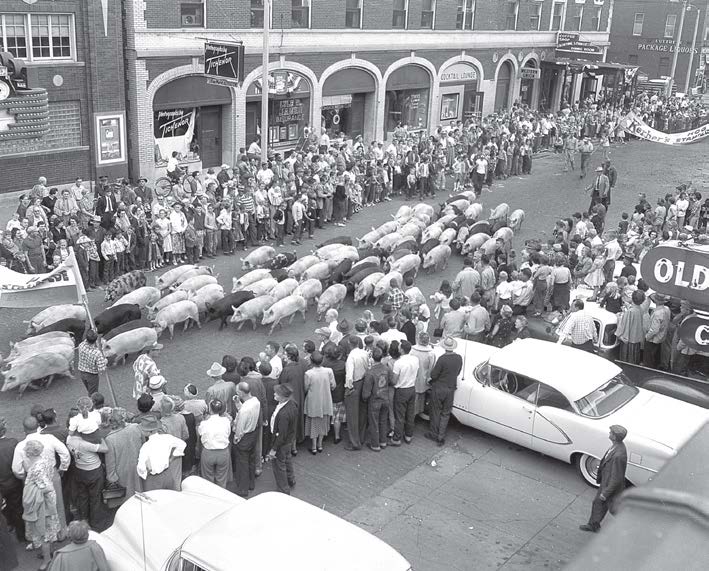
Over the years the annual event has been called Hog Day, Hog Capital Festival, Hog Capital Barbecue, and Hog Capital of the World Festival, and there have been detractors who think a festival bearing the name of an unglamorous and generally under-appreciated farm animal presents a bad image for the City of Kewanee, but it doesn’t stop us from holding a Hog Wallow Mud Volleyball Classic, a Hog Stampede (with people), something called a Pig Plop, and the original event…the Hog Capital Barrow Show, held each year at Black Hawk East.
Frank P. Johnson served one term in the House and was elected twice to the Senate, becoming an influential lawmaker in Springfield. His early efforts to establish a lake and recreational area north of Kewanee led to Johnson Sauk Trail State Park being named in his honor.
While continuing to serve in the legislature Johnson returned to Kewanee often and continued to write his weekly column. He was also involved in compiling the copy for the 144-page Centennial edition of the Star Courier published during the celebration in July of 1954. Eight months later, Johnson died on March 19, 1955 at his home at 614 S. Chestnut St., after suffering a heart attack a few days earlier. He was 65.
Sen. Johnson made the case early and often as to why hogs and those who produce them matter and are important to all of us. That’s reason enough to keep celebrating.
No matter what it’s called, when it started, or that the last census in 2020 only counted 63,284 hogs in Henry County, Kewanee Hog Days is STILL a great way to end the summer!