By Michael Berry April 18, 2023
Fred Francis designed and built Woodland Palace in the 1890s as a home for him and his wife, Jeanette. He endeavored to make the house accessible for Jeanette who suffered from tuberculosis, and since fresh air was considered important for treating her disease, he built Illinois’s first ever air conditioner. In the solarium, a room Fred dedicated to Jeanette, he created a system that cycled the air every minute.
Indeed, Woodland Palace sprung from a place of love, but it was also a testament to Fred’s imagination. A mathematical and engineering genius, Fred created a refrigeration room that never fell below 50 degrees and designed a complex water filtration system that purified rainwater as it flowed underground through sand, gravel, and charcoal before reaching Woodland’s cistern. Above all, Woodland was a place for Fred and Jeanette to grow old together. When Jeanette passed, Fred honored her memory by installing a marble sculpture in the solarium.
Those words are part of an exhibit in the Abraham Lincoln Presidential Library and Museum in Springfield.
The exhibit, titled “Here I Have Lived: Home in Illinois,” calls attention to 31 noteworthy people — some very famous and some, like Francis, relatively unknown to the outside world — who lived in Illinois.
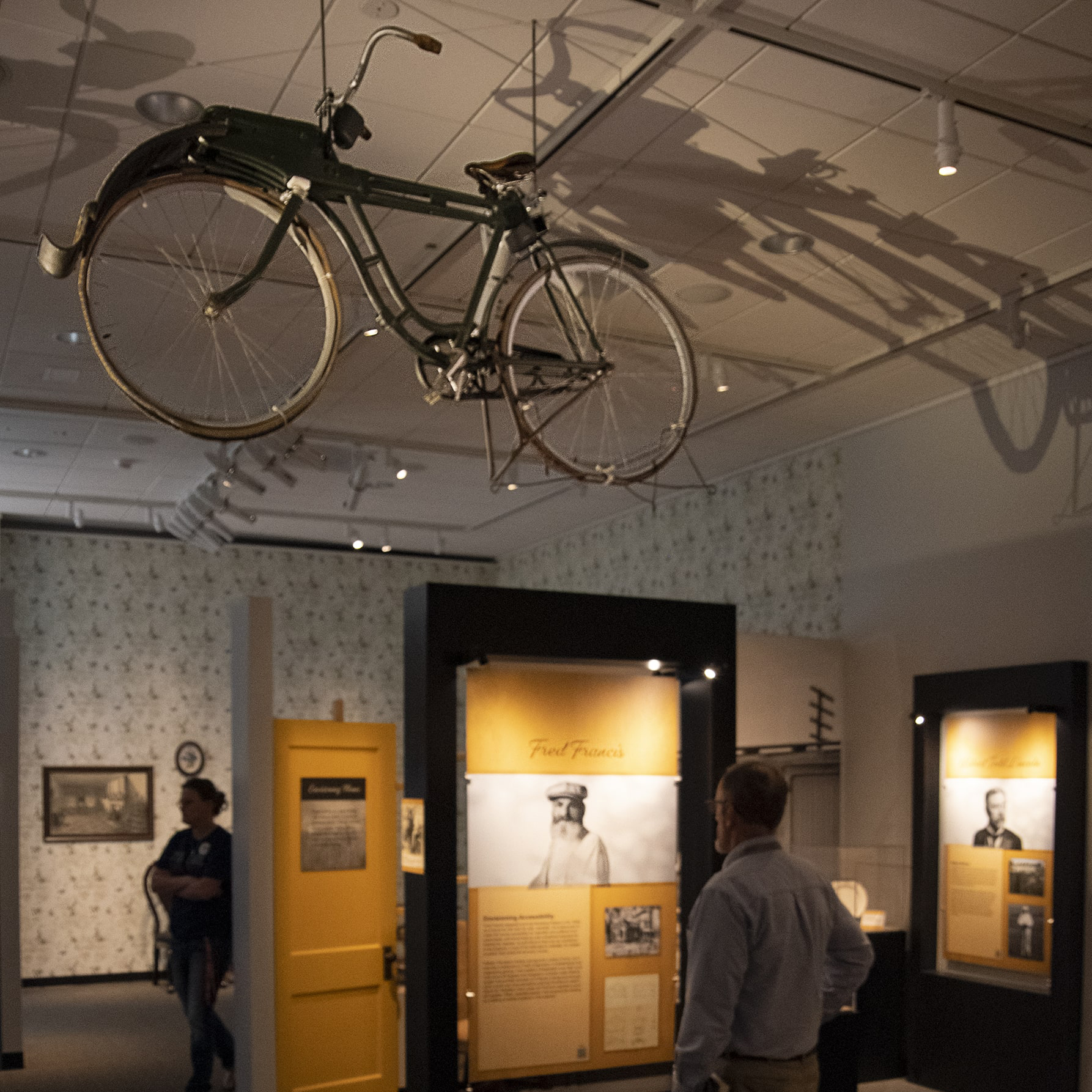
In addition to the display featuring photos of Francis and of Woodland Palace in Francis Park, an artifact from the ceiling above the display: The bicycle Francis modified so he could take his wife from their home outside Kewanee into town for church services.
Christine Shutt, executive director of the Lincoln museum, said the “Here I Have Lived” exhibit is “an example of our commitment to display all aspects of Illinois history.”
To arrange the loan of the bicycle to the museum, Shutt said, she visited Kewanee and met with city officials, since Francis Park and Woodland Palace are city property and are maintained by the city.
“I’ve been to the house,” she said. “I’m excited to be partnering with the city of Kewanee.”
The bicycle, which normally is on display at Woodland Palace, will be in place at the Lincoln museum through next Jan. 24.
All of the technological innovations listed in the museum exhibit, and more, are on display at Woodland Palace, which visitors can tour.
The Abraham Lincoln Presidential Library and Museum’s new exhibit, “Here I Have Lived: Home in Illinois,” features 31 stories of people who have called Illinois home over the centuries. They are divided into six themes: Envisioning Home, Familial Home, Fighting for Home, Finding Home, Reporting Home, and Surviving Home.
- Jane Addams, the social worker who won the Nobel Peace Prize for founding Hull House and trying to improve the lives of poor people across America
- Black Hawk, a Sauk leader who fought to reclaim his ancestral land in northern Illinois
- Margaret Burroughs, an artist and educator who turned her own home into a groundbreaking museum of Black history and art
- Cahokia Mounds resident, one of the people whose names have been lost to time but helped build a powerful city
- Harvey Clark, a Black man who simply wanted to rent an apartment in Cicero for his family. He was met with terrifying violence by a white mob
- Susan Lawrence Dana, the Springfield socialite and activist with the foresight to hire Frank Lloyd Wright to build an incredible home
- Ritta DeFreitas, a dressmaker who came to Springfield from Portugal and got to know Abraham and Mary Lincoln
- Jean Baptiste Point de Sable, a Black trader who became the first non-Native to establish a permanent home in what is now Chicago
- Martha Douglas, the Southern-born wife of Sen. Stephen Douglas who inherited enslaved people from her father
- Benjamin Driggs, who grew up in Nauvoo when it was headquarters for the young Church of Jesus Christ of Latter-day Saints
- Fred Francis, who used imagination and love to build an incredible, ahead-of-its-time home near Kewanee
- Betty Friedan, the Peoria-born author and activist who inspired a national debate on women’s rights with her book “The Feminine Mystique”
- R. Buckminster Fuller, the engineer and futurist who never stopped believing that technology could solve almost any social problem
- Charles Gibbs, a Springfield attorney who lived through a violent attack on the city’s Black residents by a white mob
- Mieczyslaw Haiman, the Polish immigrant who studied and promoted the relationship between his native country and his adopted home
- Lowney Handy, founder of a writers colony in east-central Illinois that produced, among other works, “From Here to Eternity.”
- Lorraine Hansberry, who turned her family’s experiences in a segregated Chicago neighborhood into the first Broadway play by a Black woman
- Buffie Ives, who stepped into the role of first lady of Illinois when the marriage of her brother, Gov. Adlai Stevenson, fell apart
- Hazel Johnson, an activist who helped establish the concept of environmental justice through her work on Chicago’s South Side
- Joseph Jordan, a resident of Pullman, the ultimate “company town,” during a period of groundbreaking labor unrest
- Mary Lincoln, the president’s wife whose many homes were beset by tragedy
- Robert Lincoln, the president’s son who found true happiness by leaving Illinois
- Free Frank McWorter, who bought himself and his family out of slavery and then founded a town
- Oscar Micheaux, who was born in poverty but became a novelist and pioneering Black filmmaker
- Michelle Obama, the attorney and first lady who grew up in Chicago with parents who valued education
- Louisa Phifer, a mother of seven who kept a Fayette County farm going while her husband served in the Civil War
- Richard Pryor, the groundbreaking comedian and actor who survived an abusive childhood in Peoria
- Ronald Reagan, lifeguard, college football player, actor and the only U.S. president born in Illinois
- Don Alonzo Spaulding, a surveyor in the 1830s whose maps encouraged settlement of Illinois even though it was already occupied by native tribes
- Tina Turner, who was born in Tennessee but began her journey into music history in East St. Louis
- Ida Wells-Barnett, the journalist and activist who documented the horrors of lynching
The exhibit also includes recordings of interviews with eight other Illinoisans:
- Monica Boutwell, an artist and photographer based outside of Chicago, discusses her Ho-Chunk and Potawatomi roots
- Bryan Crain reflects on his early memories and adventures growing up in the apartments above his parenta’ funeral home in Anna
- Dr. Nicole Florence tells the story of her family’s first days in their new Springfield home and her experiences in a primarily white neighborhood
- Bonnie Ho shares how she discovered her artistic talent shortly before emigrating to the United States from Hong Kong
- Dr. Patrick Lam discusses changing his name and becoming a United States citizen after immigrating to the U.S. from Vietnam
- Onyx Montes, a museum educator in Chicago, revisits her feelings of isolation in the COVID-19 pandemic as she attempted to visit her mother in Mexico
- Gabriela Ramirez reflects on serving as an English translator for her Mexican parents as a seven-year-old growing up in Chicago
- Dr. Mehul Trivedi discusses his childhood experience attending a private Christian school and coming home to a Brahman Hindu household.