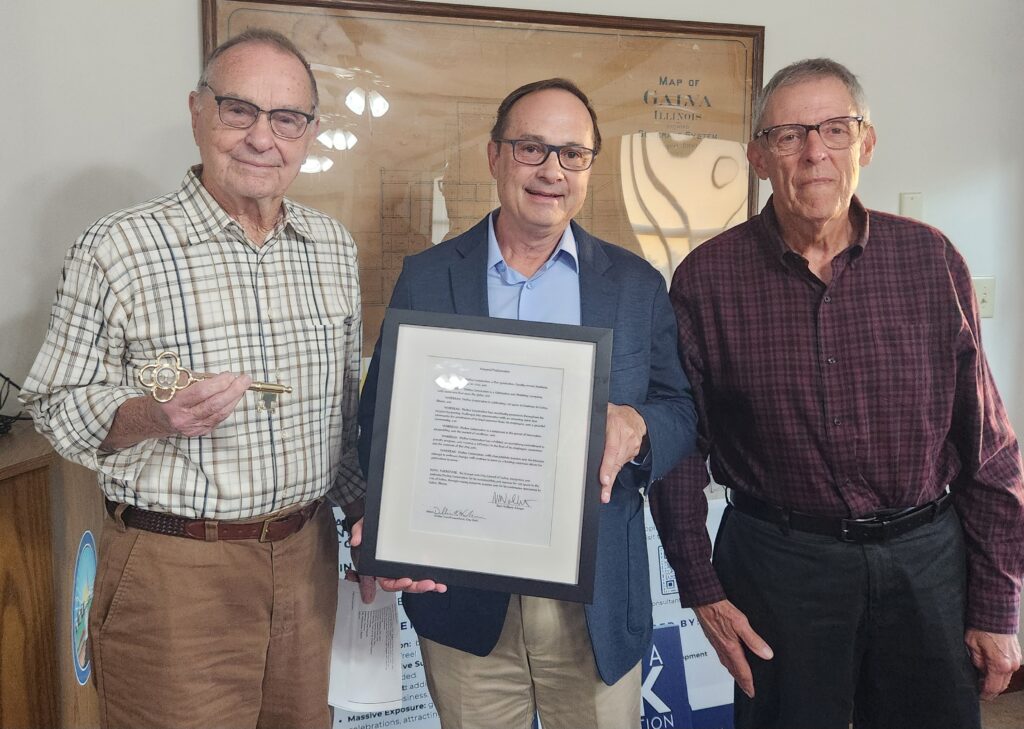
Before the start of the council meeting Monday, Mayor Rich Volkert recognized Dixline Corporation for its 100 years as a Galva business. Family-owned and operated for five generations, it has been a mainstay in the community.
“Dixline’s operation has expanded into the global marketplace,” said Volkert. “The city of Galva is proud to be your home.”

While reading the city’s proclamation honoring the Thomson family, Volkert emphasized the paragraph that noted, “Dixline has steadfastly persevered throughout the decades by turning challenges into opportunities with an enduring spirit which commands the admiration of its loyal customer base, its employees and a grateful community.”
A metal fabrication and finishing company, it was founded in 1924 by LeRoy Thomson, the great-grandfather of the current owner, Kevin Thomson.
During the meeting, the council voted to recognize and abide by the most recent National Electric Code, and there was much discussion between the council and audience on how best to handle overdue water bills.
Debbie VanWassenhove, city clerk, explained the process and the work involved in sending out notices when water bills aren’t paid. According to VanWassenhove, payment is due within 15 days from receipt of the bill. Once the bill is in arrears, the resident is notified, given fifteen additional days to pay, and a 4% penalty is applied.
If not paid, the residence is “tagged,” and if the bill is not paid within 5 days, the city workers will shut off the water. The first time the water is shut off, the resident is charged $50. After that, any further shutoffs carry a charge of $100 each.
The council was told that the hours needed to handle all that’s involved in dealing with the overdue bills amounts to the salary of a full-time employee. Greg Thompson, all operations director, said that the frequent shutoffs and subsequent turn-ons add a lot of wear and tear to the residential water valves.
“Over a year’s time the costs of repair and replacement of the valves could be as high as $1,000, “he said.
The issue was tabled until next month when a decision will be made about whether or not to raise penalties and shutoff costs and/or to dispense with the residential tagging and do shutoffs on the current schedule.
VanWassenhove reminded those attending that residents with payment problems are encouraged to call City Hall to discuss payment plans to prevent a shut-off.
The council moved to approve an increase in cemetery fees by 20 percent, to take effect May 1, 2025. Each year thereafter, the fee will be increased by the CPI on May 1.
City Administrator Dave Dyer explained that the increase will help to cover the cost of maintenance. He added, “Currently our costs for cemetery care are higher than the fees we receive.”
Mayor Volkert noted that the law prohibits people from selling cemetery plots to others for more than they paid for them.
“It’s not a money-making idea,” he said.
A bid of $1,001 for city-owned property went to Zach Thompson, who plans to construct a crematorium on the site. The tract of land is located on Lot 7, Block 1, and is commonly called “the seed shed.” Thompson, a certified embalmer, plans to start construction within a month.
Street Superintendent Richard Plummer was absent from the meeting, and Dyer gave his report. He noted that the recent city-wide cleanup was a success and that dates for a November yard waste pickup have yet to be determined.
Police Chief Kraig Townsend reported that residents are not to rake leaves into the street, nor burn them there. Leaves can be bagged in approved containers or burned on “days with a T – Tuesday, Thursday and Saturday from dawn to dusk = but not in the street.”
He also reported that his department was chosen to receive a $13,000 grant to purchase five new tasers. Townsend said that 404 departments applied for the grant, with Galva being one of the 220 selected. Mayor Volkert commended Townsend on his success and the audience broke into applause.
Greg Thompson reported that his employees will begin flushing hydrants on October 28.
“It will take us two weeks to flush all of them,” he said. “We will start in the southeast section of town and then move to the northeast, then the southwest, and end in the northwest.”
He cautioned about doing laundry when the resident’s section of town is being serviced. Thompson also noted that a new water main had been installed in the trailer court, with plans to move water meters that are underneath the trailer to the outside.
“This should prevent them from freezing and make it easier and safer for our employees to reach,” Thompson said.
Councilman Doug Anderson thanked resident Mike Martin for his progress in the trailer court, noting the area is looking much better.
Dyer reported that work is starting on the Community Solar Project, and it should be completed within a year. Once in operation, residents who choose to sign up with the city’s program can save up to 10 percent on their electric bill.
The meeting was adjourned, and the council went into executive session.
The next council meeting is set for Monday, Nov. 4 at 6 p.m. in the council chambers. This coincides with the change to the first Monday of the month for council meetings.