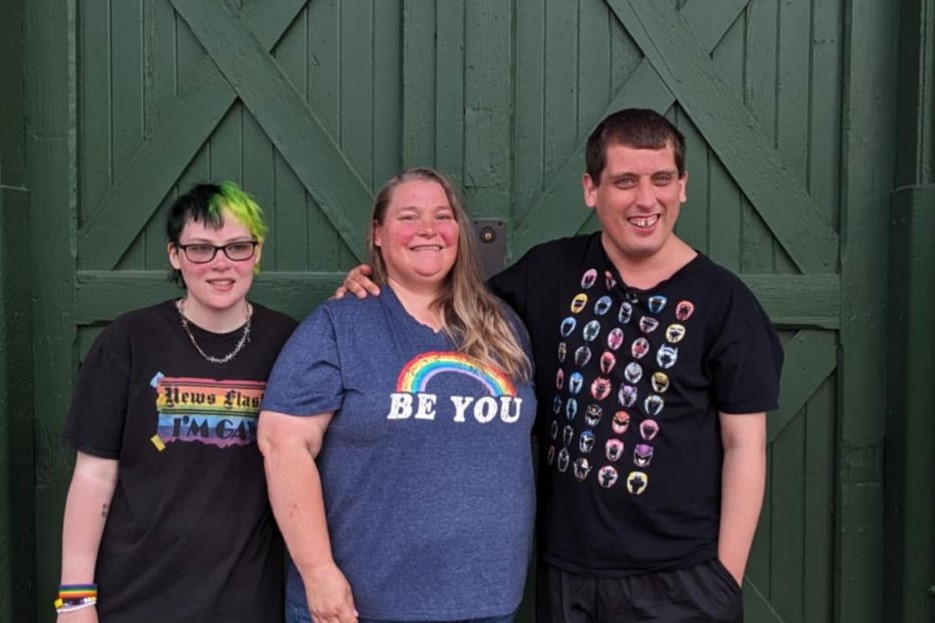
Holly Roos knows what it’s like to champion a cause. Splitting her time to live between Canton and rural Cambridge, she has been on the frontlines, advocating for her two children and others affected by a genetic disorder known as Fragile X Syndrome (FXS) for over 20 years.
FXS can cause several issues, including intellectual disability and behavioral and learning challenges. It can also manifest itself in various physical characteristics.
The syndrome is estimated to affect 1 in 2,500 – 4,000 males and 1 in 7,000 – 8,000 females, with symptoms less dramatic in females. Children and adults affected by FXS may exhibit intellectual disabilities that range from mild or severe, attention deficit or hyperactivity, anxiety and unstable mood, autistic behaviors, sensory integration problems, speech delays and seizures.
Physical characteristics often include a long face with large prominent ears, flat feet, hyperextensible joints-usually fingers, and low muscle tone.
According to the CDC, roughly 46% of males and 16% of females with Fragile X also have autism. Most boys and some girls have some symptoms of autism, but many are sociable and interested in other people.
Roos’ two children are diagnosed differently with Fragile X determined by a blood test and autism by using a checklist of behaviors.
“Many times, the diagnosis of autism overshadows anything else, and the component of FXS is missed,” said Roos. “It is important that children with autism be also checked for FXS.”
Roos, an employee of the FRAXA Research Foundation, has worked tirelessly to navigate the hardships FXS presents. Her son Parker was diagnosed just before his fourth birthday. Her younger child, who goes by A, was diagnosed at seven months.
“Parker was just not developing as I felt he should have,” said Roos, “The doctor assured me that he was okay and that I was an overreacting mother.”
An amateur researcher, Roos had been looking for answers to explain her son’s slow development and had looked into all sorts of genetic causes, including FXS. After insisting that the doctor do some further testing, her worst fears were realized. A few months after her second child was born, testing came back with the same news.
“We were shattered, and bewildered,” she said, knowing that finding the genetic trail would not be a happy one.
In the meantime, Roos’ sister also had a child with developmental delays, and the search for answers began in earnest.
“As it turns out,” said Roos, “after looking at my family’s history, my father volunteered to be tested. He was brokenhearted to learn he was a carrier of the FXS gene, but it was an important piece of the puzzle, and my parents have always had my back with this.”
Roos learned that because Fragile X can be passed silently down through generations, it might be a long time before a child is born with the syndrome. Her father is considered to carry a “premutation” of the gene.
As Roos looked further into her family history, several members in her outlying family tree were known to have mental or physical problems. More pieces of the puzzle were found. From that, she can go back at least six generations where the gene was likely passed on in some way.
“Women who carry Fragile X have a 50% chance of passing the mutated gene to each of their children. If she passes the affected gene, her children will either be carriers, or they will have Fragile X syndrome. Men who carry Fragile X will pass the premutation to all their daughters but none of their sons. These daughters are carriers, but they do not have Fragile X syndrome,” said Roos.
Roos delved into the world of FXS early, championing her children and others affected by the disorder.
“You have to be an advocate for your child. Sometimes that means disagreeing with health care providers and school personnel,” she said.
Currently employed by the Research Foundation at FRAXA, her focus is on funding important studies and finding drug manufacturers who are interested in testing and marketing the drug trials now available to many children and adults.
“There are no medications to treat FXS,” said Roos. “Drugs were available to treat the symptoms associated with it, such as antidepressants and anti-anxiety meds – but that was all. They helped some but were not a panacea for the syndrome.”
FRAXA is a grassroots organization, created and funded by parents and families of loved ones with Fragile X. Since its inception in the 1990s FRAXA has funded over $35 million dollars in Fragile X research.
“This organization provides research grants and fellowships at top universities around the globe,” said Roos. “This allows us to partner with biomedical and pharmaceutical companies, large and small, and to bridge the gap between research discoveries and actual treatments.”
Her son, now 25, is part of a drug trial and has seen great progress.
“He’s talking a lot more, is less anxious and aggressive and is enjoying many aspects of his life that he missed out on before,” she said.
He resides in Roos’ former home in Canton with a roommate and a caretaker who helps him maintain some independence and care for himself.
“He’s like a different child,” she said. “He called me on the telephone the other day – the first time ever.”
A, who is home for the summer from their studies in the UK, and who is only mildly affected, agreed. “His mood has leveled out and he can enjoy a movie without sound-absorbing headgear.”
Roos maintains that parents must be strong advocates. “Parents are their child’s voice,” she said. “There is a wealth of information at our website (www.fraxa.org) that can give parents hope – because hope is what we have now.”
She encourages parents of children with learning or physical issues to talk with their doctors about genetic testing for FXS.
“The earlier you know, the more you can do,” said Roos.
World Fragile X Day is celebrated this year on Monday July 22. Countries all around the world are lighting up prominent structures to show support for those affected by FXS, and to celebrate the research milestones so important in finding a treatment and a cure.



“The research encompasses more than just the FXS gene,” said Roos. “Treatments for Fragile X are likely to help people affected by autism, Alzheimer’s and other brain disorders.”
Roos is available to speak to clubs and organizations about Fragile X and the treatments that are proving successful. She can be reached at roosfam@live.com.