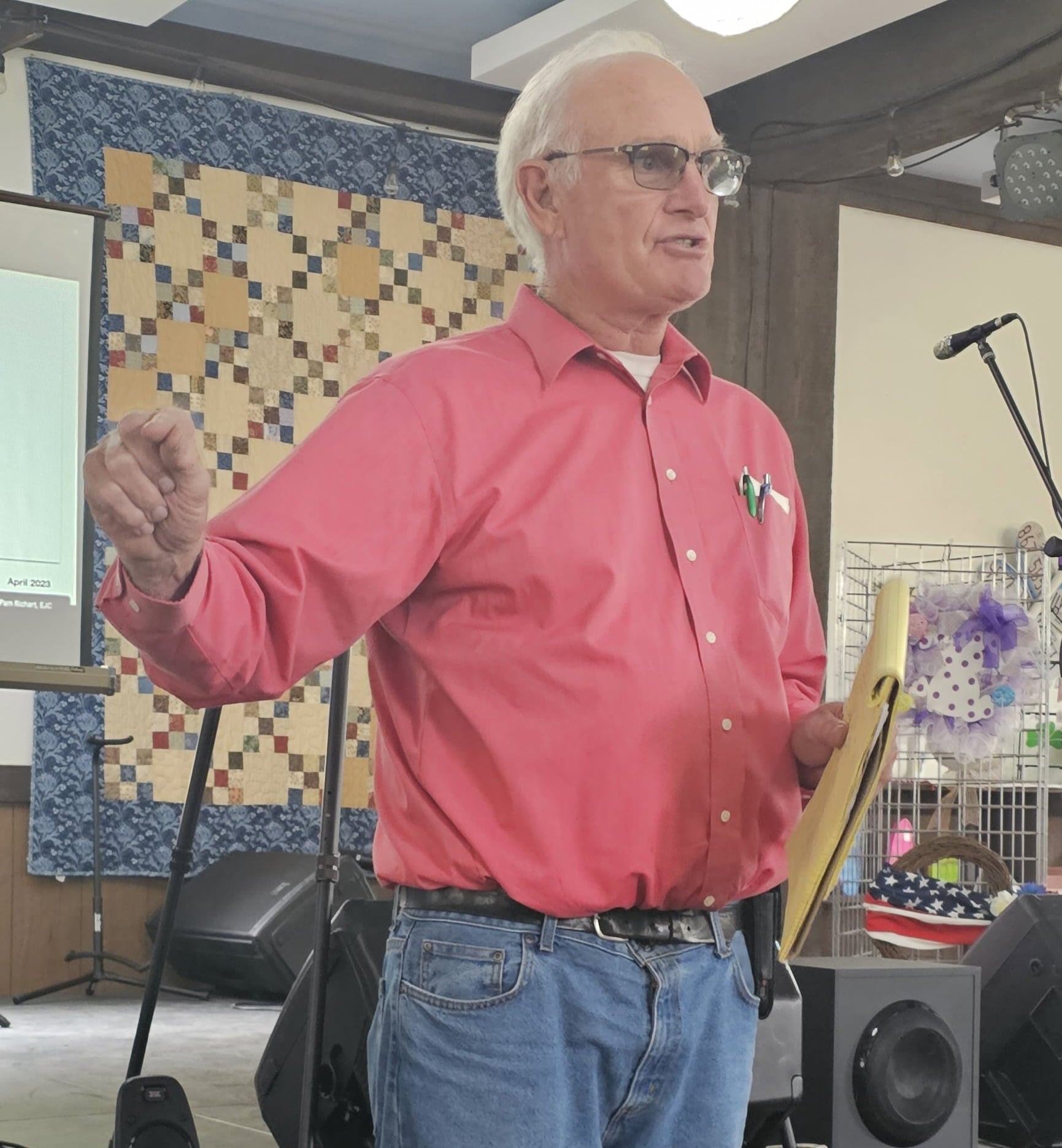
Steve Fess, a McDonough County farmer, spoke at an information meeting in Bishop Hill last month. The meeting addressed the possibility of two CO2 pipelines snaking through the state of Illinois. Fess discussed the impact of the pipelines on farmland. [Photo by Susan DeVilder]
Over 50 people filed into the Bishop Hill Commons on a gloomy Sunday afternoon to attend an informational meeting on an even gloomier topic- the possibility of miles of proposed high-pressure carbon dioxide pipelines snaking through Henry County and other parts of Illinois.
The program was hosted by storyteller and author Brian “Fox” Ellis and speakers included the co-founders and directors of the Champaign-based Eco Justice Collaborative, a life-long environmental activist and a McDonough County farmer.
In addition to being a founder and co-director of EJC, Lan Richart is a member of the Coalition to Stop CO2 Pipelines in Illinois and spoke to the group of concerned residents about the plans for two Illinois CO2 pipelines.
“Most of us aren’t familiar with carbon capture,” Richart said.
Richart said there are millions of dollars to be made by capturing carbon emission and putting it in a pipeline and moving it to Illinois, but the issue could spell trouble for landowners and residents. The plan would be for 3,500 miles of CO2 pipeline crossing the Midwest.
“Most will be stored underground permanently,” he said. “Are you willing to sell permanent easements of your property to a private company?”
Carbon dioxide is put under high pressure in order to be turned into a liquid for transport. “It’s never been done in this magnitude,” he said.
There are two pipelines that are raising concern, he told the assembled group. The Navigator Pipeline will carry high pressurized CO2 close to the community of Galva. The pipeline will be 1342 miles long and transport millions of metric tons of the substance to locations in Central Illinois.
The Wolf/ADM Pipeline is expected to run from Cedar Rapid to Peoria and on to Decatur.
Environmental activist Tracy Fox spoke on the neighborhood in Peoria that could be affected. That area, she said, is the same area that has absorbed pollution for hundreds of years. According to Fox, this group of people are already burdened by poverty and now potential environmental hazards, prompting Fox to ask attendees, “Should CO2 pipelines be located where thousands of people could be harmed?”
Reasons for concern are numerous, Richart said, including public safety and emergency preparedness. Contaminants can get into the pipeline and cause ruptures, sending billowing clouds of gas into the air. Because the gas is heavier than air, it displaces oxygen and can cause asphyxiation to anyone in the close vicinity.
Other issues include the possibility of eminent domain, the impact on farmland, especially field tiles, soil mixing and compaction and crop production loss.
Steve Fess spoke on the impact to farmers, specifically the land impact, citing a statistic that for every 80 acres where a pipeline is laid, an average of 30 tile repairs are required. Tiles are a “big deal” on a farm, Fess said, and necessary to keep the soil drained. Often promises made by pipeline companies to repair the tiles go unhonored or are untimely.
Fess also spoke about eminent domain and addressed the issue of Illinois farm bureaus that refuse to oppose the CO 2 pipelines. He urged farmers to contact their county farm bureau and let them know that, “We stand up for personal property.”
Pam Richart, co-founder, along with her husband Lan, of Eco Justice Collaborative, told the assembled group that the regulation of CO2 pipelines is spotty at best.
“They are not all regulated at all and it’s one of the reasons we are so concerned,” she said.
The Federal Energy Regulatory Commission (FERC) has determined that it has no jurisdiction on the pipelines. The Illinois Commerce Commission (ICC) is the agency that approves the route and overall plan, but the Pipeline and Hazardous Materials Safety Administration (PHMSA) doesn’t regulate CO2 pipelines and doesn’t have standards in place to mitigate fractures, she said.
Because of these concerns, Richart said now is the time to organize and stop the pipelines.
“This is our time to form a resistance to make this stop,” she said.
The good news is that so far, she said, the pipeline companies have only been able to secure about 6% of the easements they need for the pipelines.
“In Henry County, no one has signed onto the Navigator,” Pam Richardt said. “We hope Henry County will keep at it and keep that resistance high.”
She also urged people not to sign a voluntary easement contract without consulting an attorney and asked people to plan and attend informational meetings on the topic; speak on the issue at city council meetings; make phone calls to the county boards and city council members, and send letters to editors and local farm bureaus stating opposition to the proposed pipelines.
Illinois legislation HB 3119, the Carbon Dioxide Transport and Storage Protections Act is currently under consideration of Illinois legislatures. The legislation prevents eminent domain for CO2 pipelines and forced acquisition for pore space for carbon dioxide storage. It also establishes safe setbacks, creates an emergency preparedness fund and ensures that the project operator and not the state is liable for any CO2 release.
More information about the issue can be found by visiting coalition@noillinoisco2pipelines.org.