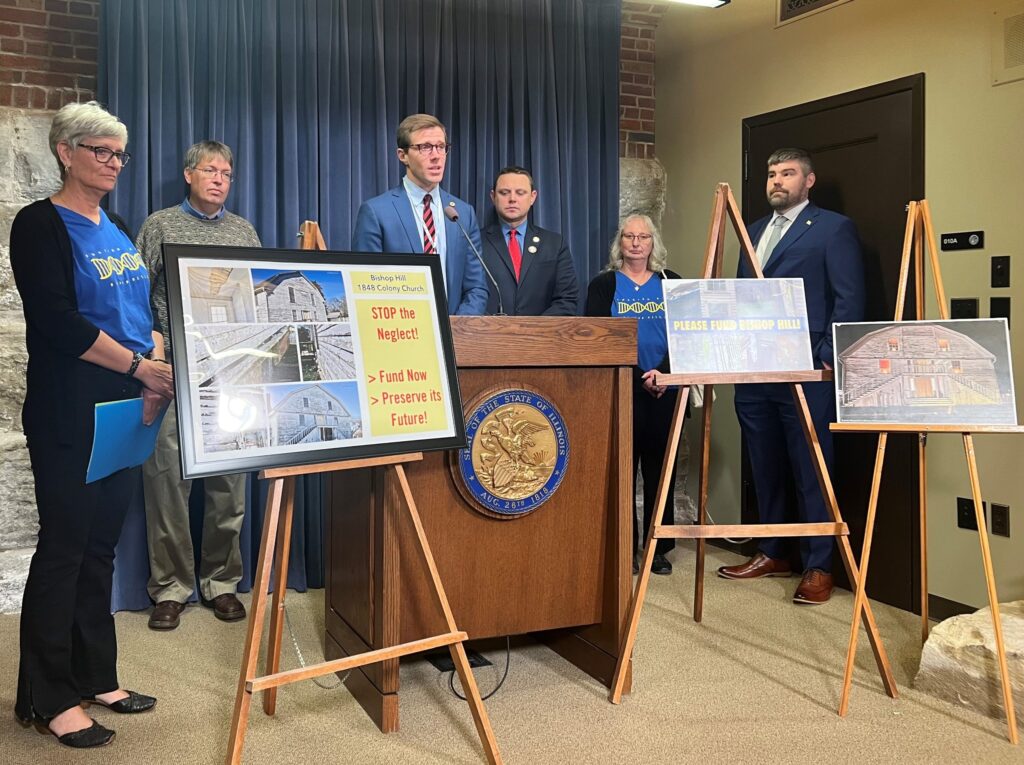
Plans are moving forward for long-awaited restoration and repair work at the Bishop Hill State Historic Site.
Cooperative efforts from the Illinois Department of Natural Resources, Capital Development Board, and Bishop Hill Advocates and Project Team have all contributed to the progress being made.

The Capital Development Board – CDB has announced that JLK Architects has been selected to complete an architecture plan to restore several buildings at the Bishop Hill site. JLK is very familiar with the Bishop Hill site, having completed the Steeple Building Exterior Restoration Project in July 2013. That $650,000 project was included as part of a Save America’s Treasure Grant.
“This is incredible news and I am so excited for the Bishop Hill community and advocates who have waited so long for these positive developments,” said State Rep. Travis Weaver. “The outreach process that led to this cannot be overstated, as there was incredible work done by so many people.”
Bishop Hill advocates went to Springfield for a press conference, and media coverage was brought out to the Bishop Hill site. People also wrote letters to their legislators, the IDNR Director visited Bishop Hill, and advocates also kept the message alive on social media channels for months on end.
“I also want to thank the CDB and IDNR for working with us and prioritizing Bishop Hill,” said Rep. Weaver. “We recognize they have an extremely long priority list and substantial maintenance requests, so it means a lot to us that they are recognizing the needs of Bishop Hill.”
The Bishop Hill State Historic Site in Henry County is a small village that includes a beautiful array of historic buildings, memorials, a park, and gazebo. The settlement dates back to 1846, when the community was founded by Swedish immigrants fleeing religious persecution.
Bishop Hill was added to the National Register of Historic Places in 1970 and listed in 1984 as a National Historic Landmark. Many of the buildings at Bishop Hill are in dire need of repairs, due to deferred maintenance, insufficient funding, and neglect.
The buildings are owned by the State of Illinois and maintained by the Illinois Department of Natural Resources. Last year, Landmarks Illinois included Bishop Hill on its 10 Most Endangered Historic Places in Illinois List.
For more information, please call Rep. Weaver’s District Office at 309-204-6514 or visit his website at repweaver.com.