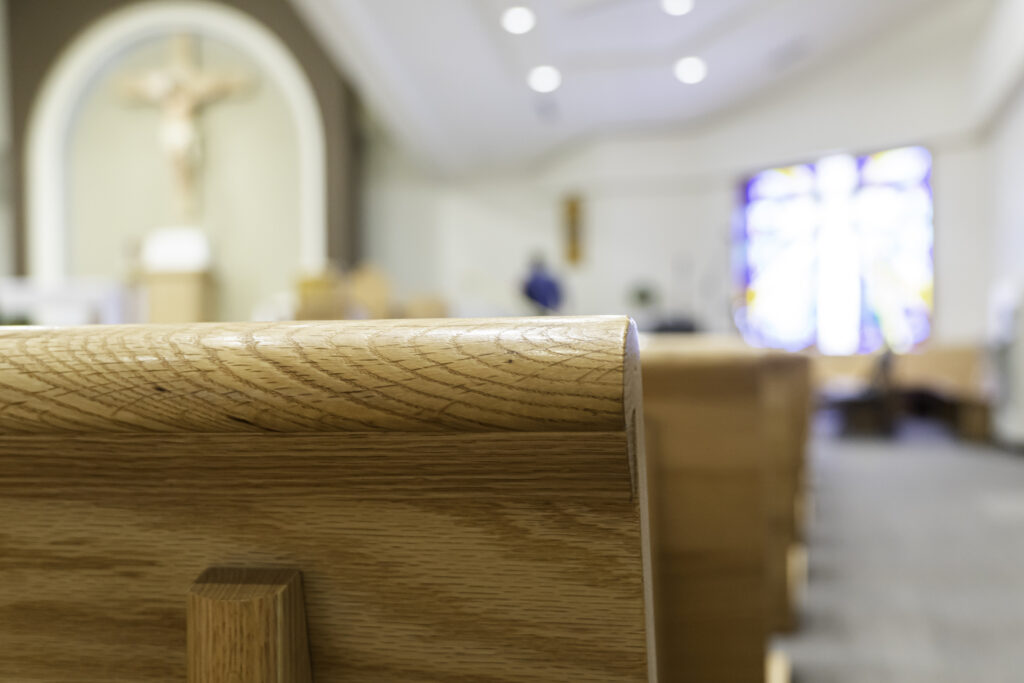
What happens when a small town flock loses its shepherd? For several Kewanee churches the answer has been to go without.
For elders of the First Presbyterian Church in Kewanee, the problem of replacing their pastor, who recently announced that he will depart after Easter, isn’t a new one. Several years ago, the church went without a full-time dedicated pastor for four years. After hiring several great pastors and a few that weren’t so great, the prospect of doing it all over again isn’t one they are looking forward to.
“Finding someone that wants to come to Kewanee, to a small town” is the biggest challenge, said Elder Roger Johnston, a 52-year member of the Kewanee church.
Last time the pastor position needed filling, the elders interviewed several candidates, he said, including at least two from the Quad Cities who planned not to relocate.
“We have to sell our town and the idea of a small town, and a drawback is for entertainment and amenities,” he said.
Linnea Gustafson is the secretary for the Kewanee Ministerial Association and she serves as interim pastor for two churches. In August of 1992, she began serving the Lutheran Church of the Redeemer.
“I am considered an interim minister because the congregation cannot afford to call a full-time pastor. Redeemer will only ever have an interim minister,” she said.
At the end of September 2024, Pastor Mara Ayhles-Iverson left Zion Lutheran Church to become the pastor of Central Lutheran Church in Wisconsin. So on Oct. 1, 2024, Gustafson began serving Zion while the church navigates through the process of discerning God’s call for the congregation and then calling a new pastor.
“We have been told this process is likely to take between 18 months and two years,” she said.
The problem of finding pastors for smaller congregations isn’t just a local problem, said Gustafson.
“Nationally we are dealing with a shortage of pastors across denominational lines. Baby boomer pastors are retiring at a greater rate than new pastors are graduating from seminaries,” she said.
Gustafson cites a study just released by her national church that shows that in the Evangelical Lutheran Church in America (ELCA) between 2015 and 2023 there were 1,914 men and women ordained. During the same period of time 3,563 pastors retired.
According to the study, in 2023 in the ELCA there were 7,156 ordained pastors, but only 6,013 of those were serving local congregations. The others were in specialized ministries such as hospital or military chaplaincy, teaching professors and missionaries. At the same time there are 8,464 congregations, some of which have more than one pastor.
“So there are simply not enough pastors to go around,” she said.
Another factor that could act as a roadblock to filling pastor positions is the cost of seminary education, which might explain the reduced number of those entering seminary, she said.
“In the ELCA traditional plan requires a four-year college education followed by four years of seminary- three in the classroom, an additional semester of Clinical Pastoral Education, typically in a hospital setting and one year serving an internship in a congregation. Leaving seminary with heavy debt can be a burden,” she said.
In the last decade and a half, Gustafson said she’s been aware of several area congregations that have had vacancies that lasted more than a few months. Locally, St. Peter’s Church has a pastor who flies in just for the weekends. The First Baptist Church took over a year or more to get a pastor here from Canada, and Pastor Andrew Christman serves both the Church of Peace and State Road.
“As congregational sizes decrease- another national trend due partly to declining birth rates- it becomes more difficult to afford a full-time minister. And, in the Kewanee area, there aren’t a lot of options available for employment in other venues for someone serving in a part-time ministry,” she said.
Over the last 50 years, the First Presbyterian Church’s membership has fallen by 150 members. With a congregation of just 48, Johnston and Elder Lanny Anderson said that the salary that they can offer a pastor is smaller.
“We are yoked with Elmira (Presbyterian Church) to kind of help with the pay part of the expense,” said Johnston.
But the aging congregation doesn’t draw many younger families and only a handful of children attend the church now, he said.
During COVID, services were held outside in the parking lot, Anderson said. But after the pandemic was declared over, several church members never returned.
Another factor that has led to falling membership is sport activities, said Anderson. Johnson agrees, citing a more affluent society where young parents are heavily invested in their children’s activities.
“Parents have children involved in a lot of sports. Many of those activities are on weekends and, in fact, on Sunday morning,” said Anderson.
While the Presbyterian elders cite sports involvement as one reason behind falling membership and attendance, Gustafson sees the shift in priorities in society with more far-reaching implications.
“Church attendance used to be central to most families’ lives. Now families are drawn in so many directions with both parents working, children in traveling sports teams in addition to those at school, etc. that church seems to have gotten lost in the shuffle,” she said. “Combine those priority shifts with the aging of baby boomers and church attendance in all the mainline denominations has declined. The ELCA study shows that now 60 percent of congregations have an average weekly attendance of less than 50.”
As a result, she said, many congregations cannot afford a full-time pastor and even if they could, fewer young people are hearing God’s call to serve.
“Since priorities have shifted away from church attendance there are fewer young people who even consider going into pastoral ministry,” said Gustafson.
How churches are dealing with not having a full-time pastor varies. Gustafson fills that role for several churches and other churches also find interim ministers to serve until a new pastor can be called.
Some churches call upon retired ministers or even senior members to fill in “in a pinch,” as they do at the Presbyterian Church, said Johnston.
“We rely on pulpit fillers,” said Anderson.
Gustafson said other churches have a satellite system with a pastor who leads worship and preaches via the internet with the service being streamed to a variety of satellite gatherings.
“In the ELCA some congregations are now served by Synodically Authorized Ministers (SAMs). These are lay people who have graduated from a two-year Diaconial program and are authorized to preach and preside over the sacraments in a particular setting. In some places congregations have identified one of their own members to take on this type of local leadership,” said Gustafson.
The shortage of pastors nationwide has given rise to “out of the box” thinking such as allowing seminary students to serve a congregation while attending seminary, Gustafson said, but non-denominational churches without a seminary to act as a feeder for pastors, some churches, sadly close because they can’t find a pastor, she said.
When the long-time pastor of St. Paul’s Lutheran Church retired in June of 2024, it didn’t take long for Pastor Winston Grieser to get the call. Grieser was installed as pastor on Dec. 22 of last year.
“In November, I received a phone call that this congregation was going to extend me a call,” he said.
Grieser had been serving at a church in Moses Lake, Wash., at the time, but he had wanted to find a way back to the Midwest.
“I felt this congregation would be a wonderful fit for me and my family,” he said. He and his wife Anya have four children.
Grieser, who is an Army major and serves in the Indiana National Guard, said that throughout the U.S. the church body has 1.9 million baptized members, and two seminaries, one in Indiana and one in St. Louis, that act to replenish retiring Lutheran pastors throughout the country.
“Pastors fresh out of the seminary must go where they are sent,” he said. After two years, however, pastors can go wherever they are called.
While enrollment in both seminaries is down, about 100 pastors enter the pool every year.
“The church body is hurting for pastors,” he said. “Congregations are competing for pastors.”
But still there is an advantage, he said, for denominational churches who have seminaries educating new pastors.
“Depending on the church body, more of the older church bodies usually have seminaries but non-denominational churches don’t have the infrastructure,” he said.
For area congregations in search of a pastor to lead them, the reason behind the shortage seems less important than the solution.
How long the Presbyterian Church will be without a pastor isn’t clear, and the search can only begin once their current pastor steps away. One suggestion put forth by Johnston in jest is for a factory that only hires Presbyterians to move in on the edge of town.
But attracting more members seems to be the key.
“We need to find ways to engage young families and youth who feel ‘too busy’ for church,” said Gustafson. “We need to be open to doing things differently while staying strong in our faith. We need to change the method but preserve the message.”
Both Anderson and Johnston believe that church attendance is an idea that many people have turned away from.
“I think going to church is a habit. Countrywide, I think our young people are so involved with sports they don’t get into the habit of going to church,” said Johnston.
For Grieser, the solution can be found in Ephesians 4:32- “Be ye kind to one another. . .” a verse that emphasizes the importance of kindness, compassion and forgiveness in relationships with others.
“Churches should operate with humility. You have to go into finding a pastor and realizing they’re people. Most pastors are very good people,” he said. “Congregations need to stop looking at them like tools,” he said, giving an example of a hammer that once it’s no good anymore, is discarded.
“That’s not how a church of God should behave. We ought to be kind to each other”
Gustafson said the ELCA is currently studying ways to address the shortage.
“Creative solutions will need to be found,’ she said. “I think whatever form ministry takes in the future, it will, out of necessity, have to include an increased emphasis on lay leadership.”
Another possibility emerging is congregation’s sharing pastors across denominational lines, but Gustafson said the time calls for prayerful contemplation of what it means to be a church, to listen to God’s call for us and identify who we are called to be and how we are called to minister to our communities.
“It is a time ripe with possibilities if we are open to God’s leading,” Gustafson said.