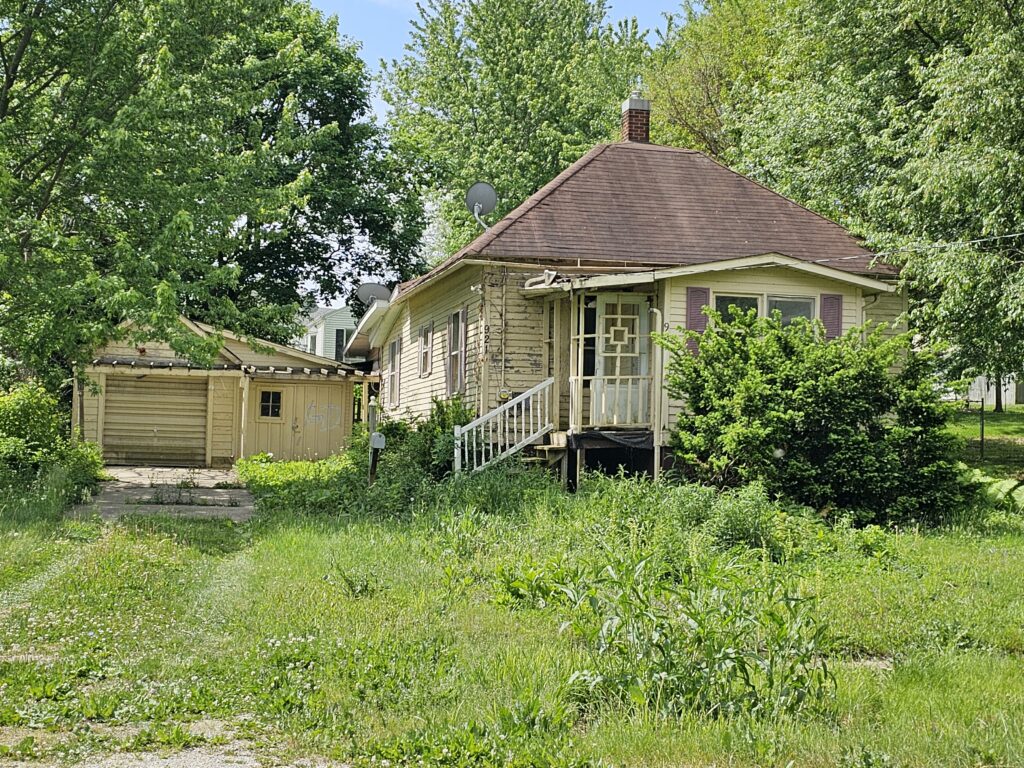
Vacant and abandoned properties are not only an issue in Kewanee, but a growing problem for many cities and towns across the country. According to a Lending Tree study done last year, over 16 million homes across the country stand empty.
Vacated homes can become an issue for municipalities since they are more “a symptom of larger economic forces at work in the community.” According to the US Housing and Urban Development, vacant or abandoned properties are often associated with crime, increase risk to health and welfare, plunging property values and escalating municipal costs.
In Kewanee, many houses that were once neighborhood gems have fallen into states of disrepair and neglect. Uninhabited houses decay at an alarming rate, according to studies, and it’s been noted that a small crack in the structure of an abandoned building is enough to bring down the entire structure in a matter of a few years. It’s often said that an abandoned house ages five years for every year it stands vacant.
When homes become dilapidated, property values in the neighborhood can decline, and oftentimes community members will begin the process of filing complaints about the property through official channels.
Keith Edwards, director of community development for Kewanee, said that when a complaint is received or if a staff initiates a report proactively, photos are taken from the city’s right of way and a letter of violation is sent to the property owner on record.
Edwards said that staff must be able to see or smell the violation from the city’s right of way in order to proceed with a complaint.
“Our goal is to gain compliance with the city ordinances and make every effort to avoid the need for legal action,” Edwards said in an email.
Edwards noted that in the past, the fines placed upon nuisance violations were rather small and didn’t elicit the desired response.
“The fine structure in the city ordinance says that fines can range from $25 up to $500 per day. In the past, the ‘per day’ verbiage was never enforced but that has changed with present cases,” he said.
Recently, the city attorney, Justin Raver, has begun to ask for maximum fines of $500 a day and an order to clean up property within certain time frames during municipal court on Friday mornings, and the judges have been ruling in favor of the larger fines. Edwards said examples of recent fines for violating city ordinances are as high as $119,000, $238,593 and $873,500.
“In most cases, if the property owner brings the property into compliance with the ordinances, the fine is sometimes waived completely or sometimes only reduced to a smaller amount,” he said, but there are cases where the fines are not waived or reduced.
If a property owner outright refuses to comply with the court order to clean up their property, the city can enter the property and remove the violations. The cost incurred by the city can then be billed to the property owner and if unpaid, the city can place a lien on the property for the amount of the bill.
“This would be an absolute last resort for extreme cases and would not be an option the City would take lightly,” Edwards said.
But that remedy only works with properties with clear ownership. Owners of abandoned properties often move away from the area and some pass away, intestate, placing the burden of the property onto the city.
According to HUD, cities often turn first to code enforcement, citations and finally property liens to address the problem, and Joseph Schilling, director of the Metropolitan Institute at Virginia, said the greatest obstacle is being able to track down and hold the owners and loan servicers responsible.
When all other courses of action fail, a property often reverts to the local government, which can pose both problems and opportunity for the municipality, according to HUD.
“The latter can present an opportunity to exert some control over the reuse of the property if the municipality is prepared to do so, such as through a land bank.”
Some communities have found creative solutions to combat the problem of reverted abandoned property. In Rockford, “a program that restores abandoned homes brings hope and economic strength to some of Rockford’s neighborhoods,” according to a WIFR report.
The city’s Community Investment Fund just celebrated its first year in January. The fund will allow more than a dozen properties in Rockford to get a new lease in life. The goal is to take abandoned homes and eyesores and turn them into livable sites. The result also improves property values in neighborhoods with the neglected homes. The funds offer loans to contractors to rehab houses in low-to-moderate income neighborhoods.
In 2020, Rockford also experimented with a program where an investor or potential owner bid a small amount of money along with the proposal for the property. There was no minimum bid necessary, and the owner was selected based solely on that proposal of how they would reuse or reform the property.