They were diametrically opposed to a man “tending only to benefit the few at the expense of the many.”
President Donald J. Trump believes that he and Andrew Jackson are cut from the same cloth. In a visit to Jackson’s plantation in 2017, President Trump called himself a “big fan,” said that Jackson was “inspirational,” and tweeted a photo of himself solemnly saluting Jackson at his Nashville tomb. In 2024, Mr. Trump continued to draw the parallel, saying that “Andrew Jackson . . . was treated worse than any other president . . . although nobody comes close to Trump.” Upon his ascension again to the presidency in 2025, President Trump brought back the portrait of Jackson to the Oval Office.
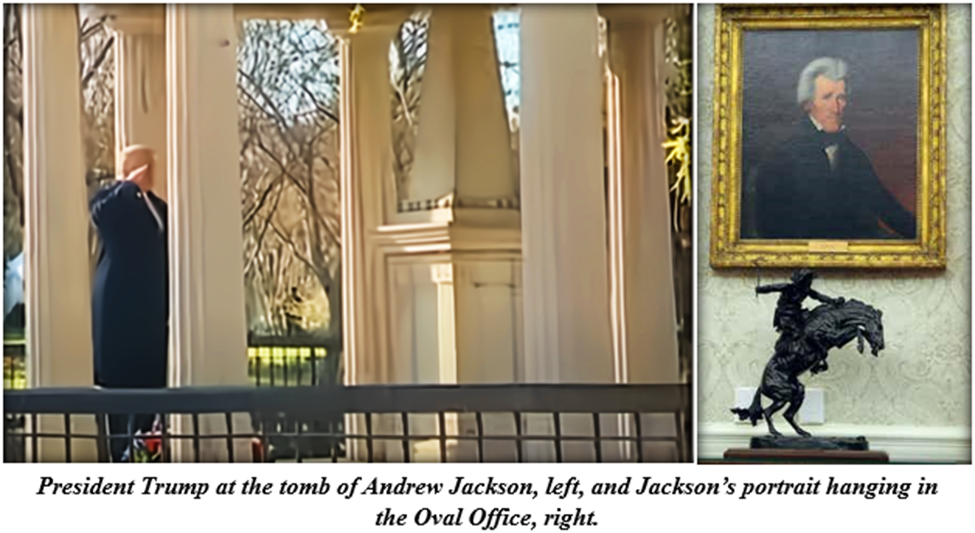
Clearly, President Trump aspires to be the modern-day heir to Jackson’s legacy.
If early Wethersfield colonists were alive today and had seen any truth in President Trump’s comparison to his predecessor, they may have banded together to throw out what they may have perceived as a similar scoundrel. Those colonists did just that in 1840 against Martin Van Buren, Jackson’s hand-picked successor, a man the colonists despised almost as much as they despised Jackson.
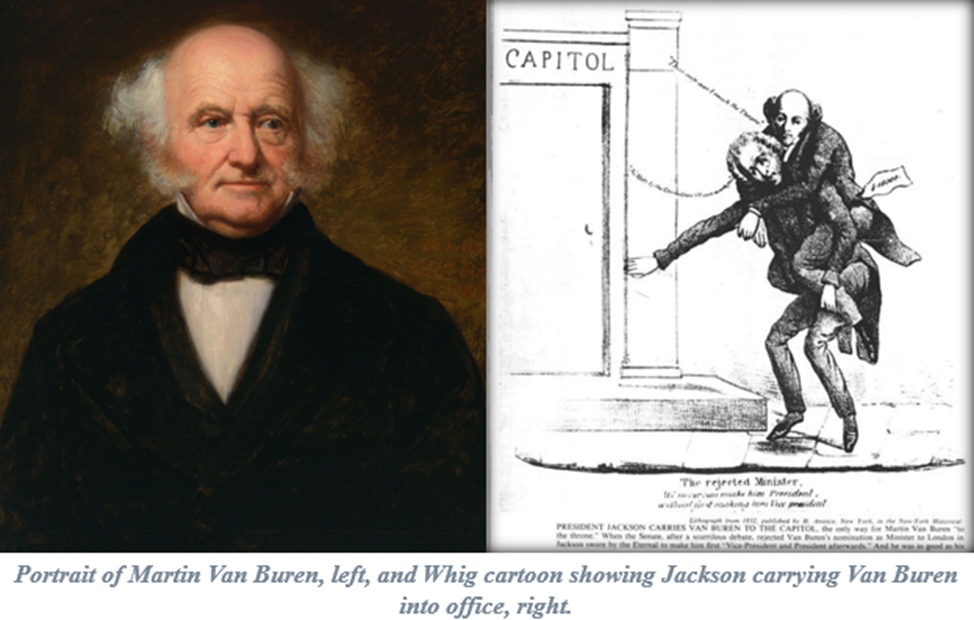
Andrew Jackson was a departure from the presidents who had preceded him. His enemies roared that he was as motivated by his personal preferences as by any principles. One critic said that Jackson’s ideas “upon all subjects are the result of his resentments, and of his vindictive passions.”
“[His ideas] upon all subjects are the result of his resentments, and of his vindictive passions.”
The first historians to assess the Jackson presidency loathed the way in which he personalized everything. They objected to the Jacksonian spoils system, governmental appointments based on blind loyalty instead of objective merit. While he was beloved by many of the people, “Old Hickory” was disparaged by many for his inadequacies and demagoguery. They believed he created an unjustified cult of personality.
Jackson was no stranger to controversies. The Indian Removal Act of 1830 led to the displacement of Native Americans to territory west of the Mississippi River. The Trail of Tears forced relocation of an estimated 15,000 Cherokee Indians. While occurring after his presidency ended, it was an event which claimed the lives of 4,000 Native Americans who died of starvation, exposure and illness, and exemplified the contempt with which Jackson held non-whites.

President Jackson also became embroiled in U.S. Supreme Court disputes, one particularly surrounding his support for the Justice who later authored the infamous Dred Scott decision, which held that the U.S. Constitution did not extend American citizenship to people of Black African descent, a decision widely considered the worst in the Supreme Court’s history,
The United States Bank and currency issues also were contentious. After warring with the Bank for years, Jackson issued the Specie Circular in 1836, which required payment in gold or silver for public lands. Banks, however, could not meet the demand, and they began to fail.
Jackson’s opponents formed a new political party during his second term, the Whig Party, to protest what they saw as the autocratic policies of “King Andrew I.” The Whig party failed to win the 1836 presidential election, won by Martin Van Buren. But Jackson had left Van Buren with a market ready to crash, which it did. The Panic of 1837 devastated the economy during not only the course of Van Buren’s presidency but well into the next decade.
The financial panic wreaked havoc on our Wethersfield ancestors, damage which stunted the growth of the colony up until the late 1840s. It also contributed to the railroad bypassing Wethersfield in favor of what became Kewanee. But, as always, the Wethersfield colonists met the challenge head on.
The 1840 election was scheduled to be held between October 30 and December 2, 1840. In March 1840, the Whigs of Henry County met. Wethersfield resident Deacon Zenia Hotchkiss was named chair, and Wethersfield resident John F. Willard appointed secretary. Other Wethersfield residents, including Henry G. Little, attended the meeting. The minutes were subsequently published in the April 24, 1840, edition of the Peoria Register and Northwestern Gazetteer.
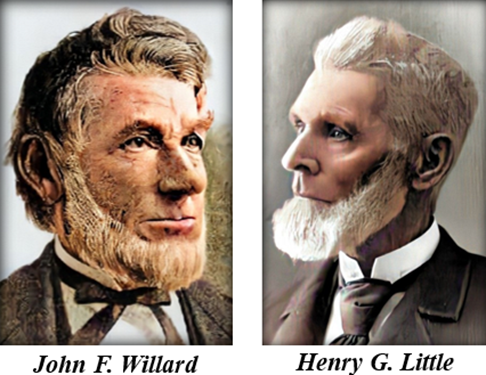
The group first wrote about the reasons why they were recommending strong action.
They explained that they viewed “the leading measures of the present administration as diametrically opposed to the best good of our country, and tending only to benefit the few at the expense of the many.”
“[T]he leading measures of the present administration [are] as diametrically opposed to the best good of our country, and tending only to benefit the few at the expense of the many.”
They also regarded “with feelings of deep repugnance and abhorrence the effort making to deprive the ‘laborer of his hire,’ by reducing the wages of the laboring class to a level with those of the menial servants of ‘European potentates.’”
Further, they said, “when the dominant party first commenced their unwarrantable attack upon the currency of the country, the leading members of the Whig party did predict and portray the gloomy picture of distress which would, and which has followed such an attack.”
Finally, they said they found “the party in power as justly accountable for the consequences which have followed their unjustifiable interference with the currency of the country.”
For those reasons, our ancestors resolved to take action.
They resolved “that we hail with joy the dawning light of that day, evidently approaching, which will consign to the grave the projects of the present ‘currency tinkers’ and forever put an end to those daring and ruthless experiments of the ‘powers that be,’ which have filled our country, for the few past years, with unparalleled suffering and distress.”
They strongly supported the candidacy of the Whig presidential nominee, General William Henry Harrison.
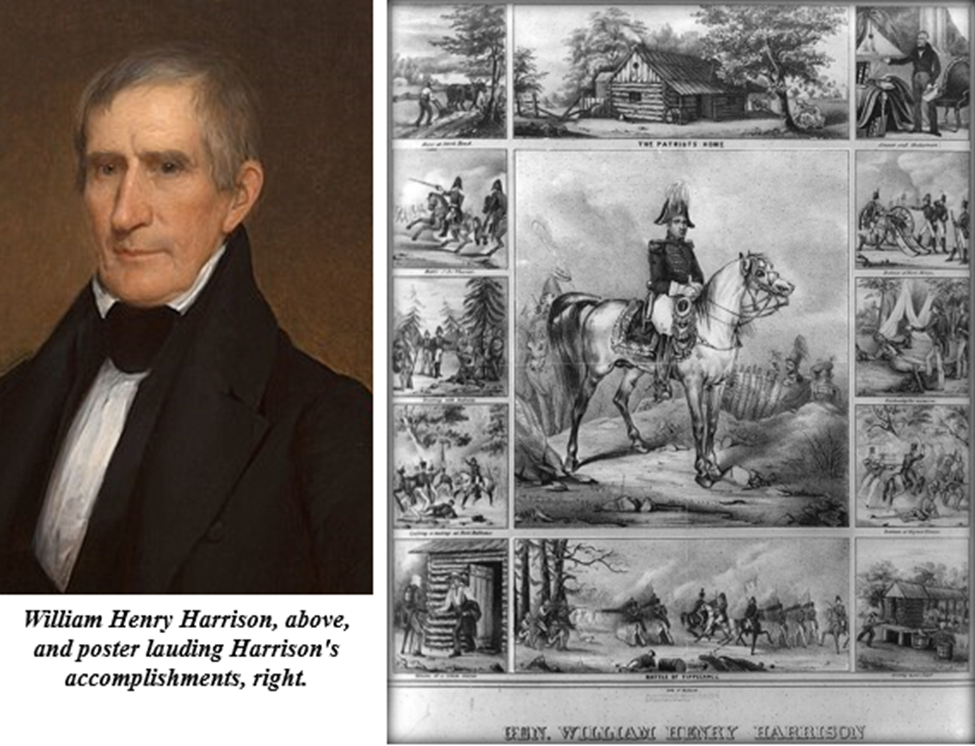
They further resolved “that we will use all honorable exertions to expel the ‘Goths and Vandals from Rome,’ who are filling their pockets with the spoils, while the ‘poor, dear people’ are not permitted to enjoy the ‘rag currency’ of former times . . . .”
They “‘are filling their pockets with the spoils, while the ‘poor, dear people’ are not permitted to enjoy the ‘rag currency’ of former times . . .”
Finally, they resolved “that we hereby stand pledged to each other, and to our friends everywhere, that we will use all laudable exertions to keep in motion that BALL which is destined to drive before it the present incumbent of the White House, and prepare the way for its peaceful occupation by the log cabin candidate.”
In a time of a crisis the depth of which none of our Wethersfield ancestors had ever seen or experienced, they stood solidly behind what they believed to be right and took actions in support of their views.
Perhaps there is a lesson to be found in the actions of those sturdy Wethersfield pioneers.
Editor’s note: The opinions expressed in this article are solely those of the author and do not necessarily reflect the views or opinions of The Kewanee Voice.