But its sturdy pioneers worked to kill a legislative bill and turn it into “cold coffee.”
(I recently read another piece about the growing Greater Idaho Movement, where proponents propose moving Idaho’s border west and absorbing close to a dozen Oregon counties which have expressed interest in joining Idaho. Supporters say those counties more closely align with Idaho’s values and culture. That reminded me of an 1837 attempt to move Wethersfield out of Henry County into a proposed new county. Here’s the story.)
In June, voters in another Oregon county said they’d like to join Idaho, the 12th county to pass a ballot initiative supporting the movement.
You live in Wethersfield, want to get married, and so you travel to the Coffee County courthouse in Toulon to obtain your marriage license.
What’s up with that?
Well, if some citizens of Knox and Putnam counties in 1837 had had their way, that’s exactly where you’d go to conduct any county business today.
But Wethersfield’s pioneers, in addition to the many other hardships they had to face in their new colony, rose up to prevent that from happening. For better or worse.
Here’s the inside story.
Henry County was established in 1825. But it was over ten years before the first settlement in the county was established, and over 12 years before the county was organized.
At the time of the founding of Wethersfield in 1836, neither Stark County nor Bureau County existed. To Wethersfield’s east lay Putnam County and to its south Knox County. Folks living at the far ends of those counties had to travel long distances, for some 30 miles or more, to the respective county seats, Knoxville and Hennepin, to conduct county business.
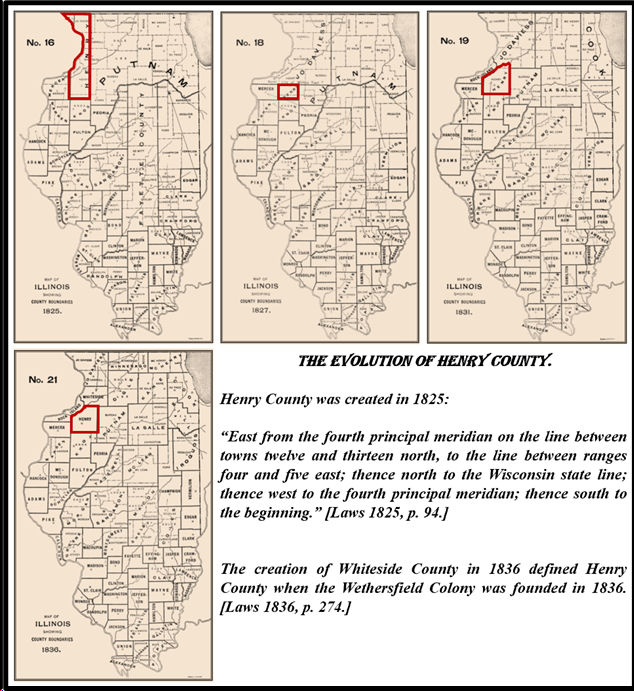
So, a committee of interested Knox and Putnam County citizens traveled to Vandalia, then the state capital, to ask the legislature to create a new county, to be named Coffee County. One of the leaders of those citizens was Colonel William H. Henderson, father of well-known General Thomas J. Henderson. Col. Henderson, very familiar with the legislative process from his time spent in Tennessee, succeeded in convincing the legislators to act. Thus, on March 1, 1837, the Illinois state legislature passed an act creating Coffee County. The vote was scheduled for the second Monday in April 1837.
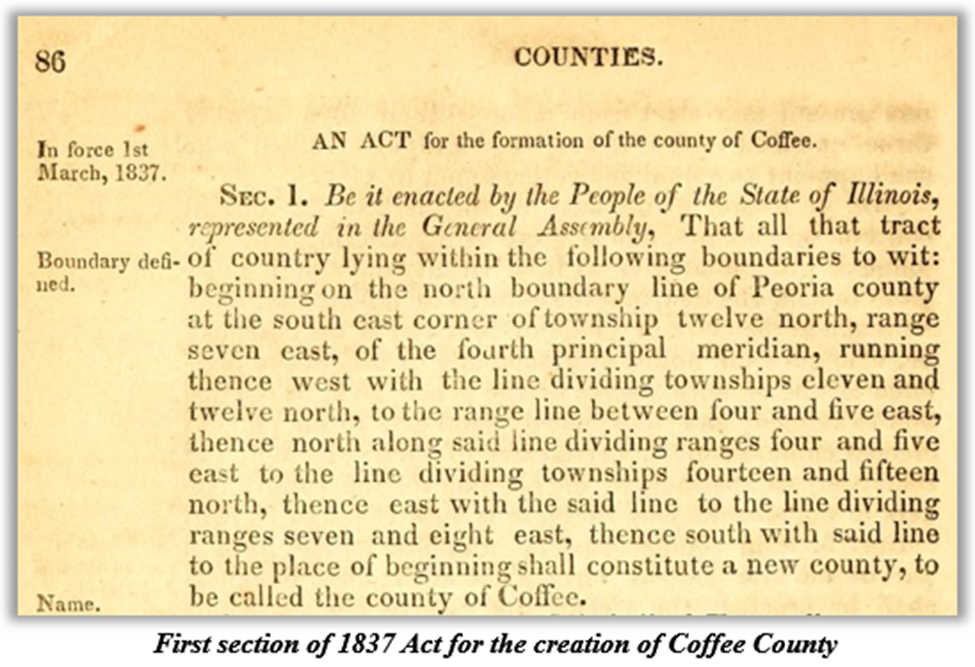
The proposed new county was to be formed by taking two Knox County townships, one Henry County township, and the rest from Putnam County. The new county’s borders were identical to today’s Stark County, except that it contained one more township, Wethersfield Township. But the act was subject to the approval of Knox and Henry counties.
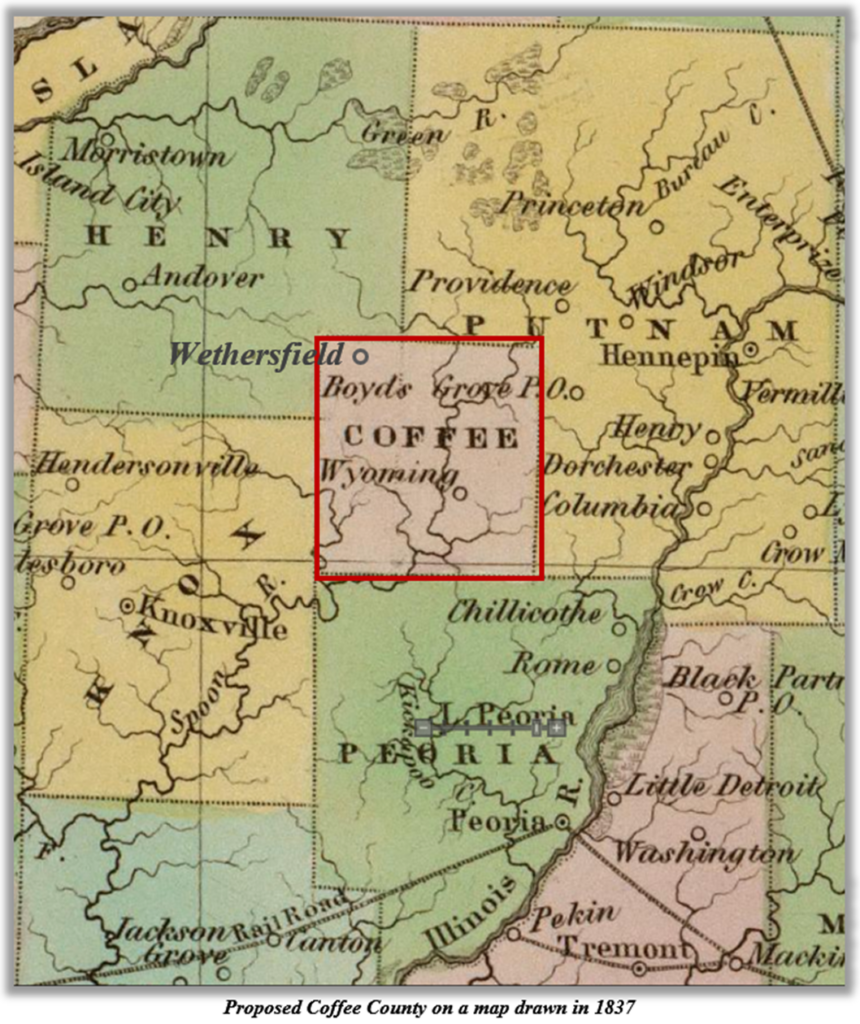
The act took Wethersfield and Henry County by surprise. Quickly Henry County residents organized committees to draft a petition against the act. Henry G. Little, one of the committee members, recalls the efforts made against the act.
“Who must do it? Well, we had a meeting at Wethersfield to decide. [Sullivan] Howard says, ‘Henry G. must go. He has a good riding horse.’ So, they all said but myself. But I dropped all business and was in the saddle for the next week or ten days. I might with propriety have been called ‘Boots and Spurs’ and mud added.”
Henry committed himself fully to the efforts made against the act, “riding from house to house and from town to town. In my district in Henry County every man I saw signed the [petition]. But my hardest work was in Knox County, which I canvassed thoroughly in the company of Wm. Dunbar, of Lafayette. The citizens of Knox County were not in agreement. Those in the eastern part of the county generally favored the organization of a new county as that would bring the new county seat nearer to them than was Knoxville. Still, we succeeded in inducing enough men to sign our [petition] to kill the bill and Coffee County was cold coffee indeed.”
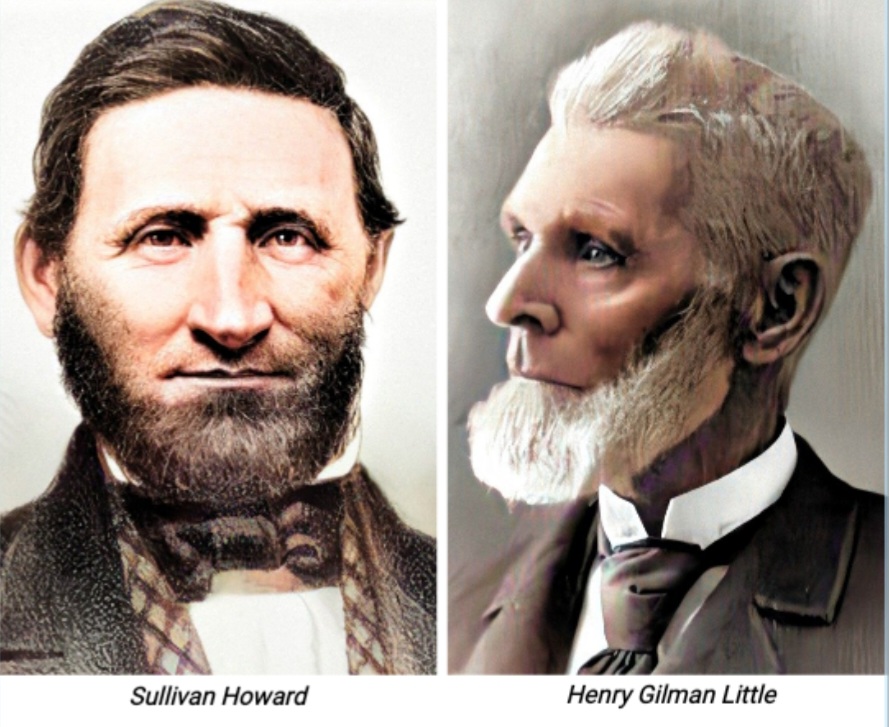
In his later years, Henry Little could recall with satisfaction his own wearisome efforts in helping keep Wethersfield Township in Henry County.
But the concept of a new county did not evaporate, and in 1839, the legislature formed Stark County, providing that the county seat should be called “Toulon” (although at the time only a single cabin had been built at the designated location).
So, thanks to Henry Little and other like-minded pioneers, Wethersfield citizens now travel about 21 miles to Cambridge, rather than about 10 miles to Toulon, to conduct their county business.
For better or worse.