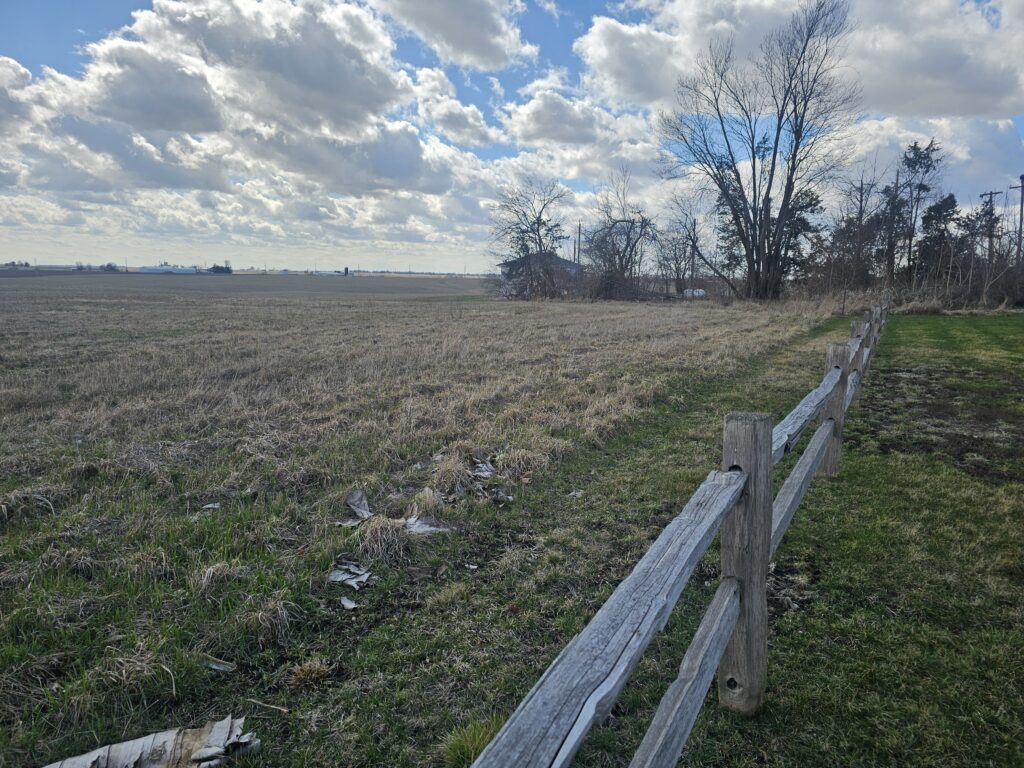
Local farmers, like sixth-generation farmer Brian Corkill of Kewanee, are facing uncertainty as tariffs continue to threaten to disrupt agricultural trade and raise costs.
Corkill farms 1,000 acres of corn and soybeans around Kewanee, east of Galva and in Stark County. Like many area farmers, he’s concerned by what he characterizes as upheaval and uncertainty and highlights the impact of tariffs on essential supplies like fertilizer and the difficulties these trade policies create for the broader agricultural economy.
“Everything is up in the air; you can’t really plan anything,” he said.
Corkill reflects the sentiment of many farmers in Henry County.
“I would say in general farmers are not in favor of tariffs. Concerning Mexico and Canada, under the guise of trying to improve border safety, I’m not sure tariffs are the right way to go about it,” he said.
Corkill said there are widespread concerns about the long-term effects of tariffs. They drive up the cost of key supplies like potash fertilizer, which farmers heavily rely on from Canada. Retaliatory tariffs further restrict exports, making it difficult for farmers to pay their bills and adding to an already challenging market.
“Eighty-five percent of potash fertilizers come from Canada so having tariffs on that would have a huge impact on the cost of fertilizer. We’re already dealing with a depressed commodity market,” he said, calling it a double whammy.
Mexico, China, and Canada are vital trading partners for U.S. agriculture, officials at the Henry County Farm Bureau said.
“More than 20 percent of U.S. farm income comes from exports which are dominated by Mexico, Canada and China. Just last year, the U.S. exported over $30 billion in agricultural products to Mexico, $28 billion to Canada and $25 billion to China,” or $83 billion combined, said the farm bureau.
The Farm Bureau states that 84 percent of fresh vegetables exported from this country go to Canada and Mexico, with 40 percent of corn exports going to Mexico and 62 percent of soybean exports going to China and Mexico. Half of America’s dairy exports go to all three countries.
Corkhill also points to fresh vegetables and dairy exports that depend heavily on these trading partners. Farmers fear the uncertainty caused by tariffs may push buyers toward more stable suppliers in other nations, creating long-term challenges for U.S. agriculture.
Efforts to expand markets globally, such as in South America, remain a priority. According to the Henry County Farm Bureau, “For decades, American agriculture has strongly supported efforts to open the world to our agricultural and other trade products. We believe an agricultural trade agenda must focus on maintaining existing markets, enforcing existing agreements and completing new trade agreements that expand market access for U.S. agricultural products.”
Officials from the Trump Administration, including the president himself, have suggested increasing domestic sales to offset export losses caused by tariffs. However, Corkill is skeptical. “General farmers are already satisfying demands in the country, so we rely on exports,” he said.
The federal government’s decision to freeze or cut grants and subsidies has further complicated matters for farmers. The Henry County Farm Bureau is still evaluating the effects of these funding changes on local farmers, but Corkill recalled the recent case where a farmer feared losing his farm due to a grant being cut.
Corkill recently used private grant funding for a project, he said, but part of those grant funds did come from the federal government. While he received the funds, other farmers are on the hook for projects they paid for up front. He called the funding freeze concerning.
“He had a contract and to me, you need to live up to the contract,” he said.
Farmers are still recovering from the fallout of the last trade war, although the past few years had improved, at least for him, Corkill said. But the uncertainty surrounding the tariffs, which have been paused numerous times, makes planning difficult. President Donald Trump recently announced that reciprocal tariffs would go into effect on April 2. On March 4, the administration implemented new tariffs on Canada, China and Mexico.
“I don’t know what’s going to happen. I am fully in favor of free trade, and this isn’t free trade,” said Corkill. “I would say at this point and time, I’m not making any changes to the upcoming growing season but looking ahead, dealing with government agencies and the NRCS (Natural Resources Conservation Service), just all of the upheaval and not knowing where there’s change,” he said, before predicting that farmers probably won’t feel the full “pinch” of the tariffs until this coming fall.
Officials at the farm bureau have “deep concerns with the use of tariffs that drive up the cost of important supplies.”
“Retaliatory tariffs limit the export of goods from America’s farms and ranches, which makes it more difficult for them to pay their bills. The uncertainty hits just as operating loans are being secured and spring planting approaches, leaving farmers in a tough spot,” bureau officials said.
Corkill fears that if tariff plans move forwards, it will be American farmers that will be on the losing side.
“Depending on how this goes if [ the Trump Administration] does follow through this further depresses grain prices, our margins will probably be negative, which means we’re losing money,” he said.
Corkill said the last time tariffs were implemented, the government provided farmers with direct aid. The trade bailout started in mid-2018 when the USDA began to issue farmers and ranchers checks to pay for the fallout of the trade war. The bailout lasted three years at a cost of $23 billion.
Corkill said he can’t predict if farmers will need to rely on bailouts again, and in spite of assurances from the agriculture secretary that funds would be made available, media reports show that many farmers are skeptical that the government will deliver on its promise. But Corkill said he and farmers he knows don’t want another government bailout, rather they want to raise and sell their crops.
The Henry County Farm Bureau points to the long-term effect of uncertainty that could include countries that may decide to buy their products from other countries to avoid volatility.
Despite these challenges, Corkill and the Henry County farming community continue to advocate for free trade and market stability.
“We need to just keep hammering home the message,” said Corkill. “This isn’t what we want. We need free trade and more trade agreements to expand markets.”