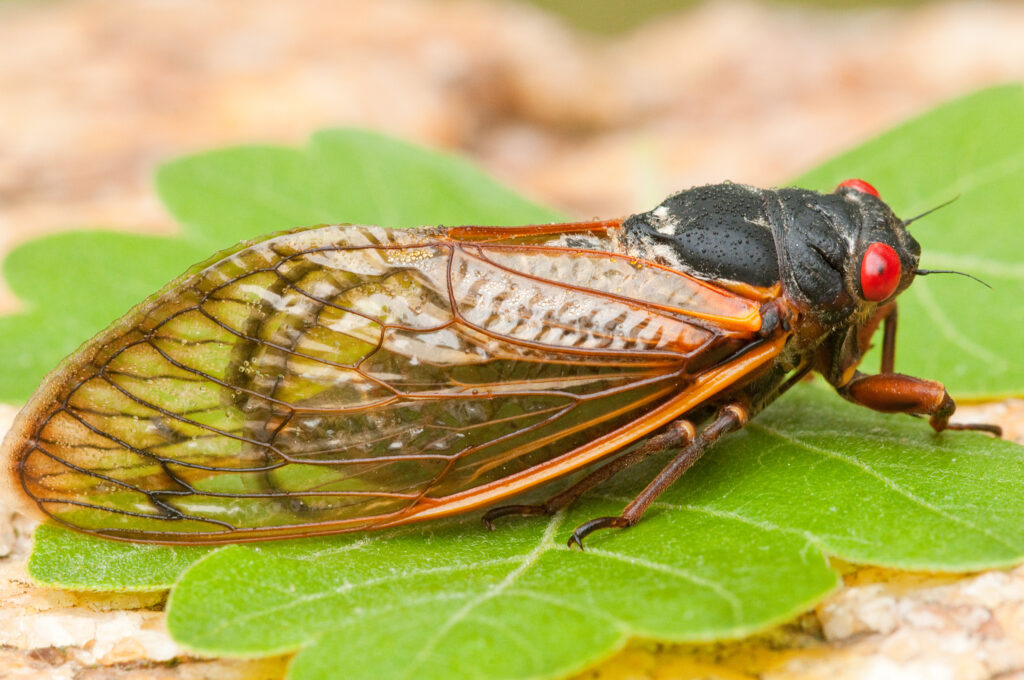
If you had hoped to be able to sit outside this spring, relax and enjoy the warm breezes, you may need to dampen your expectations. For months, news outlets have been reporting on the simultaneous emergence of two cicada broods, an event that hasn’t happened since the early 1800s.
The 13-year cycle and the 17-year cycle cicadas will emerge from underground at the same time, and that will bring billions of the insects to the surface. Somewhere in Central Illinois, probably around Springfield, the two different broods will overlap and some predict that some mating could actually occur between the two broods, a prospect that has excited researchers. But the simultaneous emergence will come with not only deafening noise but possibly an odor from the carcasses left behind.
According to experts, the emergence will begin when the ground begins to warm in the spring and early summer, sometime between mid-May and early June. But with temperatures warming earlier than normal, the event could start as early as late April.
A news release issued last year from Dr. Gene Kritsky, dean of Behavioral and Natural Sciences at Mount St. Joseph University, said that Brood XIII will be mostly seen in parts of northern Illinois and Indiana and even in Wisconsin and Ohio, while Brood XIX will spread out and cover parts of Missouri, Illinois, Louisiana, North Carolina, Virginia and Maryland.
While cicadas are harmless and actually beneficial to the environment, their emergence will be noisy. In their mating call, male cicadas can reach decibels as loud as a lawn mower or a passing jet and in larger numbers, the noise level is only heightened, according to media reports.
The good news for many is that the noise likely won’t be heard late into the night. Cicadas usually only call when the sun is out and maybe into the early evening. The bad news is that at the end of the cycle, the odor of decaying carcasses could be noticeable, according to the University of Illinois.
“During the 1956 emergence, they counted an average of 311 numphal emergence holes per square yard of ground in a forested floodplain near Chicago. This translates to 1 ½ million cicadas per acre.”
In populated areas, that number is lower, but “[W]hen cicadas start dying and dropping from the trees later in the spring, there are large numbers on the ground, and the odor of their rotting bodies is noticeable.”
In 1990, there were reports, according to the university, of people in Chicago using snow shovels to clear their sidewalks of the dead insects.
Cicadas do have benefits. The Environmental Protection Agency cites that the insects are a food source for birds and other predators, can aerate lawn and improve water filtration into the ground and add nutrients to the soil as they decompose.
The normal cicada cycle doesn’t last long. Once the insects emerge, they quickly begin mating and the cycle is over within about four weeks.