It appears that business leaders falsely claimed violence in the city to bring in the National Guard

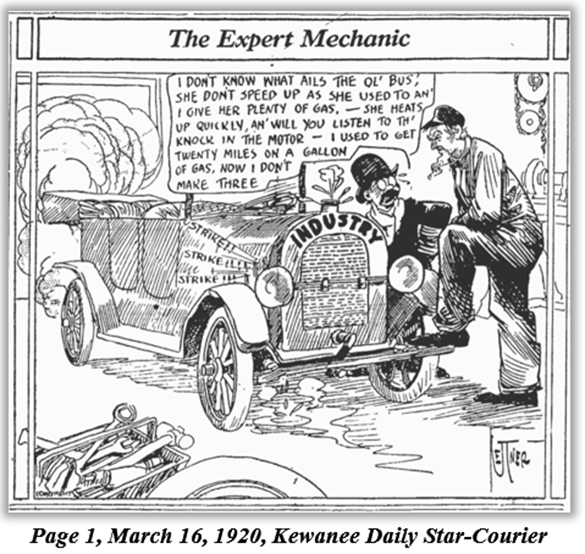
When World War I ended in late 1918, government controls over businesses also ended. People raced to buy goods that had been rationed, businesses rapidly raised prices, and precipitous inflation followed – 15% in 1919-1920.
As a result, workers wanted higher wages to keep up with inflation. But companies wanted to hold down wages because inflation was driving up their operating costs and shrinking profits.
During the war, the number of workers in unions had increased significantly. After the war, a wave of strikes caused alarm to business owners. By the end of 1919, more than 3,600 strikes had occurred involving more than 4,000,000 workers.
Business leaders, on the other hand, did not want to grant collective bargaining rights and were determined to break the power of unions.
That was the backdrop for the events which played out in Kewanee in the late winter and early spring of 1920.
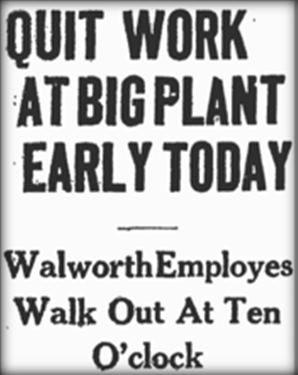
On March 15, 1920, after months of attempting to win increased wages and the right to collectively bargain, 3,400 members of Kewanee’s Federal Labor Union, Machinists Union, and Electrical Workers Union peacefully walked out of the Kewanee Works of the Walworth Manufacturing Company.
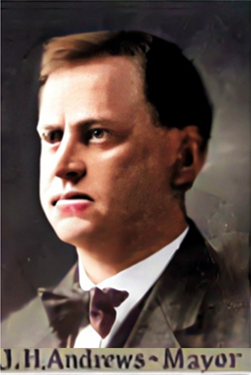
The next day, Kewanee streets were uncommonly lively with men, usually at work, strolling and visiting with each other. Police, however, reported no unusual issues, and the labor-supported mayor, James H. Andrews, met with union leaders and received assurances of a peaceful strike.
Over the next few days, rumors of violence circulated, but the police reported only an incident or two, that no serious trouble had occurred, and they urged calm.
On March 18, the sides met with the mayor and, while no resolution was reached, a “spirit of harmony” prevailed. The talks continued the next day while the police kept people from congregating near the plant.
Over the next few weeks, the newspaper continued to report that the situation remained unchanged, and the police continued to report that everything remained quiet.
The mayor eventually asked the Secretary of Labor to send a representative to help bring about conciliation, and he arrived on Monday, April 5. Both sides expressed hopes for an agreement. However, before that could happen, events began to escalate toward a conflagration.
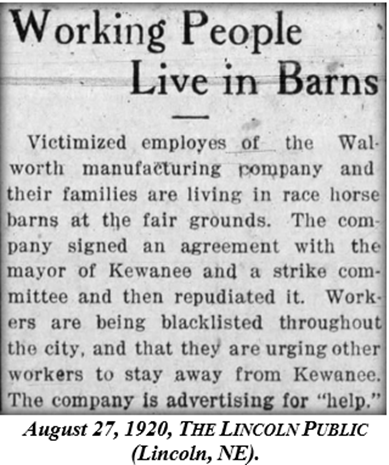
On the Monday the representative arrived, Walworth announced it would reopen the plant on Wednesday, April 7. That same Monday evening, upon the petition of Walworth, the city council agreed to appoint more than 60 “special policemen” to patrol Kewanee, paid for by city businesses which furnished them.
When Walworth reopened its doors on April 7 and a small number of workers returned, the police reported no serious trouble. However, Sam Wilson, the Henry County sheriff, arrived in the city and said “[w]e are here to assist the city administration in preserving order.”
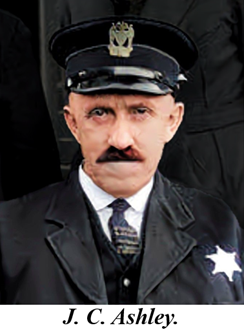
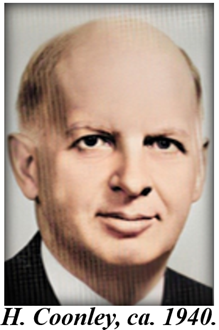
On April 8, J. C. Ashley, chief of police, reported that, while there had been a couple of incidents of violence, “the situation in general was quiet and that most of the rumors which had been circulated were unfounded.” But that evening, at a Chamber of Commerce dinner, a letter from Howard Coonley, Walworth’s president, was read, revealing the company’s thinking:
“Just as soon . . . as a substantial portion of our former employees show their desire to return to work in the proper spirit, we will . . . start the wheels in motion and return to normal production . . . .”
(Emphasis added.)
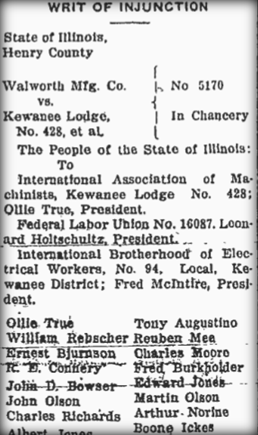
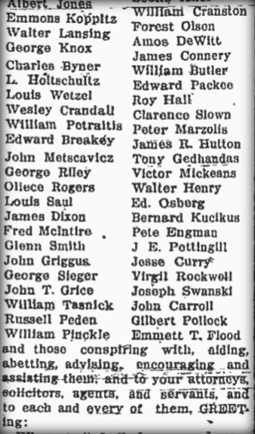
Events further escalated on April 9 when, despite reports of little violence, Walworth asked for and received an injunction against the unions and their representatives, prohibiting
“annoying or intimidating any of the employees or servants of [Walworth] by threats, physical violence, picketing or other unlawful means; and from establishing or maintaining picket lines to stop, intercept or otherwise annoy any employee or employees . . . .”
Saturday’s paper reported a brick thrown through the window of a Walworth employee’s house, but it did not link it to the labor strife.
On Monday, April 12, the paper reported that “Kewanee remained quiet Sunday, according to peace officials today.”
Also on Monday, the unions announced a “parade of all organized labor, its sympathizers, and all liberty loving citizens of this community [on] Tuesday, April 13, at 6 o’clock. . . . This parade is a protest against the uncalled-for usurpation of the City Administration’s power.” They were objecting to additional hundreds of special deputies now acting under the direction of the county sheriff and the injunction which precluded peaceful picketing.
Once again, in the April 13 paper officials said there had been no incidents of violence. On the same day, the paper printed the unions’ position on violence, which, in part, said that
“the strike was carried on peacefully and quietly prior to the coming into Kewanee of Sheriff Wilson and his several hundred deputies. . . . [E]quipping large numbers of men who are known to be [against] union labor, with shot guns . . . and other weapons and parading on the business streets of Kewanee before a law abiding and peaceful citizenship, has added a good deal of [tension] to the situation . . . .
“There has been one complaint only made to either the city authorities or the State’s Attorney, of misconduct on the part of any striker since the strike began five weeks ago. The person charged . . . was promptly arrested . . . and bound over to the Grand Jury of Henry County . . . without objection or interference on the part of the unions. No other disorder serious enough to merit complaint . . . has come to the attention of either the city police or the State’s Attorney.”
(Emphasis added.)
On Wednesday, April 14, the paper reported two incidents that morning. In the first, a crowd (size not reported) tried to stop the car of a Walworth employee, and a deputy was injured by a thrown brick when he tried to intervene. The paper reported that “the police quelled the disturbance before anything further happened.” In the second, a group of fifteen allegedly set upon a man and a deputy, after which the man ran home for his shotgun, returned, and fired three times. The man wounded two men and a woman. The anti-union shotgun-wielder was held in jail pending charges.
On the same day, an editorial opined that
“[t]here have been many instances of trouble, much of it of such nature that it did not get to the authorities, but which, nevertheless, was not conducive to peace. The reports from day to day have been correct so far as applied to general conditions . . . . The situation is viewed as a whole by the sheriff and chief of police when statements are made and this is why cognizance is often not taken in these reports of the individual cases [of altercations].”
Over 1,300 marched in Wednesday evening’s protest parade without incident. In the lead was a color guard of six men with two large American flags, followed by banners reading “We Carry Union Cards, Not Guns” and “We Protest Against the Action of Gunmen in Our City.”
Union banners:
“We Carry Union Cards, Not Guns” and “We Protest Against the Action of Gunmen in Our City.”
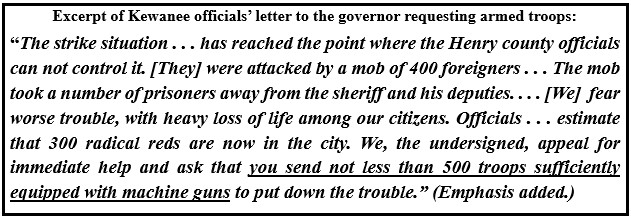
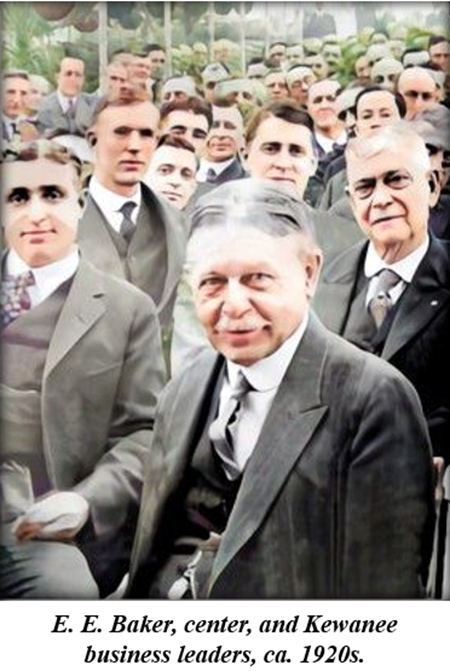
However, that same day, despite the lack of evidence of violence, the business-supported Henry County sheriff, his deputy, and the state’s attorney, as well as E. E. Baker, president of the pro-business Chamber of Commerce, signed an urgent-sounding communique to the acting governor:
“The strike situation . . . has reached the point where the Henry county officials can not control it. The sheriff and 150 deputies were attacked by a mob of 400 foreigners at 7:30 o’clock this morning, and one deputy and several workmen were seriously injured. The mob took a number of prisoners away from the sheriff and his deputies.
“We have 385 deputies at work, but fear worse trouble, with heavy loss of life among our citizens.
“Officials of the Walworth . . . and citizens of Kewanee estimate that 300 radical reds are now in the city. We, the undersigned, appeal for immediate help and ask that you send not less than 500 troops sufficiently equipped with machine guns to put down the trouble.”
(Emphasis added.)
At a little after 2:00 a.m. on Thursday morning, April 15, 500 troops from the 11th Infantry of the Illinois National Guard arrived by train in Kewanee. By daylight, the khaki-clad soldiers had set up machine guns at strategic points and were patrolling the streets of Kewanee with fixed bayonets.
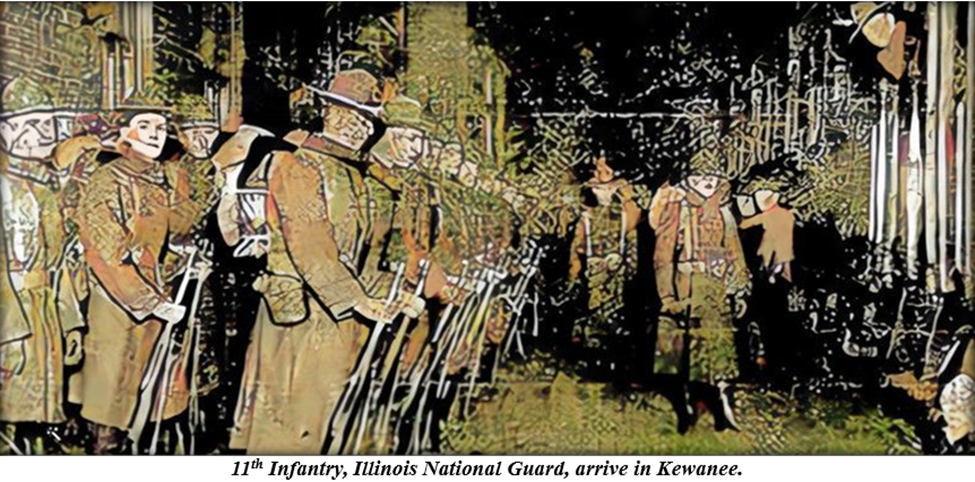
The paper reported no additional violence, and the majority of soldiers were gone by April 20.
By April 24, all of the unions voted to end the strike. The Department of Labor later reported that the strike had been “adjusted,” which implies a settlement was reached, although the parties did not reveal any terms.
On Monday, April 26, large numbers of men returned to work at Walworth. However, because parts of the plant had been shut down, some men would not be able to return to work until all operations were up and running. Most eventually returned, but a number of the leaders of the strike were blacklisted, some for the rest of their working lives. There also were numerous published stories of problems with the settlement.
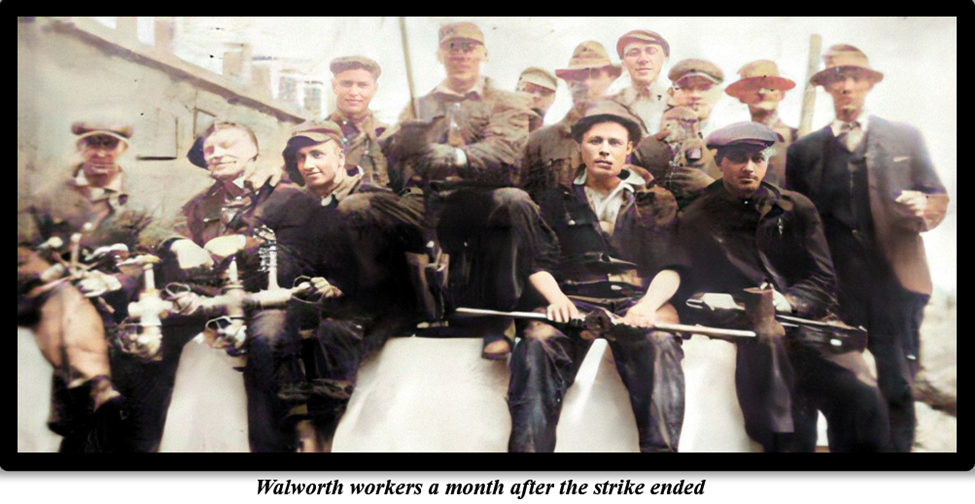
As it turned out, the strike was successful, resulting in changes in working conditions and employees gained the right to some form of collective bargaining. In the May 1920 Kewanee Union newspaper published by Walworth, the company announced the formation of a conference committee representing management and workers within the context of collective bargaining. Beginning that month, the company also started operating on a shorter 48-hour work week.
So, were there really “riots,” “mobs,” and “reds” in Kewanee?
The Kewanee Daily Star-Courier never reported any large mob attacks or the presence of radical reds, let alone to the degree alleged in the letter requesting troops. And there seems to be no other support for the allegations in the letter prior to it being sent. So, the record suggests that the law enforcement and businesses created a false impression of the situation.
It’s true that, after the troops arrived, many newspapers in Illinois and in other states did report that there had been mobs, riots, and reds in Kewanee. However, they all regurgitated similar words and phrases, suggesting that their stories all emanated from the same source.
That source likely was the Star Courier, which printed the letter which contained allegations of violence sent to the acting governor, but the letter was printed in quotation marks in the newspaper, making it clear that the paper was not reporting it as factual news but merely providing the content of the letter. However, like a game of telephone, the first newspaper reporting on the letter in the Star Courier may have included the quotation marks. Nevertheless, subsequent newspapers dropped the quotation marks, reporting it as factual news instead of merely allegations in a letter. Thus, printing the contents of a letter making allegations became a passel of stories in which the allegations were reported as true.
And, there seems to be no independent evidence of the truth of the allegations of violence in the letter.
The April 16 Bureau County Tribune essentially confirmed that when it reported that
“[a]t the Star-Courier office, it was learned that there was some disorder Wednesday but that there was nothing which resembled mob violence.”
The Princeton paper also said that
“[r]eports of disorder among the strikers at [Walworth] were greatly exaggerated . . . One Chicago paper stated that 200 women mobbed the [returning] workers . . . and that scores were injured and had to be cared for at the hospital. They stated further that deputy sheriffs were attacked by strikers when they attempted to quiet down the women. It was reported that the women threw brick bats and stones and they fought violently.”
But, according to the Princeton paper, none of that was true, at least based on what it learned from visiting the Star Courier office. And, again, no other sources can be found suggesting otherwise.
Based on the totality of the information available, it appears that there really were no significant “mobs,” or “riots” in Kewanee, that it was fabricated or at least exaggerated, that is, it was “fake news” from the company, the authorities, and Kewanee business owners, powerful men used to having their way. Whether they intentionally deceived the acting governor or were merely seeing “red,” they felt they, not their workers, knew what was best for their business and the city.
Yes, there were likely some agitators among the striking employees. There probably were a few Bolsheviks among them, too. But the vast majority of the striking workers believed in the promise of America and simply wanted a better life for themselves and their families.
Regardless of the accuracy of the allegations of violence, there was no turning back the workers’ march to improving their lives. Unions grew stronger and, combined with the economic boom following the end of World War II, the American middle class took off.
Whether or not you currently believe in the need for unions, there is no denying that they played a significant role in the trajectory of our country, helping make America great.
Unions also played a significant role in the trajectory of Kewanee. Many in my family, and probably yours, became part of the middle class because of them.
Author’s note: The opinions expressed in this article are solely those of the author and do not reflect the views or opinions of The Kewanee Voice.